
USDA Offers Funding to Reimburse Farms Transitioning to Organic Production
Amy Barkley, Team Leader & Livestock Specialist
Southwest New York Dairy, Livestock and Field Crops Program
The U.S. Department of Agriculture (USDA) is providing up to $20 million to reimburse agricultural producers and handlers who are certified organic and crop and livestock producers who are transitioning to organic for eligible expenses incurred during fiscal years 2020, 2021, and/or 2022. The new program, Organic and Transitional Education and Certification Program (OTECP), is part of USDA's Pandemic Assistance for Producers initiative.
USDA's Farm Service Agency (FSA) will accept OTECP applications for fiscal years 2020 and 2021 from November 8, 2021, through January 7, 2022. The application period for fiscal year 2022 applications will be announced at a later date.
Some of the key messages including qualified expenses are:
- During the COVID-19 pandemic, certified organic and transitional operations faced challenges due to loss of markets, increased costs, and labor shortages, in addition to costs related to obtaining or renewing their organic certification, which producers and handlers of conventionally produced commodities do not incur.
- Transitional operations also faced the financial challenge of implementing practices required to obtain organic certification without being able to obtain the premium prices associated with certified organic commodities.
- USDA's new Organic and Transitional Education and Certification Program (OTECP) will provide up to $20 million to reimburse agricultural producers and handlers who are certified organic and crop and livestock producers who are transitioning to organic for eligible expenses incurred during fiscal years 2020, 2021, and/or 2022.
- OTECP funding is provided through the Coronavirus Aid, Relief, and Economic Security Act (CARES Act).
- OTECP is open to certified operations and transitional operations located in the 50 United States, the District of Columbia, the Commonwealth of Puerto Rico, Guam, American Samoa, the U.S. Virgin Islands, and the Commonwealth of the Northern Mariana Islands.
- For each fiscal year, OTECP covers 25% of a certified operation's eligible certification expenses, up to $250 per certification category (crop, livestock, wild crop, handling, and State Organic Program fee). This includes application fees, inspection fees, USDA organic certification costs, state organic program fees and more.
- Crop and livestock operations transitioning to organic production may be eligible for 75% of a transitional operation's eligible expenses, up to $750, for each year. This includes fees charged by a certifying agent or consultant for pre-certification inspections and development of an organic system plan.
- For both certified operations and transitional operations, OTECP covers 75% of the registration fees, up to $200, per year, for educational events that include content related to organic production and handling to assist operations in increasing their knowledge of production and marketing practices that can improve their operations, increase resilience, and expand available marketing opportunities.
- Additionally, both certified and transitional operations may be eligible for 75% of the expense of soil testing required under the National Organic Program (NOP) to document micronutrient deficiency, not to exceed $100 per year.
Answers to frequently asked questions can be found at farmers.gov/otecp/faq.
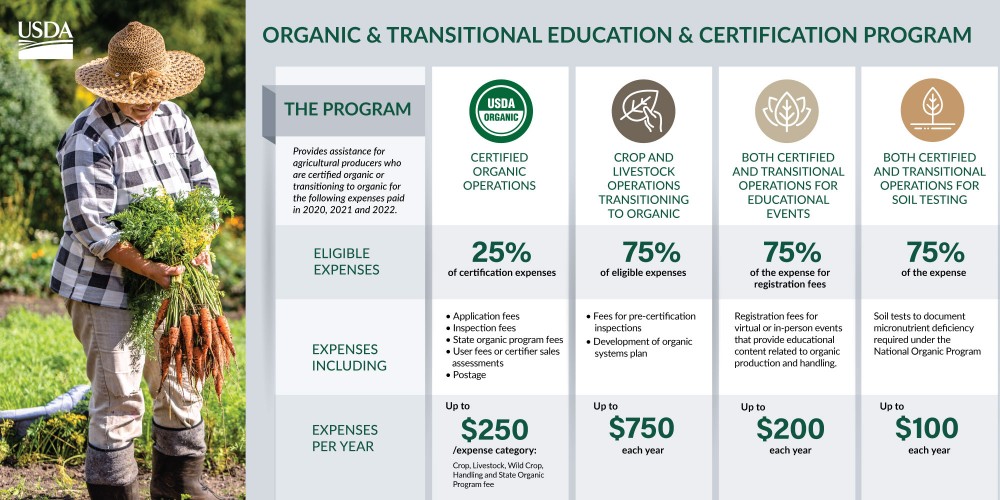 Click on the fact sheet to enlarge it.
Field Crops
Dairy
Business
Livestock
Grains
Upcoming Events
Poultry Processing Workshop, Canandaigua, NY
September 17, 2026 : Poultry Processing Workshop - Canandaigua, NY
Canandaigua, NY
This program is one of four statewide roadshow stops across the state, offering farmers a full poultry processing experience. The class will teach skills that build confidence, reduce costs, and strengthen your farm's independence. This hands-on workshop gives farmers the chance to process a bird from start to finish, learning every step of the workflow used by small farms across the state.
Tax 101: An Introduction to Income Taxes for Farmers
September 17, 2026 : Tax 101: An Introduction to Income Taxes for Farmers
Join NY Farm Net for a FREE mid-day webinar about income tax basics for farmers. Attendees will learn what documents you need, options for recordkeeping systems, how identify common tax forms and schedules, and more!
Large Animal Awareness Training For First Responders
September 19, 2026
Dunkirk, NY
Join the Chautauqua County Technical Rescue Services and NYS Veterinarian, Dr. Kate Card-Allen, for a specialized training on how to safely and effectively respond to large animal incidents. Learn techniques for managing large animals during traffic accidents, rollovers, entrapments and other transportation emergencies.
Announcements
No announcements at this time.