
Wet weather manure spreading reminders - Do you need more storage?
By Kirsten Workman and Jason Oliver
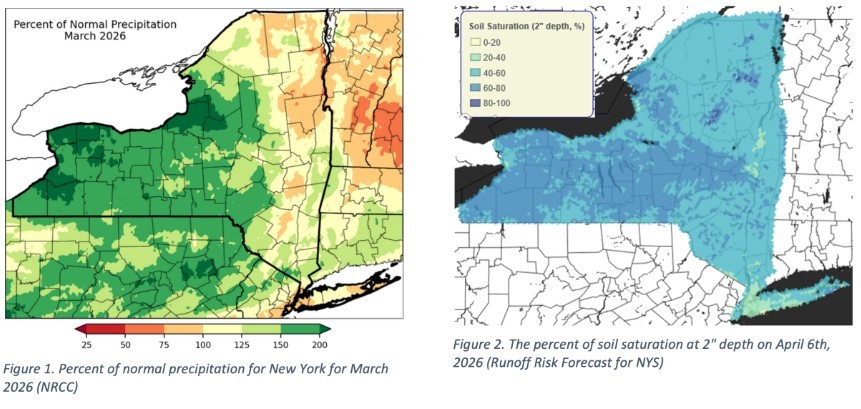
March 2026 has been wet, hovering around 150 percent of normal precipitation for much of New York (Figure 1). While this has some manure storages approaching or exceeding their full operational capacity, it is critical to follow the prohibited spreading conditions in the CAFO permit, the Revised Winter And Wet Weather Manure Spreading Guidance and the spreading plans in your CNMP as it may have also created saturated soil conditions across much of the state (Figure 2). Care should be taken when deciding if, when and where to make manure applications. You can monitor forecasts to identify days in the near term that may have conditions with lower risk using the Runoff Risk Forecast for New York State. Monitoring fields and tile outlets for runoff during and after applications is also advised.
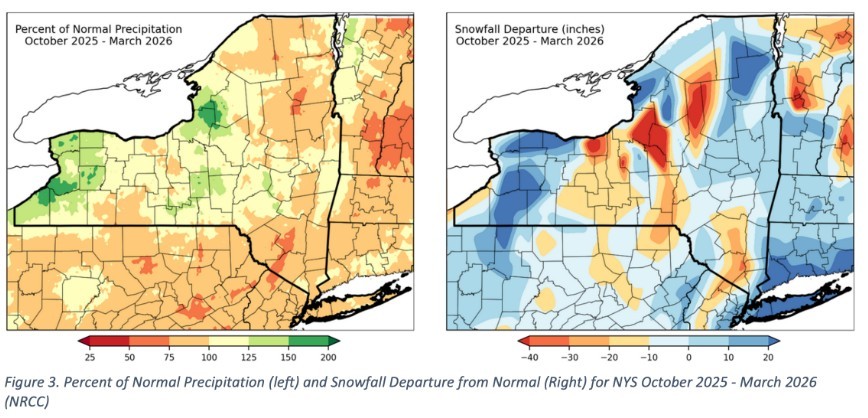
Despite fall and winter weather that was more normal for New York than some recent years, a late 2025 crop harvest and a wet March have some producers feeling tight on manure storage capacity. (See the maps below from the Northeast Region Climate Center (NRCC) showing departures from normal for both total precipitation and snowfall from October 2025 - March 2026 in Figure 3). While there is no requirement for minimum days of storage, PRO-DAIRY specialists advise that having at least six-months of storage capacity between farm-located and satellite storages is a risk management strategy that allows for sound (and CAFO compliant) manure application decision-making. Anytime you add cows, don't properly agitate and/or remove settled solids, add bunker silo storage and runoff, change parlor water usage or make other changes on the farm - you are impacting manure storage capacity. So, if you are feeling pinched this year, it could be a good time to re-evaluate storage volumes and management with your planner.
Before transferring manure to fields, check soil conditions, tile outlets and weather and runoff forecasts to see if prohibited or high-risk conditions are present or if heavy or persistent rain is in the forecast. The CAFO Permit requires that, "Farm personnel shall manage application rates and timing so as to prevent runoff from leaving crop fields during any application event," and prohibits manure applications on saturated or frozen-saturated soils or when applied at a rate that causes the soil to become saturated at the time of that application. When winter or wet weather conditions[i] exist, manure applications must follow the revised winter and wet weather guidance.
For permitted CAFO farms, the overtopping of a manure storage is a permit violation and requires the storage be re-evaluated by a Professional Engineer before it can be put back into service. Additionally, any emergency applications of nutrients must be made in accordance with the farm's Emergency Action Plan and monitored for runoff. Discharges to surface waters; applications above the single manure application rate discussed in Part III.A.8.b of the ECL CAFO general permit (GP-0-22-001); and any storage overtopping must be reported to the Department within 24 hours verbally and in writing within five days. If nutrients must be applied, they should be injected or incorporated if possible to minimize offsite movement.
If a CAFO finds itself in an emergency situation, the farm should discuss with their AEM certified planner other interim solutions that may be available to the farm to alleviate the emergency.
Farms that do not operate under the CAFO permit should also heed these strategies for manure management and application, as no farm is allowed to create a water quality violation as a result of a manure application.
Resources:
- Revised winter and wet weather manure spreading guidelines to reduce water contamination risk
- Runoff risk forecast for New York State
- Northeast Regional Climate Center
- Your farm's CNMP planner for help identifying low risk fields, adjusting rates and setbacks, re-evaluating manure storage capacity, or farm or field-specific questions.
- Kirsten Workman, PRO-DAIRY Nutrient Management & Environmental Sustainability Specialist, 607-255-4890 or kw566@cornell.edu,
- Jason Oliver, PRO-DAIRY Dairy Environmental Systems Engineer, 607-793-8484, jpo53@cornell.edu
Field Crops
Dairy
Business
Livestock

Grains
Upcoming Events
Livestock Production Field Day
August 29, 2026 : Livestock Production Field Day
Chaffee, NY and East Aurora, NY,
Join us on visits to Horizon Ridge Farm in East Aurora and Troll Bridge Farm in Chaffee for an introduction to small beef and small diversified livestock enterprises. Through walking farm tours, attendees will learn about management, meat processing, setting prices, and finding local markets. Dinner will be provided. Register by contacting Amy Barkley at amb544@cornell.edu or 716-640-0844.
Poultry Processing Workshop, Canandaigua, NY
September 17, 2026 : Poultry Processing Workshop - Canandaigua, NY
Canandaigua, NY
This program is one of four statewide roadshow stops across the state, offering farmers a full poultry processing experience. The class will teach skills that build confidence, reduce costs, and strengthen your farm's independence. This hands-on workshop gives farmers the chance to process a bird from start to finish, learning every step of the workflow used by small farms across the state.
Tax 101: An Introduction to Income Taxes for Farmers
September 17, 2026 : Tax 101: An Introduction to Income Taxes for Farmers
Join NY Farm Net for a FREE mid-day webinar about income tax basics for farmers. Attendees will learn what documents you need, options for recordkeeping systems, how identify common tax forms and schedules, and more!
Announcements
No announcements at this time.