
Drones in Agriculture: Exploring Opportunities
Katelyn Miller, Field Crops and Forage Specialist
Southwest New York Dairy, Livestock and Field Crops Program
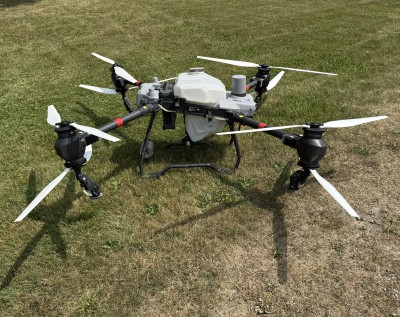
As you may remember, I wrote an article some time ago that covered some of the considerations for making the decision around implementing drone use in your spray programs. The considerations highlighted mostly revolved around the benefits, costs, and regulations that need to be kept in mind, but was strongly geared towards the idea of if you were purchasing the technology. Even since writing that article, technology continues to flourish, especially in agriculture, with more acreage each year being sprayed or scouted with drone technology.
For all intents and purposes, this article dives into the spray portion of drone usage. There are different programs that can be purchased for drone scouting, but I recommend researching the programs yourself and determining which ones best fit your needs. We have some exciting drone scouting efforts coming down the pipeline with a grant project beginning this summer, so stay tuned!
Now, I don't think that drones will completely replace boom sprayers, but there are scenarios in which drones present an interesting opportunity.
- It's no secret that our fields here in Southwest NY aren't exactly square, or flat. This can make spraying with booms challenging, as many commercial booms have a spray width of 90 feet. This makes field access for the equipment a restriction (extreme slopes are in this category too). Many of us live in rural areas, with the only road access to some fields being similar to a cow path, only allowing one lane of traffic. Driving any equipment on these roads is challenging but also adds an additional risk factor to the operator.
- In our region, there is limited fungicide use in corn. This could be due to a couple of factors, but equipment plays its part. There is limited access to crop dusters, as many require a specific field size to effectively spray and operate. Additionally, the access to spray booms that are tall enough for corn is extremely limited.
- There are some additional unique situations such as target spraying in season for weed escapes, and heavy or saturated soils where it may be historically difficult to get access for spraying in a timely manner.
- In Delaware County, CCE staff have a project in which they are evaluating drone spray usage among fencelines in pastures, which could present some interesting opportunities. While full project details haven't been shared yet, a field day was hosted to look at spraying multiflora rose.
While there has been an uptick in drone research occurring, the verdict is still out around consistent efficacy in spray patterns, including swatch width, coverage, and carrier volumes. A project conducted in Maryland claims that drones can achieve the same coverage as planes and helicopters between 2.5-5 gallons per acre, including similar droplet density and volume median diameter in soybeans. A corn trial out of Kentucky showed spray deposition was greater with a boom sprayer over a drone, but in part was influenced by flight speeds. An additional project coming out of Purdue showed that weed control was consistent among glufosinate and glyphosate active ingredients over different spray volumes, but there was minimal coverage below the canopy. But the biggest question to arise out of this project was swath width, as the target was 20 feet, but treatments never reached that far. An older DJI model was used, so it's possible that this could have impacted results as the technology has come a long way.
Another factor that needs to be considered in making drone spraying decisions is labeling on products (which shouldn't be a surprise, because the label is the law!). But there is verbiage that can promote or eliminate the use of drones for a product. Currently, there aren't many labels with drone verbiage explicitly listed. However, if products have listed "aerial applications", then drones may be used. A deeper dive into the label needs to be conducted to ensure that appropriate restrictions can be followed.
On the label, checking the minimum carrier volume for aerial use, as well as other restrictions such as height above canopy or nozzle size, will help determine if drones can be used to apply that product. There are some products in which it's off label to utilize low spray volumes, such as you would have with certain drones, even if the product is labeled for aerial use. Additionally, drones do not have the same nozzle choices as many spray booms.
Technology in agriculture is booming, and drones are no exception to this. More research still needs to be conducted to build out our full understanding of efficacy, such as spray patterns, resulting coverage, carrier volumes, etc. For the time being, boom sprayers probably aren't going anywhere in our spray programs but drones present interesting opportunities to integrate into our systems.
Resources:
"Evaluating Efficacy of Aerial Pesticide Spray Applications Using Drones", University of Maryland Extension
https://ukrec.mgcafe.uky.edu/articles/ground-truthing-drone-fungicide-efficacy
https://www.farmprogress.com/technology/drone-research-offers-mixed-findings
Field Crops
Dairy
Business

Livestock

Grains
Upcoming Events
Poultry Processing Workshop, Canandaigua, NY
September 17, 2026 : Poultry Processing Workshop - Canandaigua, NY
Canandaigua, NY
This program is one of four statewide roadshow stops across the state, offering farmers a full poultry processing experience. The class will teach skills that build confidence, reduce costs, and strengthen your farm's independence. This hands-on workshop gives farmers the chance to process a bird from start to finish, learning every step of the workflow used by small farms across the state.
Tax 101: An Introduction to Income Taxes for Farmers
September 17, 2026 : Tax 101: An Introduction to Income Taxes for Farmers
Join NY Farm Net for a FREE mid-day webinar about income tax basics for farmers. Attendees will learn what documents you need, options for recordkeeping systems, how identify common tax forms and schedules, and more!
Large Animal Awareness Training For First Responders
September 19, 2026
Dunkirk, NY
Join the Chautauqua County Technical Rescue Services and NYS Veterinarian, Dr. Kate Card-Allen, for a specialized training on how to safely and effectively respond to large animal incidents. Learn techniques for managing large animals during traffic accidents, rollovers, entrapments and other transportation emergencies.
Announcements
No announcements at this time.