
Beef Market Update, April 16th, 2020
Amy Barkley, Team Leader & Livestock Specialist
Southwest New York Dairy, Livestock and Field Crops Program
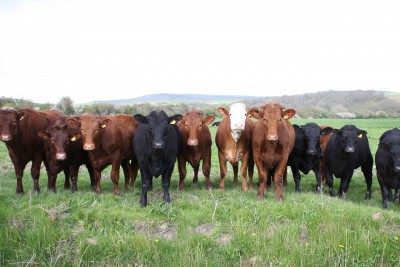
On April 16, 2016, Dr. Mike Baker, Bill Bullock, and Betsy Hodge shared a marketing update for the beef industry.
All sectors of the beef industry are operating with revenue losses at this time, and the situation remains fluid. In the United States, this looks like $3.7 billion for cow-calf operations ($111.91/mature breeding animal), $2.5 billion in stocker backgrounder ($159.98/head), and $3.0 billion to the feeding sector ($205.96/head). Local market reports reflect the national numbers, with sharp declines in prices vs last year. There is currently no market for finished beef in the state. That said, specialty cattle, such as grass fed, may still have markets.
At this point, producers may be wondering if they should keep finished cattle until demand and prices increase, or sell them now. Keeping them presents a challenge in that a portion of cattle ready now will not tolerate extended feeding well and may end up as yield grade 4s, too fat, and/or have low feed efficiency from now until the time they're processed. Dr. Mike Baker recommends that finished cattle ready now should be sold rather than maintained, since by decreasing the plane of nutrition, the quality of the carcass will go down. On the other hand, some producers who normally sell calves at this time may find that with corn futures down, it may be economically viable to finish those animals instead.
By the end of March, NYS cull cow prices had dropped from a high of $0.55/cwt to a low of $0.45/cwt. Last week showed a slight bit of recovery, around $0.42/cwt. Processors are overwhelmed by the number of requests to process cull cattle, and are responding by lowering the price paid to help reduce the number of cows coming through the system. Producers who have extra, cheap feed or pasture have the option of holding on to cull cows, especially the thinner ones, to gain body condition. The increase in price received for better body condition may outweigh the costs of keeping those cows for an extra few months. Cull beef cows are usually in better condition than dairy cows, but holding them may make sense if there is pasture available. That said, there is a risk here in that if Cargill shuts down, then any prediction for prices won't hold.
Looking at the larger plants servicing the region, JBS reopened on Monday, April 20th, and is currently taking in contract cattle. It is uncertain if they will be purchasing cattle outside contract in the immediate future. Cargill continues to harvest cull cows, though capacity has been decreased from 1,800 head/day to 1,500 head/day. This drop in capacity is a result of required employee health screenings, making 1,500 head/day the maximum capacity for the foreseeable future. With less versatility in regards to further processing, Nicholas Meats is buying only what they need, which has reduced their demand for cull cows.
As of this writing, custom butchers are full, with long wait times to get animals processed.
All this said, the number of beef purchases and beef consumption remain high. However, there is concern that as time progresses and things even themselves out, the nation will see a drop off in beef consumption as people stop buying to eat through their stores. The silver lining to this is that the trend of people cooking at home may continue after the stay-at-home orders are lifted, which may result in a stable, increased trend in beef consumption moving forward.
For the latest NYS beef cattle market information, visit the Cornell Beef Management Website: https://blogs.cornell.edu/beefcattle/market-information/.
For more information, feel free to reach out to our Livestock Specialist, Amy Barkley, at amb544@cornell.edu or (716) 640-0844.
Field Crops
Dairy
Business
Livestock
Grains
Upcoming Events
Livestock Production Field Day
August 29, 2026 : Livestock Production Field Day
Chaffee, NY and East Aurora, NY,
Join us on visits to Horizon Ridge Farm in East Aurora and Troll Bridge Farm in Chaffee for an introduction to small beef and small diversified livestock enterprises. Through walking farm tours, attendees will learn about management, meat processing, setting prices, and finding local markets. Dinner will be provided. Register by contacting Amy Barkley at amb544@cornell.edu or 716-640-0844.
Poultry Processing Workshop, Naples, NY
September 17, 2026 : Poultry Processing Workshop - Naples, NY
Naples, NY
This program is one of four statewide roadshow stops across the state, offering farmers a full poultry processing experience. The class will teach skills that build confidence, reduce costs, and strengthen your farm's independence. This hands-on workshop gives farmers the chance to process a bird from start to finish, learning every step of the workflow used by small farms across the state.
Large Animal Awareness Training For First Responders
September 19, 2026
Dunkirk, NY
Join the Chautauqua County Technical Rescue Services and NYS Veterinarian, Dr. Kate Card-Allen, for a specialized training on how to safely and effectively respond to large animal incidents. Learn techniques for managing large animals during traffic accidents, rollovers, entrapments and other transportation emergencies.
Announcements
No announcements at this time.