
The Ins and Outs of Processing, Labeling, and Handling Poultry for Sale
Amy Barkley, Team Leader & Livestock Specialist
Southwest New York Dairy, Livestock and Field Crops Program
The Ins and Outs of Processing, Labeling, and Handling Poultry for Sale
By Amy Barkley, Livestock Specialist SWNYDLFC Team
Chicks are on the ground, the weather is warming, and in a few short weeks, the first batches of pasture raised chickens will be processed. For many, this means processing in preparation for sales off the farm or at farmer's markets. Bearing that in mind, there are requirements that producers must follow to ensure food safety and legal packaging/labeling of that poultry for sale.
Processing Regulations:
Farmers can either process poultry on their farm under the 1,000 bird exemption or through a certified 5A Small Enterprise exempted processor. Keep in mind that not all 5A certified facilities are permitted to process your chickens for you to then take home and sell. Many only process poultry for the grower's home use. Verify with your processor that they have the Small Enterprise exemption and can legally process poultry for resale.
If processing under the 1,000 bird exemption, you are permitted to process up to 1,000 bird units per year per farm. That number can include chickens, ducks, quail, or other poultry. Turkeys are the exception where one turkey is the equivalent to 4 chickens. For a real-life example, if you wanted to raise 400 chickens, 50 turkeys, and 50 ducks, that would be the equivalent of 650 bird units.
If you have more than 1,000 bird units to process for sale, you can do a combination of processing on-farm until the bird limit is reached and then send the rest to a 5A processor. If you're growing over 1,000 bird units, want to process on farm, and your intent is to keep some of those processed birds for home use, those birds don't count towards the 1,000 bird exemption. Just ensure that you have good records of how many birds you processed and how many you kept for home use vs sold in the case of an audit.
Some individuals like to expand their product offerings beyond whole birds. Legally, poultry processed under the 1,000 bird exemption can be cut into common cuts of wings, drumsticks, thighs, leg quarters, breasts, soup bones, organ meats, quartered birds and half birds (bone in or out, skin on or off). Further processed products, such as stock, ground, dehydrated, brined, or seasoned, live poultry needs to be processed by either a USDA processor or 5A Small Enterprise processor, and then further processed in a 20C licensed kitchen by a 20C licensed person. All products should be labeled for human consumption; pet treats and foods fall under additional licenses and regulations. All ingredients used in further processed products must also be listed.
There are best management practices associated with processing poultry on-farm to achieve quality and food safety. Those can be found in the Cornell On-Farm Poultry Slaughter Guidelines.
Packaging:
Poultry processed on-farm must be packaged in either butcher paper, loose bags, or heat shrink bags. Vacuum packing is not allowed. Some 5A and USDA processing facilities provide the option of vacuum packing.
Carcasses need to achieve an internal temperature of 45?°F or less within 4 hours of being dispatched. This is accomplished by cooling the carcasses in an ice slurry or blast chiller. Packaging warm carcasses can lead to internal decay if placed in a fridge or standard freezer.
Labeling:
New York State has adopted federal labeling requirements. This is to allow for full transparency of the product as well as provide contact information for traceability purposes. All poultry needs to be labeled with the following:
- -Product name using the species and part (whole chicken, whole turkey with giblets, duck breast, chicken drumsticks, etc.)
- -Inspection legend if processed at a 5A facility.
- -Exempted notation if processed on-farm. That exact statement is, "Exempted — P.L. 90-492"
- -Farm name and address
- -Packed on date
- -Sell by date, where fresh poultry must be marked that it is to be frozen within 4 days of processing. Frozen meat does not require a sell-by date, though most producers aim to sell their products within a year for best quality. Packaging that excludes air results in a product that maintains quality longer in frozen storage.
- -If selling by the pound, price per pound, where you can only sell by the pound if weighing poultry using an Dept of Weights and Measures certified and inspected scale.
- -If selling by the package rather than by the pound, a price per package.
- -Safe Handling instructions, where the required wording is:
- SAFE HANDLING INSTRUCTIONS
- Keep refrigerated or frozen. Thaw in refrigerator or microwave.
- Keep raw meat and poultry separate from other foods. Wash working surfaces (including cutting boards), utensils, and hands after touching raw meat or poultry.
- Cook thoroughly.
- Keep hot foods hot. Refrigerate leftovers immediately or discard.
Claims cannot be made on the package without justification. Comparative wording such as "healthier" or "fresher" aren't allowed. Furthermore, neither are claims of nutritional values that deviate from USDA published values. Common areas where we see this expressed in poultry is "more vitamin A", "less cholesterol", "less saturated fat", etc. If the meat is tested for nutritional content at a certified laboratory to make a claim, a standard nutrition label is required in addition to the claim. Otherwise, a nutrition label is not required.
Do not use any certified seals on the carton unless you have a current certification. This applies most often to organic or welfare claims. Welfare claims include certified cage free, free range, or pasture-raised. However, you can use descriptors of your management practices on your packaging, such as "turkeys raised on pasture" or "chickens fed non-GMO feed".
Transportation:
Keep fresh poultry below 45?°F and frozen poultry below 32?°F during transport. This is best achieved by mobile coolers or freezers. Placing a thermometer in the cooler or freezer allows you to ensure that you are meeting food safety guidelines. Fully frozen poultry can last for a short time in coolers packed with ice, especially if it is coming out of a deep freeze (less than 0?°F). Packing fresh refrigerated poultry products in ice can keep it food safe so long as the products aren't transported for a long period of time. An abundance of loose ice is required to maintain proper food safe temperatures. Ice packs don't provide enough cooling power to keep fresh poultry cool, even in insulated coolers, especially if it's warm and sunny outside.
Sales:
Poultry that has been processed on-farm can only be sold to the end consumer, though you can make sales off the farm, through a farm stand or store you own, or through your stand at a farmer's market. If your poultry was processed by a 5A Small Enterprise Exempt facility, you can sell meat to a wider range of customers, including direct sales, sales at stores other than those you own, hotels, restaurants, and institutions. USDA processing is required to sell poultry into NYS farm-to-school programs. USDA processing is also required to sell processed poultry across state lines.
If you have any questions about poultry processing or regulations, reach out to Amy Barkley at 716-640-0844 or amb544@cornell.edu.
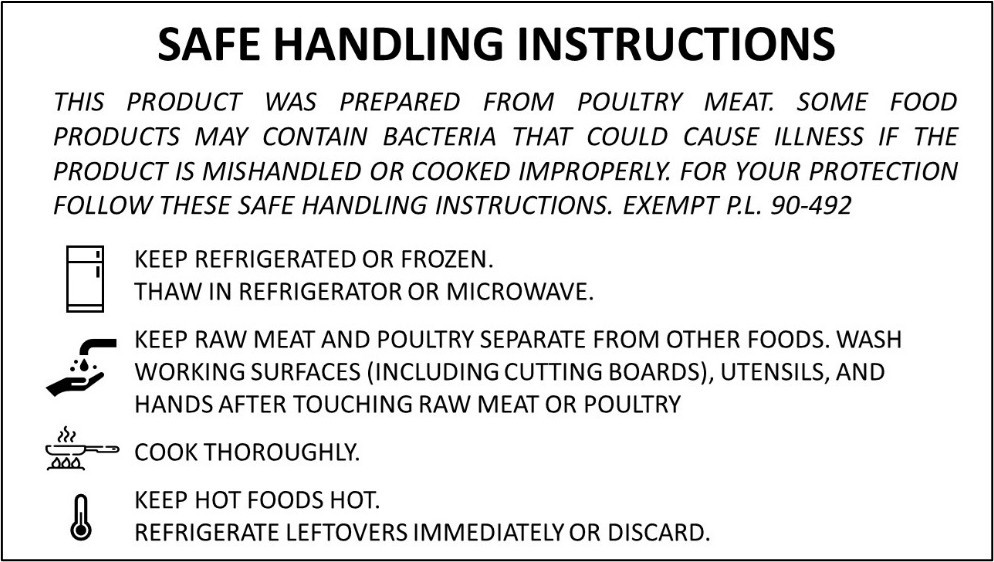
Example of a safe handling instructions label. Click to enlarge.
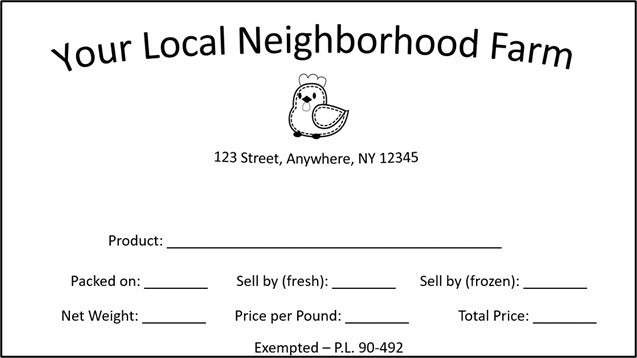
Example of a complete poultry label (if you are affixing the safe handling instructions label separately) for on-farm processed poultry that allows flexibility in whether the product is fresh or frozen, and sold by the pound or by the item. Click to enlarge.

Field Crops
Dairy
Business
Livestock

Grains
Upcoming Events
Livestock Production Field Day
August 29, 2026 : Livestock Production Field Day
Chaffee, NY and East Aurora, NY,
Join us on visits to Horizon Ridge Farm in East Aurora and Troll Bridge Farm in Chaffee for an introduction to small beef and small diversified livestock enterprises. Through walking farm tours, attendees will learn about management, meat processing, setting prices, and finding local markets. Dinner will be provided. Register by contacting Amy Barkley at amb544@cornell.edu or 716-640-0844.
Poultry Processing Workshop, Naples, NY
September 17, 2026 : Poultry Processing Workshop - Naples, NY
Naples, NY
This program is one of four statewide roadshow stops across the state, offering farmers a full poultry processing experience. The class will teach skills that build confidence, reduce costs, and strengthen your farm's independence. This hands-on workshop gives farmers the chance to process a bird from start to finish, learning every step of the workflow used by small farms across the state.
Large Animal Awareness Training For First Responders
September 19, 2026
Dunkirk, NY
Join the Chautauqua County Technical Rescue Services and NYS Veterinarian, Dr. Kate Card-Allen, for a specialized training on how to safely and effectively respond to large animal incidents. Learn techniques for managing large animals during traffic accidents, rollovers, entrapments and other transportation emergencies.
Announcements
No announcements at this time.