
Using Barns to Manage Barber Pole Worm Infections in Small Ruminants
Amy Barkley, Team Leader & Livestock Specialist
Southwest New York Dairy, Livestock and Field Crops Program
Using Barns to Manage Barber Pole Worm Infections in Small Ruminants
By Amy Barkley, Livestock Specialist, SWNYDLFC Team
Managing Haemonchus contortus, or barber pole worm, in small ruminants is always a challenge. While pasture rearing sheep and goats is a popular practice, strategically using a barn to help disrupt the parasite's life cycle can be helpful in managing high risk animals.
If animals are kept in a barn for their entire lives, they will not have a high parasite burden, if a one at all. An off-pasture environment with no access to growing forage severely limits sheep and goats from picking up high loads of infective larvae. While there is abundant evidence that barber pole worm eggs hatch and develop into their infective stage in feces at temperatures and humidities that can be achieved in a barn setting in NYS, the larvae still need a film of water to move up onto vegetation where they will be easily consumed3,4. For this reason, unless the bedding in a barn is very damp and the sheep are eating off the floor of a highly infected pen, it is unlikely that reinfection and continuing infections can occur.
Using a barn as a parasite mitigation strategy
Individuals with depressed or underdeveloped immune systems and/or genetic susceptibility to internal parasites can benefit most from strategic housing in a barn. Lambs and kids, pregnant dams, and dams in peak lactation all have depressed immune systems. Housing these susceptible groups indoors, especially if ideal pasture rotations and conditions are not achievable, can help to reduce financial risks associated with infections.
Of the high-risk groups, lambs are most vulnerable. It's therefore unsurprising that one of the primary challenges of rearing lambs on pastures is managing parasite loads. To complicate matters, the dam's immunity to parasites is inversely correlated with her milk production curve, so the ability of her immune system to suppress the parasites from reproducing internally diminishes as she approaches peak lactation2. This, in combination with extended pasture rotations (>1 week) can result in a buildup of infective parasite larvae that then the already susceptible lambs will ingest, resulting in extreme parasite loads and a higher rate of clinical disease and death.
Because of this, some farms elect to raise their young stock exclusively in a barn setting where they have no access to pasture until their immune systems are developed enough to tolerate infection. Generally, lambs' immune systems are weakest in the three week-long periods following both birth and weaning. As they approach maturity at 12 months of age, their immune systems improve substantially, and by the time they reach 2 years of age, their immune systems are completely mature2. Some producers opt to keep their young stock in the barn from birth until 1-2 years of age to manage immunity prior to pasture exposure as added insurance to promote healthy lambs/kids and optimal growth and development rates.
Using the barn to help manage the relationship between nutrition and barber pole worm
Poor nutrition can lead to higher parasite burdens. This can happen through providing stored forage that is deficient in nutrients, allowing animals to graze an overgrazed pasture, or providing animals pasture that is overmature. If limited pasture production does not permit you to provide enough quality calories for your animals, it may make sense to move them to the barn after they have rotated through the pasture, allowing for a fallow period of 45-60 days before the next grazing cycle. This will give the pasture time to regrow, eliminate parasites through desiccation and solar radiation, and reduce the risk of the animals picking up parasites from grazing too low.
While in the barn, they still need proper nutrition to work through an already established infestation. Adequate protein and energy for an animal's age and stage of production reduces bodily stress and increases relative immunity (see figure 1 on the next page). However, these two macronutrients aren't the whole story. Micronutrients (vitamins and minerals) are extremely important to immune function, including vitamin E, selenium, and zinc. Most forages that have been harvested in a timely manner and have not been exposed to rain or too much heat/sunlight should retain adequate vitamin levels for the first year of storage. Older forages may require a vitamin supplement. Minerals should be provided regardless of the forage source, as many of our regional soils are deficient in selenium and other minerals needed for optimal immune health. Remember that sheep and goats have different mineral needs, so a species-specific formulation is required. Namely, sheep are susceptible to copper toxicity from some mineral blends.
Stressors that make barn housing less successful
While barns don't have grass on which animals can readily pick up parasites, employing stress management indoors is vital to keep the immune system functioning on all cylinders. Some stressors inside the barn include:
- Wet or extremely soiled bedding, resulting in the wetting of hair or wool. In winter this is especially challenging because animals cannot properly thermoregulate, which results in shivering and general stress. In summer, soiled, moist bedding is a source of coccidia proliferation and introduction to the animals.
- Overcrowding leads to stress from squabbles or exclusion from feed and water. The recommended stocking density is to give each ewe at least 12-16 square feet, with 15-20 square feet given to ewes with lambs (5). Feeder and water access should also be appropriate for the number of animals you have.
- Adequate ventilation is required to ensure proper movement of stale air and moisture from the barn. Moisture, ammonia, and manure gas buildup can initiate respiratory disease, decreasing the immune system's ability to fight internal parasites. Natural air flow or mechanical ventilation can be used to achieve a whole room air exchange of once every 2 minutes in summer, or once every 4-15 minutes in winter1.
Additionally, managing sacrifice areas or exercise lots around the barn is required for success. Infective larvae from barberpole worms can thrive in small patches of forages around fence lines or in corners. Sheep and goats home in on these tasty, small, green patches, and will pick up infective larvae this way. Because the patches of forage are limited, the relative concentration of infective larvae is very high. Leaving access to this forage will reduce the effectiveness of your barn management.
All this said, deciding to strategically house sheep and goats in barns is an individual choice that spawns from your management beliefs, resource availability, and time. There is no right answer, and I encourage you to try this as a management strategy if you have struggled with barberpole worm in the past.
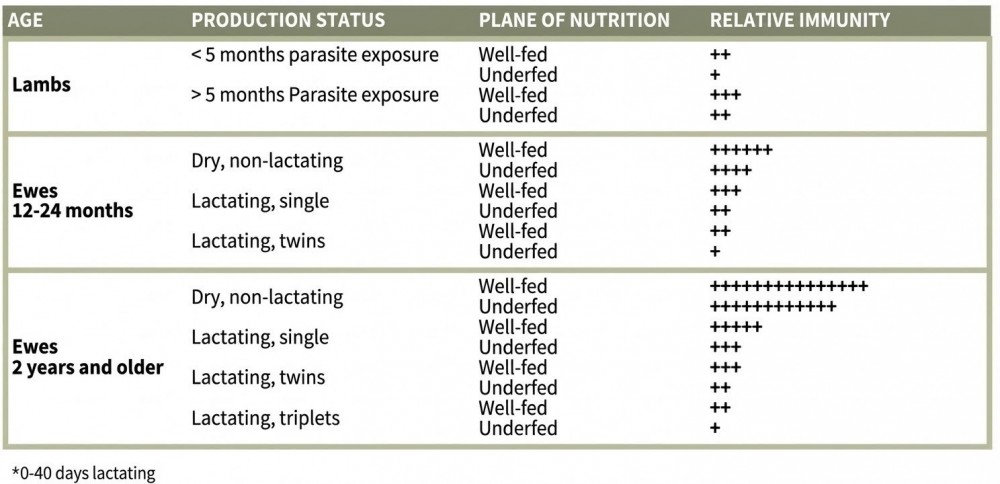 Figure 1. This chart shows the interplay between age, stage of production, plane of nutrition, and relative immunity for lambs and ewes. Chart from Ehrhardt, 2024. Click to enlarge.
Resources:
- Delaney, C. 2002. Ventilation and Lighting for Goat Barns. http://goatdocs.ansci.cornell....
- Ehrhardt, R. 2024. Understanding the Risk Factors. Michigan State University. https://www.wormx.info/riskfactors
- Machen et al., 2017. A Haemonchus contortus Management Plan for Sheep and Goats in Texas. Texas A&M Agrilife Extension. ANSC-PU-066.
- Miller, J. 2021. The Four Phases of Gastro-Intestinal Worm Infection. https://www.wormx.info/_files/ugd/6ef604_dfa578ac6a7849e3ba0029f17fd5aaa8.pdf
- Penn State. 2025. Sheep Facilities and Housing Requirements. https://extension.psu.edu/shee...
More information about internal parasites in small ruminants can be found at The American Consortium for Small Ruminant Parasite Control at https://www.wormx.info/
This work is supported by the Northeast Extension Risk Management project award no. 2024-70027-42540, from the U.S. Department of Agriculture's National Institute of Food and Agriculture.
Field Crops
Dairy
Business
Livestock
Grains
Upcoming Events
Poultry Processing Workshop, Canandaigua, NY
September 17, 2026 : Poultry Processing Workshop - Canandaigua, NY
Canandaigua, NY
This program is one of four statewide roadshow stops across the state, offering farmers a full poultry processing experience. The class will teach skills that build confidence, reduce costs, and strengthen your farm's independence. This hands-on workshop gives farmers the chance to process a bird from start to finish, learning every step of the workflow used by small farms across the state.
Tax 101: An Introduction to Income Taxes for Farmers
September 17, 2026 : Tax 101: An Introduction to Income Taxes for Farmers
Join NY Farm Net for a FREE mid-day webinar about income tax basics for farmers. Attendees will learn what documents you need, options for recordkeeping systems, how identify common tax forms and schedules, and more!
Large Animal Awareness Training For First Responders
September 19, 2026
Dunkirk, NY
Join the Chautauqua County Technical Rescue Services and NYS Veterinarian, Dr. Kate Card-Allen, for a specialized training on how to safely and effectively respond to large animal incidents. Learn techniques for managing large animals during traffic accidents, rollovers, entrapments and other transportation emergencies.
Announcements
No announcements at this time.