
Cattle Injection Tips
Amy Barkley, Team Leader & Livestock Specialist
Southwest New York Dairy, Livestock and Field Crops Program
Giving injections of vitamins, vaccinations, dewormers, and antibiotics is a scientific process. Following label instructions, giving injections in the "injection triangle", and opting for sub-cutaneous (sub Q) injections reduces the risk of muscle lesions and trim loss.
Prior to the development and implementation of the National Beef Quality Assurance Program (BQA), processors and farmers were losing money from trim loss. Separate from bruising, lesions located in the muscle tissue from intramuscular (IM) injections into large primal muscles was severe. Once the data of loss was quantified, the BQA program worked to reduce this incidence in beef cattle and is now working to decrease this incidence in dairy cattle as well, since they are moved into the beef supply chain at the end of their milking lifetimes. This spawned a transition of many injectables to be reformulated for the subcutaneous injection route (under the skin) and for intramuscular injection (in the muscle) options to be removed from the product labels if they could be. While subcutaneous injections don't prevent tissue inflammation and lesions, they greatly reduce them and their resulting trim loss. Some of these lesions and their severity can be seen in Figure 1.
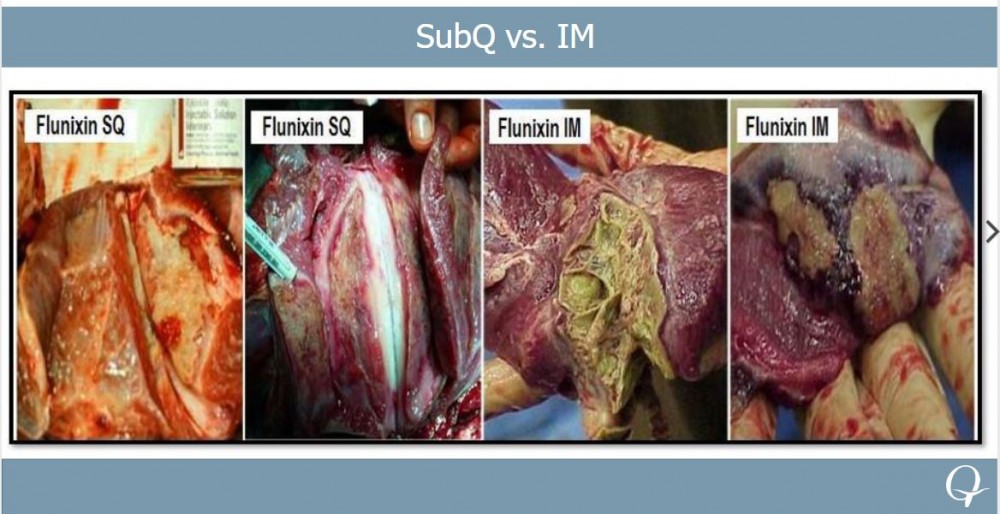 Figure 1. Fascia and muscle lesions following subcutaneous and intramuscular injections. Photos from the NY Beef Quality Assurance Program. Click to enlarge.
Regardless of when injections are given, intramuscular lesions will usually stay with the animal for life. Therefore, it's important to place injections properly from day 1. The area that the industry broadly recommends for giving injection in is what we call the "vaccination triangle". This is an area bordered off by the nuchal ligament in the top of the neck, the spine in the lower-mid area of the neck, and the shoulder blade. This area of the animal is low value in terms of the meat, so if there is trim loss from an injection, it will be less impactful to the overall value of the animal. See Figure 2 below to visualize the location.
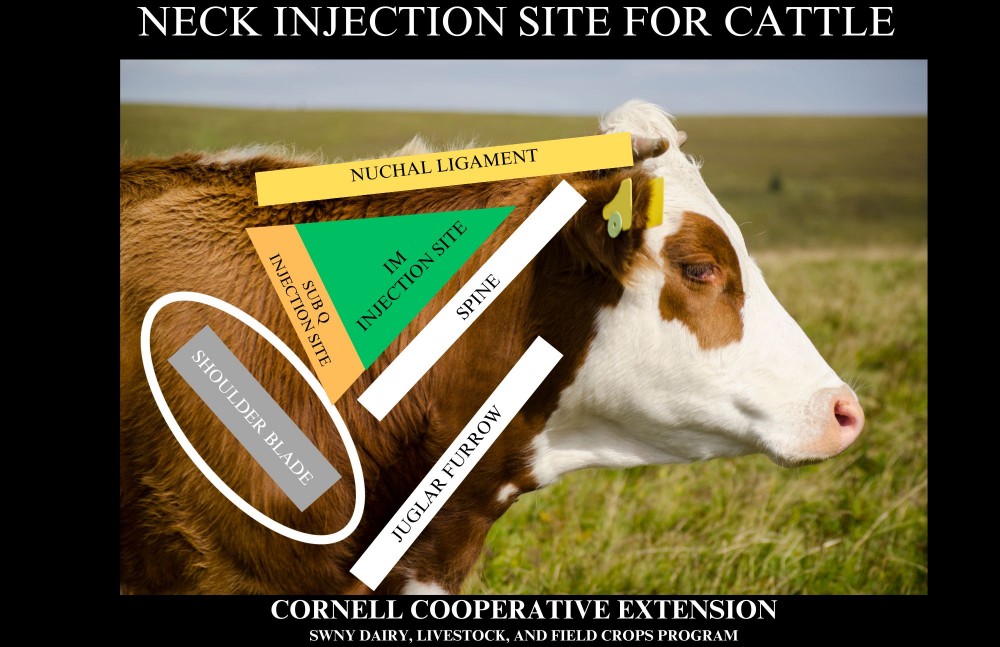 Figure 2. The "injection triangle" is an area of the neck bordered by the nuchal ligament, spine, and shoulder blade. There is an area recommended for subcutaneous injections and an area recommended for intramuscular injections. Click to enlarge.
Before you give your injections, remember these tips:
1.) Read the label prior to giving your injection. Many are given under the skin (subcutaneously) and others are given in the muscle.
2.) If you are placing multiple injections at once, you can utilize both sides of the animal. If you find that there is a need to place multiple injections on the same side, you will place them 3 inches apart at a minimum. Some labels recommend specific placement within the vaccination triangle for their injection.
3.) Limit injections to 10 ccs or less per intramuscular site and 15 ccs or less per subcutaneous site.
4.) Use the needle gauge and size recommended on the injectable package. Most IM injections require a 1" - 1.5" long needle, and most subcutaneous injections require a 1/2" - 3/4" needle. As the solution becomes thicker, you will need a thicker needle (gauge 16 for example) and if it's closer to water in consistency, you'll need a thinner needle (gauge 20 for example).
When giving a subcutaneous injection, use the tented skin technique. This is there you pinch the skin with one hand and slide the needle just under the pinched area. By doing this, you'll help place a subcutaneous injection correctly every time. Figure 3 shows this in more detail.
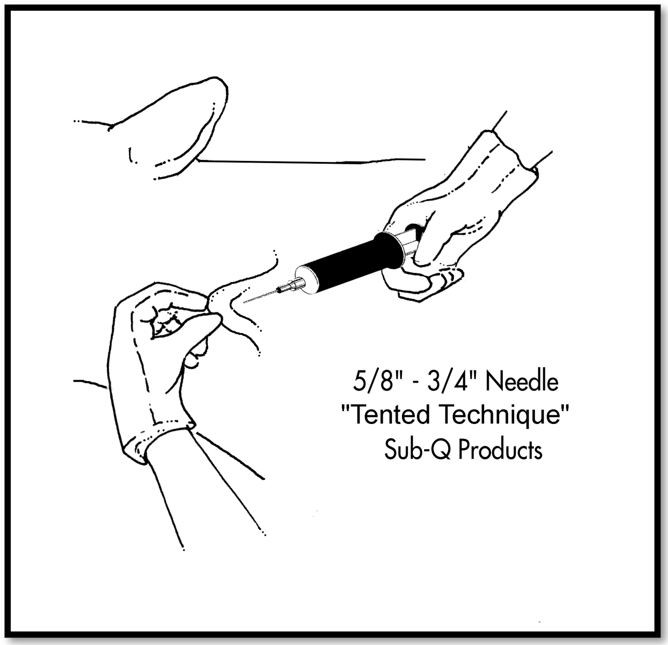 Figure 3. Tenting the skin prior to injection within the injection triangle will aid in reducing errors in injectable placement. Diagram from the NY Beef Quality Assurance Program. Click to enlarge.
Through proper placement and use of injectables, it's easier to bring high quality cattle with limited lesions to the marketplace. For questions, contact Amy Barkley, Livestock specialist at 716-640-0844 or amb544@cornell.edu.

Field Crops
Dairy
Business
Livestock
Grains
Upcoming Events
Poultry Processing Workshop, Canandaigua, NY
September 17, 2026 : Poultry Processing Workshop - Canandaigua, NY
Canandaigua, NY
This program is one of four statewide roadshow stops across the state, offering farmers a full poultry processing experience. The class will teach skills that build confidence, reduce costs, and strengthen your farm's independence. This hands-on workshop gives farmers the chance to process a bird from start to finish, learning every step of the workflow used by small farms across the state.
Tax 101: An Introduction to Income Taxes for Farmers
September 17, 2026 : Tax 101: An Introduction to Income Taxes for Farmers
Join NY Farm Net for a FREE mid-day webinar about income tax basics for farmers. Attendees will learn what documents you need, options for recordkeeping systems, how identify common tax forms and schedules, and more!
Large Animal Awareness Training For First Responders
September 19, 2026
Dunkirk, NY
Join the Chautauqua County Technical Rescue Services and NYS Veterinarian, Dr. Kate Card-Allen, for a specialized training on how to safely and effectively respond to large animal incidents. Learn techniques for managing large animals during traffic accidents, rollovers, entrapments and other transportation emergencies.
Announcements
No announcements at this time.