
Face Covering Required for Essential Workers With Direct Public Contact
Katelyn Walley, Business Management Specialist and Team Leader
Southwest New York Dairy, Livestock and Field Crops Program
Originally published on the Cornell Agricultural Workforce Development website.
On April 12, New York Governor Cuomo issued an executive order that included the following text:
"For all essential businesses or entities, any employees who are present in the workplace shall be provided and shall wear face coverings when in direct contact with customers or members of the public. Businesses must provide, at their expense, such face coverings for their employees. This provision may be enforced by local governments or local law enforcement as if it were an order pursuant to section 12 or 12-b of the Public Health Law. This requirement shall be effective Wednesday, April 15 at 8 p.m."Of course, farm employees are "essential businesses" so this order applies to farm employees. However, the order also limits the requirement to only when employees are "in direct contact with customers or members of the public." Until we have any further guidance it seems reasonable that this face covering requirement would apply to farm employees working in U-pick, farm market, or other customer-facing environments. It might also apply to farm employees who must interact with other non-farm employees such as delivery personnel as part of their jobs, such as office staff. Farms should interpret the executive order for their specific context with the intent of protecting the health of employees and those they must interact with.
New York's executive order came in the context of the U.S. Centers for Disease Control (CDC) now recommending the widespread use of cloth face coverings to slow the spread of COVID-19. It's important to share a recent CDC statement about this:
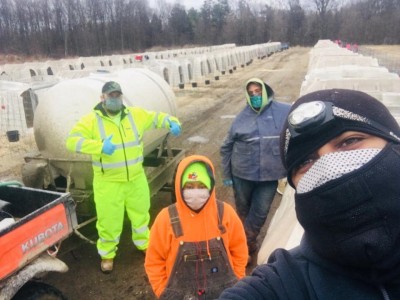
"CDC continues to study the spread and effects of the novel coronavirus across the United States. We now know from recent studies that a significant portion of individuals with coronavirus lack symptoms ("asymptomatic") and that even those who eventually develop symptoms ("pre-symptomatic") can transmit the virus to others before showing symptoms. This means that the virus can spread between people interacting in close proximity—for example, speaking, coughing, or sneezing—even if those people are not exhibiting symptoms. In light of this new evidence, CDC recommends wearing cloth face coverings in public settings where other social distancing measures are difficult to maintain (e.g., grocery stores and pharmacies) especially in areas of significant community-based transmission."In this context, many farms are issuing cloth face masks to employees as another way to help prevent the spread of COVID-19. Mapleview Dairy in Madrid, NY recently posted on Facebook a photo of their team wearing cloth face coverings and a video showing part of the farm's daily mask cleaning and preparation procedure.
CDC provides instructions for making cloth face coverings on their web page. The Cornell Farmworker Program is working with community groups to organize face mask production and distribution to farm workers. Many farms are reaching out to people in their community to help, Mapleview used a local embroidery shop to source their face coverings. Farms should consider finding a source of face coverings to provide for employees and adding this tool to help fight COVID-19.
CDC also recommends that face coverings be cleaned regularly using an ordinary laundry process. Farms should consider building the cleaning step into their procedures.
Working together, our farming industry will overcome COVID-19 and keep on providing for farmers, farm employees, rural communities, and the public who depends on us.
By Richard Stup, Cornell University. Permission granted to repost, quote, and reprint with author attribution. The post Face Coverings Required for Essential Workers With Direct Public Contact appeared in The Ag Workforce Journal

Field Crops
Dairy

Business

Livestock

Grains
Upcoming Events
Large Animal Awareness Training For First Responders
September 19, 2026
Dunkirk, NY
Join the Chautauqua County Technical Rescue Services and NYS Veterinarian, Dr. Kate Card-Allen, for a specialized training on how to safely and effectively respond to large animal incidents. Learn techniques for managing large animals during traffic accidents, rollovers, entrapments and other transportation emergencies.
Dairy Feeder School
October 29, 2026 : Dairy Feeder School
Freedom, NY
- One day on-farm training for dairy farm feeders
- Offered in English and Spanish
- Stations with hands-on activities/demos
Tax 102: Tax planning and strategies for Farmers
November 4, 2026 : Tax 102: Tax planning and strategies for Farmers
This webinar follows the "Introduction to Income Taxes" webinar from September, going more into depth on topics including: understanding common tax concepts, tax strategies, long-term approaches to managing taxes, and more!
Announcements
No announcements at this time.