
The Root of the Problem: Battling Western Corn Rootworm
Katelyn Miller, Field Crops and Forage Specialist
Southwest New York Dairy, Livestock and Field Crops Program
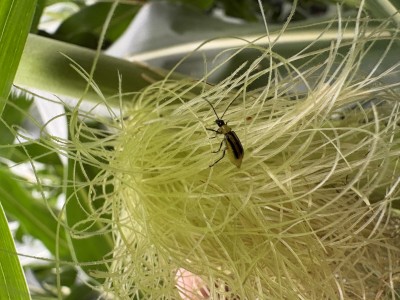
You may remember back in May I wrote an article discussing how last winter might impact insect pressure for this growing season. I highlighted some common pests we see like black cutworm, armyworm, and alfalfa weevil, but there were a few that didn't make the cut; the most critical for this summer being Western Corn Rootworm. Quite frankly, this is a pest that has not been on my radar much, only having received a few reports of damage since I joined the team. This summer, however, it's had a significant impact statewide, leaving us with many questions about the future efficacy of our current management options.
Based on grower reports out of Central NY, 22 fields and over 2,000 acres have been impacted over 4 counties by root injury and goosenecking. The southern tier is not immune from CRW pressure, as scouting efforts show pest presence here as well. So, how serious is this pest and what's the end result?
Western Corn Rootworm is a major pest of corn, with an estimated $2 billion in economic losses nationwide, derived from yield reductions and associated management costs. The primary cause of concern comes from larval feeding damage on roots, which weakens plants, causing lodging, or "goosenecking". While this lodging can create harvest challenges, the primary issue lies in yield loss from stunted plants and reduced ear size. During late summer, adult's lay eggs in the soil, which then overwinter and hatch the next spring. The adults emerge from the soil around pollination at which time they will feed on the pollen and corn silks, resulting in the clipped appearance. Outside of the yield losses that occur from root feeding damage, if silk clipping happens before the corn pollinates, you will see a reduction in kernel set.
One of the most effective strategies that can be used to manage this pest is crop rotation. Consecutively planting corn year after year greatly increases your risk for damage. Rotating out of corn will allow most of the existing population to flush out of the soil, as corn is the only host for CRW. To work around this, a strategy used has been the use of Bt toxins. The first toxin Cry3Bb1 was introduced in 2003, and by 2010, multi-trait pyramids were used for rootworm control, with Cry3Bb1 in SmartStax along with Cry34/35Ab1. Unfortunately, along this same time frame, entomologists in the Midwest started uncovering issues with the original Cry3Bb1 trait, discovering better survivability of larvae in fields planted to corn with this trait, showing strong evidence of field evolved resistance in the Midwest. This concern has shown the importance of rotating the toxin type used to a different mode of action when planting corn consecutively.
While this situation has been ongoing in the Midwest for some time, there is still plenty of potential here for resistance to develop. As I mentioned, pockets in NYS this summer have experienced significant CRW pressure, with some fields having 5 beetles per plant (threshold is 1 beetle/plant). Though large beetle populations do not necessarily equate resistance, it can be an indicator of a larger issue. The population intensity that we have been finding in the state indicates that trait failure may be on our doorstep. Detecting these issues is crucial, but in the face of pest pressure, it should be our goal to preserve the efficacy of these traits before further issues have the chance to develop.
An additional management tool that has shown promise is the use of entomopathogenic nematodes (EPNs), which was first developed to control alfalfa snout beetles in Northern NY, but has also shown the ability to control other soil dwelling pests such as CRW. Research conducted over 7 years has indicated that when traits prove to not be effective, the presence of EPNs reduce the damage below economic levels.


Tables from "Biological Control of Corn Rootworm with Native NY Entomopathogenic Nematodes", Elson Shields, The Manager, March 2021
The CRW outbreak this summer has left us with many questions surrounding our future technology availability for this pest. While there are no effective or economic management options for this time of year, remain vigilant for lodging while harvesting corn this fall. Many seed reps are required to investigate and report any damage or concerns related to CRW failure, so be sure to notify them.

Aerial photograph of Western Corn Rootworm damage, Tully (Onondaga Co.), 2026 season. Photo: Ben Rogers, Pioneer
Resources:
https://extension.psu.edu/managing-western-corn-rootworm-resistance-to-bt-on-the-fringe
Sequential evolution of resistance by western corn rootworm to multiple Bacillus thuringiensis traits in transgenic maize (https://pmc.ncbi.nlm.nih.gov/articles/PMC11929453/)
The Handy Bt Trait Table for U.S. Corn Production - https://www.texasinsects.org/uploads/4/9/3/0/49304017/bttraittable_aug2025.pdf
Field Crops
Dairy
Business
Livestock

Grains
Upcoming Events
Poultry Processing Workshop, Canandaigua, NY
September 17, 2026 : Poultry Processing Workshop - Canandaigua, NY
Canandaigua, NY
This program is one of four statewide roadshow stops across the state, offering farmers a full poultry processing experience. The class will teach skills that build confidence, reduce costs, and strengthen your farm's independence. This hands-on workshop gives farmers the chance to process a bird from start to finish, learning every step of the workflow used by small farms across the state.
Tax 101: An Introduction to Income Taxes for Farmers
September 17, 2026 : Tax 101: An Introduction to Income Taxes for Farmers
Join NY Farm Net for a FREE mid-day webinar about income tax basics for farmers. Attendees will learn what documents you need, options for recordkeeping systems, how identify common tax forms and schedules, and more!
Large Animal Awareness Training For First Responders
September 19, 2026
Dunkirk, NY
Join the Chautauqua County Technical Rescue Services and NYS Veterinarian, Dr. Kate Card-Allen, for a specialized training on how to safely and effectively respond to large animal incidents. Learn techniques for managing large animals during traffic accidents, rollovers, entrapments and other transportation emergencies.
Announcements
No announcements at this time.