
A Side of Nitrogen, Please!
Katelyn Miller, Field Crops and Forage Specialist
Southwest New York Dairy, Livestock and Field Crops Program
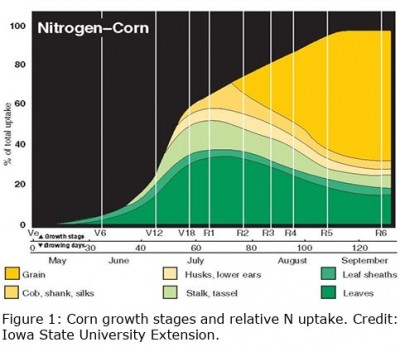
As we know, nitrogen (N) is a critical nutrient for corn production, but is also one of the most difficult to manage. Application rates must be balanced in a way that meets crop needs in an economical way, while also protecting against environmental
losses. One of the best ways to manage this is by using practices such as sidedressing to provide additional N at a time
when the plant will have increased uptake requirements.
For the first two weeks after planting, the seed contains enough N reserves to keep the plant alive until photosynthesis
can take place. It isn't until V1 to V3 that the roots start taking up N from the surrounding soil, accounting for approximately
5% of the total N needs, or 10-15 lbs. By V6, plants have taken up an estimated 25-30 lbs of N and quickly build biomass.
At V9, corn starts developing new leaves every 2-3 days, tassels begin developing rapidly, and brace roots are
establishing. Between V6 and V12, which is typically a two-week period, 25% of the total N uptake occurs. This is being
allocated to ear development, where the N status will influence kernel number on the ear. V12 and VT account for about
40% of total N uptake, with an additional 20% uptake attributed to reproductive stages R1 through R6.
In summary, between V6 and VT, corn will take up about 65% of its total N needs for the growing season. So, when is
the optimal time to apply additional N by sidedressing? Research done by the NMSP team indicates that the optimum
time is between V4 to V6, compared to the same rates applied at V8 to V10 corn. Sidedressing at 180 lbs of N per acre
at V4 and V6 resulted in yields that averaged 97% of the Nrich treatment, whereas the delayed application of that rate
resulted in 95% (V8) and 87% (V10) of the Nrich treatment, and 96% (V8) and 89% (V10) of the yield obtained at the
V6 application.

Caption: Corn grain yield as impacted by timing of sidedressing (NoN = starter only; Nrich = 300 lbs N per acre at planting; V4, V6, V8, and V10 = sidedressing of 180 lbs N per acre at the designated growth stage). The trials were conducted on continuous corn fields without a recent manure history at the Musgrave Research Farm in Aurora, NY). The values above each bar indicate the mean yield. Yield are not statistically different if followed by the same letter (a, b, etc.). Photo sourced from Nutrient Management Spear Program.
For every ton of corn silage produced per acre, it's expected that approximately 7 pounds of N will be taken up. For grain, it is estimated that 1 pound of N will be removed for every bushel produced. Recommended application rates depend on many cropping factors.
- N application rate pre-plant or at planting
- Soil type
- Soil N supply
- Crop rotation
- Yield potential
- Manure history
- Weather
N availability is impacted largely by soil moisture. This spring, our soils remained cool and wet, resulting in accelerated losses through denitrification and leaching. Continued weather forecasts will play a role in determining rates and timing of the application of additional N. If using urea, some rain is needed after application but avoid applying before heavy rainfall periods. N availability is also impacted by droughty conditions, reducing availability. When planning applications, both moisture extremes should be considered to help determine rates and select appropriate fertilizer management such as stabilizers.
While the plant needs a small percentage of N early in its growth to support a strong root system, the later vegetative stages have the highest uptake. Splitting N applications allows for high nutrient use efficiency, applying the nutrient when it's needed in the highest quantity.
Resources:
http://nmsp.cals.cornell.edu/p...
https://blogs.cornell.edu/what...
Field Crops
Dairy
Business
Livestock
Grains
Upcoming Events
Poultry Processing Workshop, Canandaigua, NY
September 17, 2026 : Poultry Processing Workshop - Canandaigua, NY
Canandaigua, NY
This program is one of four statewide roadshow stops across the state, offering farmers a full poultry processing experience. The class will teach skills that build confidence, reduce costs, and strengthen your farm's independence. This hands-on workshop gives farmers the chance to process a bird from start to finish, learning every step of the workflow used by small farms across the state.
Tax 101: An Introduction to Income Taxes for Farmers
September 17, 2026 : Tax 101: An Introduction to Income Taxes for Farmers
Join NY Farm Net for a FREE mid-day webinar about income tax basics for farmers. Attendees will learn what documents you need, options for recordkeeping systems, how identify common tax forms and schedules, and more!
Large Animal Awareness Training For First Responders
September 19, 2026
Dunkirk, NY
Join the Chautauqua County Technical Rescue Services and NYS Veterinarian, Dr. Kate Card-Allen, for a specialized training on how to safely and effectively respond to large animal incidents. Learn techniques for managing large animals during traffic accidents, rollovers, entrapments and other transportation emergencies.
Announcements
No announcements at this time.