
What's the Sweep on Insects this Season?
Katelyn Miller, Field Crops and Forage Specialist
Southwest New York Dairy, Livestock and Field Crops Program
Every year I get asked, "What pests are we dealing with this year?" I wish it was a clear answer, but our ability to predict pest pressure is about as accurate as long-term weather forecasts. Jokes aside, it is incredibly difficult to 'predict' what is going to happen, but we can evaluate historic insect populations, weather, and consider biology to give us a better idea of what we could see this growing season.
This winter fit the bill of 'a classic NY winter' as I heard many refer to it, with cold temperatures, high snowfall amounts in areas, and stretches of negative wind chills. Outside of the Northeast, the south experienced a deep freeze, a relatively uncommon phenomenon. We can make the overall assessment that it was cold, but was it cold enough to actually impact insect populations?
Most insects are cold-blooded, meaning that they can match the temperature of their own bodies to the surrounding environment. They are impacted by air temperature, as opposed to wind chills like we are, with many containing antifreeze compounds (glycerol) that lower the freezing point of water in their bodies.
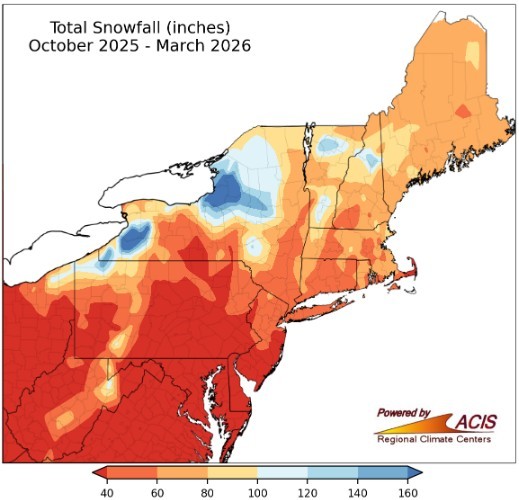
Here in Northeast, we have some insects that overwinter, but a majority migrate in spring. One overwintering pest is alfalfa weevil, where adults survive in leaf litter, alfalfa stubble, or nearby grassy areas. Once temperatures rise in those first warm spring days, they become active. It takes a temperature of 13?°F at the soil surface to cause 20-30% mortality, with a small amount able to survive down to 1?°F. Snow cover doesn't cause mortality and insulates the pests from temperatures (but also helps protect plants from winterkill). Throughout the region, snowfall amounts and cover were variable, which will impact mortality, but it's a challenging figure to accurately forecast.
Graphic from Northeast Regional Climate Center
Soybean aphids overwinter but also migrate in. This insect overwinters as eggs on buckthorn, where there is typically less protection from snow cover. Eggs will freeze between 25-35?°F, with many freezing at 29?°F. There is some mortality that is caused in the fall due to factors like dehydration and cold snaps. In the past few years, there has not been widespread soybean aphid pressure, and mostly has been isolated fields. Even if mortality rises above 50%, they can migrate from the south to cause issues in a growing season. When factoring out wind chills, the reality is that there probably wasn't much mortality of aphids due to low temperatures.
Insects that migrate every year to the Northeast include potato leafhopper (PLH), common armyworm (CAW), and black cutworm (BCW). Typically, PLH migrates from mid-May to early June, so we'll likely start seeing them soon. Once these insects catch the southerly winds, they can be here in the Northeast in 2-3 days, or even sooner under ideal conditions. This speed also can apply to CAW and BCW. With the deep freeze that took place in the south, I was curious to see what the timeline of arrival would look like for these insects. With the freezing temperatures, mortality could have occurred, or they got pushed further south extending their timeline of arrival. In the case of CAW and BCW, it doesn't seem to have impacted the arrival of these pests in the Northeast, as I am already getting catches in my pheromone traps that I placed on April 17th. I even have had a significant flight recorded for BCW in Arkport on May 1st (>15 moths).
So, was it cold enough to impact insect populations? The short answer is probably not. Like any year, consistent scouting will continue to help you stay on top of arising pest issues.
Resources:
https://nedews.nrcc.cornell.edu/
https://blog-crop-news.extension.umn.edu/2026/02/is-it-cold-enough-yet-insect.html
Field Crops
Dairy
Business
Livestock
Grains
Upcoming Events
Dairy Feeder School
October 29, 2026 : Dairy Feeder School
Freedom, NY
- One day on-farm training for dairy farm feeders
- Offered in English and Spanish
- Stations with hands-on activities/demos
Tax 102: Tax planning and strategies for Farmers
November 4, 2026 : Tax 102: Tax planning and strategies for Farmers
This webinar follows the "Introduction to Income Taxes" webinar from September, going more into depth on topics including: understanding common tax concepts, tax strategies, long-term approaches to managing taxes, and more!
Labor Roadshow: Practical Workforce Strategies for Agricultural Professionals Across New York
November 30, 2026
December 21, 2026
The Agricultural Workforce Development Council of New York State (AWDC) will celebrate a decade of connecting and educating agricultural professionals when Labor Roadshow X returns this December with five in-person events and two webinars across New York State.
For nearly ten years, the Labor Roadshow has brought agricultural professionals together to learn, connect, and navigate the evolving challenges of agricultural labor. The 2026 event will continue that tradition with timely, expert-led discussions focused on the issues affecting farms and agricultural employers today—including labor law and compliance, employee engagement, retention, and workplace culture.
Announcements
No announcements at this time.