
Side Dressing Fertilizer in Corn by Janice Degni
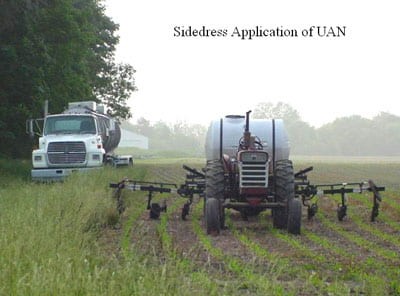
Side-Dressing Fertilizer in Corn by Janice Degni
It won't be long and it will be time for sidedressing corn nitrogen needs in continuous corn or fields with no or low rates of manure. This spring's dryer conditions have not lead to high losses of N. North Dakota State University provides a nice summary of considerations and tips for Side-Dressing Fertilizer in Corn:
The greatest need for nitrogen is from the V12 stage to the corn blister stage in a corn plant's life. Typically, corn is side-dressed at the 6 leaf (V6) stage; however any time prior to V12 will achieve management goals.Soil type heavily influences the side-dressing decision. High clay soils should have a planned split-application of nitrogen fertilizer due to the risk of nitrogen loss by denitrification. Fine-textured sandy soils also have high risk of nitrogen loss due to leaching.
Corn at 2-3 leaf staging can withstand a broadcast application of urea. Urea can used in older corn plants can cause fertilizer burn or plant death and the least favorable nitrogen choice. Urea broadcast should be limited at 60 lb actual N/acre.
By 4 leaf crop staging, nitrogen should be applied between the rows. In older corn, anhydrous ammonia can be applied if the soil will seal up. The second most desirable application method is the application of UAN (28%) with a coulter which places fertilizer at an approximate 2 inches depth. The third-best alternative is to apply UAN as a surface band using orifice nozzles between the rows. Corn injury can be reduced if a stiff hose which drags or nearly drags on the ground is configured to the stream bar.
Fertilizer placed in every other row is sufficient. Slow-release formulations should be avoided.
According to Dave Franzen, North Dakota State University Extension Soil Specialist, the following Corn Side-Dress Options are considerations for those growers who still need to apply nitrogen on their corn:
If the corn is 2-3 leafs at most, urea broadcast can be done. If you can't count on at least ½ inch of rain coming at one time to soak the urea into the soil, applying the urea with Agrotain should give about 10 days of safety from urea volatilization. If the corn is more advanced than 3 leaf, too much urea will settle into the whorl and injure the corn too much to tolerate. The option from 4 leaf on is to apply the N between the rows. If the soil will seal, anhydrous can be applied. In most of the state, soils with high clay will not seal and many loam textured soils are also saturated and will have trouble sealing. The next most desirable application method is the application of UAN (28%) with a coulter. This will place the UAN below the soil surface, but shallow enough that practical application can be conducted without going very deep 2-3 inches is plenty of depth. If this is not possible, apply the UAN as a surface band using orifice nozzles. If you anticipate wind (it's hard not to anticipate wind in North Dakota) configuring the outlet with a stiff hose that drags or nearly drags on the ground will eliminate most splashing on the corn leaves that could be harmful.Things not to consider-
Stream-bar UAN or Nisol-type products, the consequence is too much burn. Low rates of slow-release N products. The consequences are not much burn, but not enough N. The efficiency factor advertised by product marketing has not been evaluated in research trials.
Calculating Sidedress Rates
A pre-sidedress soil test result will tell you if you need additional N or not or if you are in a gray zone of maybe. It does not tell you the rate of additional N needed. To figure the rate needed you must calculate backwards from the N needed for the crop subtracting contributions that season from soil, old sod decay, manure applications and fertilizer.
The Cornell Nutrient Management Spear Program has a handy calculator on their website that you can access at http://nmsp.cals.cornell.edu/software/calculators.html. Select the Corn Nitrogen Calculator.


Field Crops
Dairy
Business

Livestock

Grains
Upcoming Events
Dairy Feeder School
October 29, 2026 : Dairy Feeder School
Freedom, NY
- One day on-farm training for dairy farm feeders
- Offered in English and Spanish
- Stations with hands-on activities/demos
Tax 102: Tax planning and strategies for Farmers
November 4, 2026 : Tax 102: Tax planning and strategies for Farmers
This webinar follows the "Introduction to Income Taxes" webinar from September, going more into depth on topics including: understanding common tax concepts, tax strategies, long-term approaches to managing taxes, and more!
Labor Roadshow: Practical Workforce Strategies for Agricultural Professionals Across New York
November 30, 2026
December 21, 2026
The Agricultural Workforce Development Council of New York State (AWDC) will celebrate a decade of connecting and educating agricultural professionals when Labor Roadshow X returns this December with five in-person events and two webinars across New York State.
For nearly ten years, the Labor Roadshow has brought agricultural professionals together to learn, connect, and navigate the evolving challenges of agricultural labor. The 2026 event will continue that tradition with timely, expert-led discussions focused on the issues affecting farms and agricultural employers today—including labor law and compliance, employee engagement, retention, and workplace culture.
Announcements
No announcements at this time.