
EPA Approves Federal Registration for Over-the-Top Dicamba Application
Katelyn Miller, Field Crops and Forage Specialist
Southwest New York Dairy, Livestock and Field Crops Program
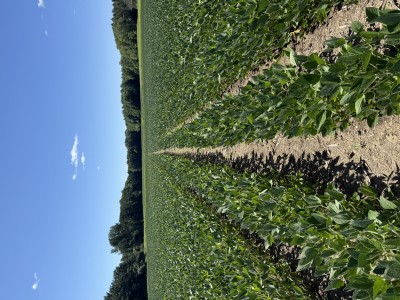
You may recall in 2024, the U.S. District Court vacated registrations for three dicamba containing products (XtendiMax, Engenia and Tavium) for over-the-top (OTT) applications in dicamba tolerant soybeans. Fast forward to February 6, 2026, the EPA has approved three OTT products in soybeans and cotton for the next two growing seasons. These products include:
- Stryax (Bayer)
- Engenia (BASF)
- Tavium (Syngenta)
This approval is for one specific use, as they are not introducing a new product onto the market or bringing a product back that was gone. Dicamba has continually remained on the market for other uses. The new piece is the strength of environmental protections, being referred to as the "strongest protections in agency history". Dicamba products have ecological risks associated with drift and volatility, hence the strong restrictions behind product use. This registration is only extended for the next two growing seasons (2026 & 2027) and is subject to additional review during this time.
So, what do these new restrictions look like?
As I mentioned, there are ecological risks associated with dicamba use, so restrictions are designed to address these concerns. Below is a condensed list from the EPA bulletin stating restrictions shared on the updated label for OTT applications in soybeans.
- Maximum 1 pound/acre can be applied per year. Only two applications are allowed per season, with a maximum rate of 0.5 pounds/acre.
- 40 ounces/acre of a Volatility Reduction Agent must be included in the tank.
- When temperatures are between 85?????°- 95?????°F, only 50% of your acreage can be sprayed. You must wait two days before treating the rest of the acres. When temperatures exceed 95?????°F, no applications can be made.
- For every treated field, mitigation points from EPA's conservation practices menu (https://www.epa.gov/pesticides/mitigation-menu) need to be implemented. At least 3 must be earned for each field, with 6 points required in areas with endangered species. This will be where PULA's (pesticide use limitation areas) reside.
- There is no spraying within 240 feet of the downwind edge of the field. If dicamba-sensitive crops are downwind, this product cannot be sprayed.
- Spraying is prohibited within 48 hours of expected rain, when soil is saturated, within 1 hour after sunrise or 2 hours before sunset, and during temperature inversions.
- Required wind speed must be between 3-10 mph.
- Nozzle use must be coarse or coarser, and spray release must be no higher than 2 feet above the ground or crop canopy.
- Ammonium sulfate (AMS) cannot be in the tank mix.
- No aerial application is permitted.
For applicators, annual training will be required. This label is a preview of the scrutiny that all pesticide products will be undergoing because of enforcement of the Endangered Species Act in pesticide registrations by the EPA. In this progressing age of pesticide application, recordkeeping will continue to be a crucial component, as records of every application must be kept ensuring enforcement of the above restrictions, and to remain in compliance with all label requirements.
Its important to note that it's possible that access to these products may not happen immediately. Even though they are approved federally, it still has to go through registration in NYS. Discussions with industry folks who sell these products have shared that its unlikely these products will be registered and fully available for use in the 2026 growing season, as it will likely take 4-6 months to get NYS registration. While there is no longer restrictions on date of when these products can be applied, under this timeline, they'll likely become available too late this growing season to have an impact in your spray program.
UPDATE as of 5/16/2026: Engenia, Styrax & Tavium has been registered by the NYSDEC. It is unclear at this if any dealers will be recieving product. For use, an annual training will be required from one of the three companies (Syngenta, Bayer, BASF), which are now available online.
Resources:
https://www.epa.gov/newsreleases/epa-implements-strongest-protections-agency-history-over-top-dicamba-use-cotton-and https://www.epa.gov/ingredients-used-pesticide-products/registration-dicamba-use-dicamba-tolerant-crops
Field Crops
Dairy
Business
Livestock
Grains
Upcoming Events
Poultry Processing Workshop, Canandaigua, NY
September 17, 2026 : Poultry Processing Workshop - Canandaigua, NY
Canandaigua, NY
This program is one of four statewide roadshow stops across the state, offering farmers a full poultry processing experience. The class will teach skills that build confidence, reduce costs, and strengthen your farm's independence. This hands-on workshop gives farmers the chance to process a bird from start to finish, learning every step of the workflow used by small farms across the state.
Tax 101: An Introduction to Income Taxes for Farmers
September 17, 2026 : Tax 101: An Introduction to Income Taxes for Farmers
Join NY Farm Net for a FREE mid-day webinar about income tax basics for farmers. Attendees will learn what documents you need, options for recordkeeping systems, how identify common tax forms and schedules, and more!
Large Animal Awareness Training For First Responders
September 19, 2026
Dunkirk, NY
Join the Chautauqua County Technical Rescue Services and NYS Veterinarian, Dr. Kate Card-Allen, for a specialized training on how to safely and effectively respond to large animal incidents. Learn techniques for managing large animals during traffic accidents, rollovers, entrapments and other transportation emergencies.
Announcements
No announcements at this time.