
Combine Adjustments to Minimize Corn Harvest Losses
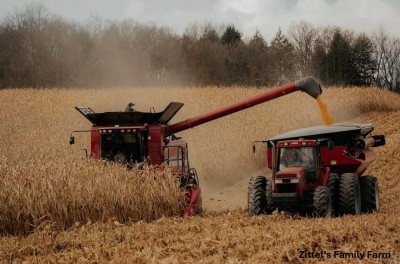
By Ashley Isaacson, Tosh Rung Mazzone, & Zachary Curtis: Penn State Extension
Do you struggle with volunteer corn every year?
Volunteer corn infestations popping up in your crop rotation can reduce crop yield and require additional herbicide considerations. For example, a study conducted in Nebraska found that 1 volunteer corn plant per square meter reduced soybean yield by 22% (Stephens et al, 2024). With widespread planting of stacked herbicide-tolerant corn, additional herbicides are needed to control these undesirables, which may lead to greater costs. Consider adjusting your combine settings to minimize harvest losses and preserve grain yield without sacrificing quality.
To minimize grain loss as much as possible, we must understand where grain losses can occur. Losses can occur both pre-harvest, such as with lodging or lost corn ears on the ground at-harvest, during cutting, threshing, and cleaning. Often, the majority of at-harvest loss occurs at the header, as corn stalks are pulled into the header and transported into the combine. Grain losses are the sum of pre-harvest, or corn on the ground measured before the header, and at-harvest, the kernels left on the ground after passing through the combine.
For information on estimating total grain yield losses, see the University of Nebraska's How to Estimate Harvest Losses in Soybean and Corn Fields. Without checking kernels left on the ground at harvest, it is impossible to know how much grain is lost and if combine adjustments are retaining more grain.
Combine Adjustments Losses at Header- Combine settings - Adjust the combine to the manufacturer's recommended settings as listed in your user manual. Then, adjust as needed for crop conditions to prevent harvest loss and kernel damage accordingly. Adjust header settings according to the user manual to prevent loss of whole ears.
- Ground speed - The forward speed determines the feed rate of the material into the combine. Operate the combine at a ground speed that matches the crop condition and provides constant flow of material without clogging the threshing mechanism or overloading the combine.
- Gathering chain speed - Match the gathering chain speed to the ground speed to control the flow of material into the header. This will prevent the displacement of the stalks being pushed forward, pulled backward or sideways, which may result in ear losses. The corn header can also be modified to add brushes, impact pads, or sweeps onto the gathering chain to capture corn kernels. A study by Virginia Tech has found that adding brushes to the gathering chains helped to capture falling corn kernels. They found an additional benefit to the brushes which helped capture large-sized weed seeds, reducing the number of weed seeds from being blown out with the chaff and adding to the weed seedbank.
- Header and Row Alignment - Adjust the header to match any variation in the row spacing. Careful planting and auto-steer technologies can help minimize stalk disturbance.
- Gathering Snouts - Snouts should be adjusted so that they just touch the ground. If plants are lodged, let snouts float on the ground and reduce ground speed to allow the stalks to be pulled in without losing the ear.
- Deck Plates - Ensure deck plates are positioned properly. Common spacing suggested by combine manuals suggests an initial spacing of 1 1/8" at the bottom and 1¼" at the top. Deck plates should be spaced as wide as possible without losing ears or shelling corn off the ear. If kernels are smaller than normal, consider narrowing this spacing to limit shelling losses. If spacing is too wide, butt-shelling may occur where the butt end of the ear contacts the stalk rolls, which results in kernel loss. If adjusting the spacing, be sure to check the adjustment is working as intended.
- Cross Auger and Feederhouse - The cross auger delivers the ears to the center of the head, where it enters the feederhouse. Reducing the space from the auger to the feederhouse drum may minimize the buildup of the crop, helping to prevent backfeeding losses.
Threshing losses are typically very low but can occur from a variety of factors. Losses occur when kernels fail to break free of the cob as it passes between the cylinder or rotor and the concave.
- Rotor/Cylinder - Increasing the rotor or cylinder speed can decrease threshing losses but may also increase damage to the kernels. Follow what the manufacturer recommends and use the lowest possible setting to achieve the best total threshing, then make small changes as needed. Excessive cylinder or rotor speed can lead to grain damage and an increased amount of foreign material in the grain.
- Concave clearance - Adjust the clearance so cobs fracture into halves or thirds. Avoid breaking the cobs into many pieces to minimize threshing losses and damaged kernels.
Cleaning system losses should also be very small and are hard to distinguish from separation losses.
- Fan Speed - Adjust fan speed to the appropriate level. If set too low, foreign material will remain with the grain and result in a dockage for poor quality. If set too high, kernels may be lost and thrown out the back of the combine. One exception would be when harvesting corn suspected of high mycotoxin load; increasing fan speed to expel diseased kernels generally results in lower vomitoxin content.
- Sieve Openings - Check the operator's manual for the recommended sieve openings. Set sieve to the widest recommended setting and adjust as needed to allow the grain to filter down and the chaff to float off. Adjust as needed for crop conditions.
Now is the time to prepare for harvest by calibrating your equipment to minimize harvest losses. Consider making adjustments now and adapting these settings once a few acres have been harvested and a grain loss check off the combine has been done. Continue to monitor and adjust settings as you move between fields with different hybrids. Adjusting your combine settings appropriately will preserve your grain yield, maintain grain quality and result in less kernels on the ground to rear their ugly head next year in the following crop.
ReferencesStephens, T., Kumar, V., Rees, J., & Jhala, A. J. (2024). Harvest loss in corn and implication for volunteerism. Weed Technology, 38, e48.
Field Crops
Dairy

Business
Livestock

Grains
Upcoming Events
Poultry Processing Workshop, Canandaigua, NY
September 17, 2026 : Poultry Processing Workshop - Canandaigua, NY
Canandaigua, NY
This program is one of four statewide roadshow stops across the state, offering farmers a full poultry processing experience. The class will teach skills that build confidence, reduce costs, and strengthen your farm's independence. This hands-on workshop gives farmers the chance to process a bird from start to finish, learning every step of the workflow used by small farms across the state.
Tax 101: An Introduction to Income Taxes for Farmers
September 17, 2026 : Tax 101: An Introduction to Income Taxes for Farmers
Join NY Farm Net for a FREE mid-day webinar about income tax basics for farmers. Attendees will learn what documents you need, options for recordkeeping systems, how identify common tax forms and schedules, and more!
Large Animal Awareness Training For First Responders
September 19, 2026
Dunkirk, NY
Join the Chautauqua County Technical Rescue Services and NYS Veterinarian, Dr. Kate Card-Allen, for a specialized training on how to safely and effectively respond to large animal incidents. Learn techniques for managing large animals during traffic accidents, rollovers, entrapments and other transportation emergencies.
Announcements
No announcements at this time.