
Late Fall is Time to Winterize Your Sprayers
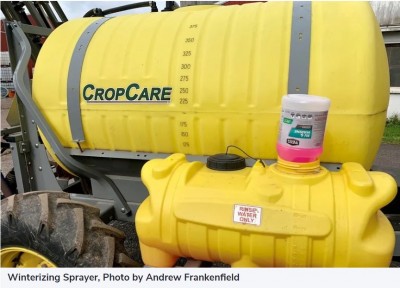
By Andrew Frankenfield: Penn State Extension
Wear Personal Protective Equipment (PPE)Always wear the proper PPE when cleaning, winterizing, or simply making repairs and adjustments to your sprayer. Remember: Pesticides are not the only chemicals that pose exposure risk. Check the tank cleaner precautions.
Clean the Sprayer RegularlyBe diligent in cleaning your sprayer. This should be done after each spray but is critical before winter storage. Pesticide labels indicate proper cleaning procedures, including what cleaning agent to use.
Take Care of the SprayerTaking care of your sprayer is essential to ensure its best performance and maximize its life span. This includes following proper maintenance and storage procedures throughout the year.
Winterize the SprayerWinterizing your sprayer after the season is over will help prevent damage and save you both time and money in the spring. Be sure to read the owner's manual for your sprayer and pump. Using the wrong material to winterize your sprayer could void the warranty. Sometimes liquid fertilizer is used because it is readily available on the farm but that in not recommended because it is corrosive and crystallizes when cold. Besides I can purchase RV antifreeze cheaper than I can purchase liquid fertilizer these days.
Filters- Remove filters from sprayer.
- Wash by hand with soapy water and rinse.
- Store metal filters in vegetable oil to prevent rust pitting.
- Place filter housing back on sprayer.
- Remove nozzles, check valves and screens.
- Wash by hand with soapy water and rinse.
- Store metal screens in vegetable oil.
- Remove all pressure gauges and cap openings.
- Store at room temperature in an upright position.
- Remove as much water as possible from the sprayer (can use an air hose to blow out any moisture).
- Add RV antifreeze (see below) with corrosion preventer already added.
Smaller sprayers:
- Refer to owners manual for complete instructions
- Add RV antifreeze to tank.
- Use sprayer pump to circulate through pump and all lines.
Larger sprayers:
- Refer to owners manual for complete instructions
- Add manufactures recommended amount of RV antifreeze to rinse tank
- Circulate throughout the entire plumbing system
- Turn on sections of the boom and turn off when you see pink coming out of the nozzle openings, and then cap nozzle openings to maintain fluid in system.
- Refer to owner's manual for proper instructions for the other sprayer components, such as the foam marker system, flow meter, rate controller, and electronic system.
Winterizing Pesticide Sprayers online course Learn when and how to winterize sprayers. Recognize and prevent damage from inactivity and freezing temperatures. Earn 1 core pesticide applicator credit.
For more pesticide education information visit the Pennsylvania Pesticide Applicators website at Penn State Extension.
Field Crops
Dairy
Business
Livestock

Grains
Upcoming Events
Poultry Processing Workshop, Canandaigua, NY
September 17, 2026 : Poultry Processing Workshop - Canandaigua, NY
Canandaigua, NY
This program is one of four statewide roadshow stops across the state, offering farmers a full poultry processing experience. The class will teach skills that build confidence, reduce costs, and strengthen your farm's independence. This hands-on workshop gives farmers the chance to process a bird from start to finish, learning every step of the workflow used by small farms across the state.
Tax 101: An Introduction to Income Taxes for Farmers
September 17, 2026 : Tax 101: An Introduction to Income Taxes for Farmers
Join NY Farm Net for a FREE mid-day webinar about income tax basics for farmers. Attendees will learn what documents you need, options for recordkeeping systems, how identify common tax forms and schedules, and more!
Large Animal Awareness Training For First Responders
September 19, 2026
Dunkirk, NY
Join the Chautauqua County Technical Rescue Services and NYS Veterinarian, Dr. Kate Card-Allen, for a specialized training on how to safely and effectively respond to large animal incidents. Learn techniques for managing large animals during traffic accidents, rollovers, entrapments and other transportation emergencies.
Announcements
No announcements at this time.