
Inventorying Forage
Article written by Joe Lawrence: PRO-DAIRY Forage Systems Specialist
With low forage yields, knowing what you have in inventory is critical to plan for how to best manage this feed to get through the coming year. It will affect decisions such as:
- Do I have enough feed for the milking herd and young stock?
- Do I need to look at fillers for the ration to stretch forage inventories?
- Should I cull unproductive animals?
- Do I have more youngstock than I need?
First, you can calculate just how much forage you need by calculating what you are feeding each day, and how many days you will need to feed prior to next year's harvest. Helpful tools to calculate inventory needs are at: http://www.ansci.cornell.edu/d...
If you have a fixed structure such as an upright silo, you likely know in general how long a full silo will last, though the dry matter (DM) content of forage can have a large impact on just how much feed is there and how long it will last.
Upright Silos
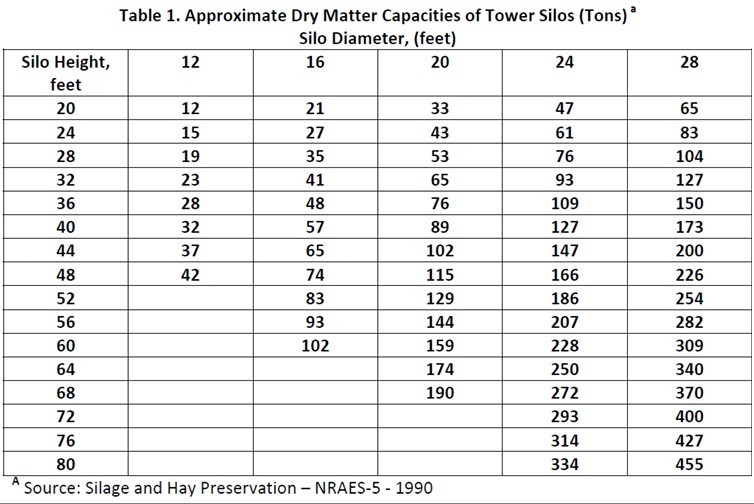
For tower silos, Table 1 shown here is from the Cornell Dairy Nutrition Factsheet series "Determining your current forage inventory" located on the web at: http://www.ansci.cornell.edu/d.... This website offers a number of other helpful factsheets related to forages and feeding, as well as worksheets to print and fill in your own numbers to help make calculations for your herd.
Ag Bags
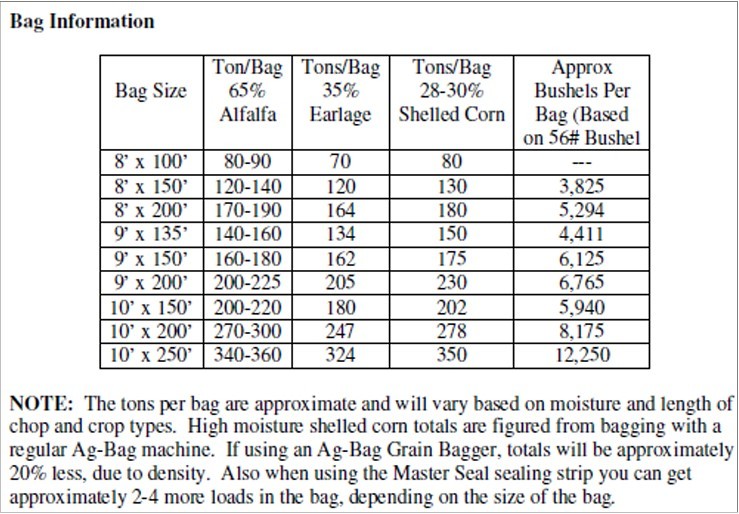
The Miller Ag Bag Company http://www.agbagplastic.com/pd... has a factsheet with the approximate capacities of Ag Bags. Below is a table from their factsheet.
Bunkers and Drive-over Piles
Horizontal silos can be the most difficult to determine inventories for, but that shouldn't stop you from determining them. There are two main factors to determine how much silage is in a pile; total cubic feet of silage in the storage and the density (pounds per cubic feet) of the feed. We have discussed several times the importance of achieving high densities to reduce storage and quality losses, but regardless of what density you were able to achieve, the most important factor when determining inventories is to use the most realistic estimate you can as to not over or under estimate the amount of forage in storage.
There are a few ways to determine density. Samples can be taken from the bunk face, using a tool such as the Dairy One Master Forage probe. Care needs to be taken with this method as working around the face of the bunk can be dangerous. A second approach is to use a density calculation tool from the University of Wisconsin Team Forage. This tool can be found at: http://www.uwex.edu/ces/crops/... or contact CCE to work through the spreadsheet with you. The spreadsheet can be very accurate, but it depends on the accuracy of the numbers you put into the spreadsheet. To use the spreadsheet you need information such as weight of packing tractors, delivery rate of forage to the bunk, size of the bunk, and layer thickness of silage while packing.
Determining the cubic footage comes down to a math problem (cubic feet = lengths x width x height). Since most bunks are not nice even sided boxes, it is best to tackle the storage by ! breaking it into squares, rectangles and triangles. Here is an example of a bunk with side walls and a back wall, a ramp on the front and a sloping top. Though the top may be a little more rounded, in reality you can do the best to measure it as a triangle. Since a right triangle is one half of a square or rectangle, the calculation for the cubic footage of a triangle = ½ (length x width x height). So, for this example the total is:
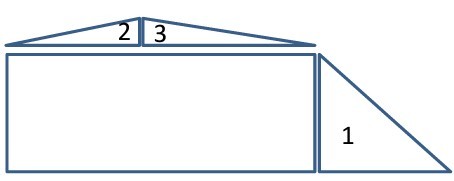
Rectangle = length x width x height
plus
Triangle 1 = ½ (length x width x height)
plus
Triangle 2 = ½ (length x width x height)
plus
Triangle 3 = ½ (length x width x height)
Field Crops
Dairy
Business

Livestock

Grains
Upcoming Events
Poultry Processing Workshop, Canandaigua, NY
September 17, 2026 : Poultry Processing Workshop - Canandaigua, NY
Canandaigua, NY
This program is one of four statewide roadshow stops across the state, offering farmers a full poultry processing experience. The class will teach skills that build confidence, reduce costs, and strengthen your farm's independence. This hands-on workshop gives farmers the chance to process a bird from start to finish, learning every step of the workflow used by small farms across the state.
Tax 101: An Introduction to Income Taxes for Farmers
September 17, 2026 : Tax 101: An Introduction to Income Taxes for Farmers
Join NY Farm Net for a FREE mid-day webinar about income tax basics for farmers. Attendees will learn what documents you need, options for recordkeeping systems, how identify common tax forms and schedules, and more!
Large Animal Awareness Training For First Responders
September 19, 2026
Dunkirk, NY
Join the Chautauqua County Technical Rescue Services and NYS Veterinarian, Dr. Kate Card-Allen, for a specialized training on how to safely and effectively respond to large animal incidents. Learn techniques for managing large animals during traffic accidents, rollovers, entrapments and other transportation emergencies.
Announcements
No announcements at this time.