
Transition milk has a lot of immunoglobulins - PRO DAIRY
Transition milk has a lot of immunoglobulins - To access original article click here
Vimal Selvaraj, Kasey Schalich, and Rob Lynch - PRO DAIRY
Antibodies in the dam's colostrum, specifically immunoglobulins G and A, are the reason why newborn calves are able to immediately combat bacterial and viral pathogens in the environment. Based on early research, the predominant recommendation to improve calf survival rates and health has been to feed newborn calves first-milking colostrum to obtain maternal IgG.
Yet even with a single colostrum feeding, failure of passive transfer (FPT) still occurs at high rates, ranging between 12.1 to 37.1 percent in different studies on North American dairies. Recognizing this problem, it is being increasingly advocated to provide a second colostrum feeding to calves. But is this enough? And what do we know about the IgG content of transition milk? Could it also provide immunological value to calves? From a physiology perspective we reasoned that transition milk might also have high levels of IgG that can be collected and fed to the calf not only to increase the amount absorbed before gut closure, but also fed after gut closure to protect against harmful microorganisms inside the gut that would otherwise cause gastrointestinal infections. This is called enteric protection.
To investigate this possibility, we measured the IgG content in six sequential, complete milkings including colostrum (less than two hours after calving) and transition milk (4, 16, 28, 40 and 52 hours after calving) in Holstein dairy cows. To our surprise, we found that only 25 percent of all IgG is secreted into colostrum and that the remaining 75 percent of IgG is secreted into the next five milkings in transition milk (Figure 1).
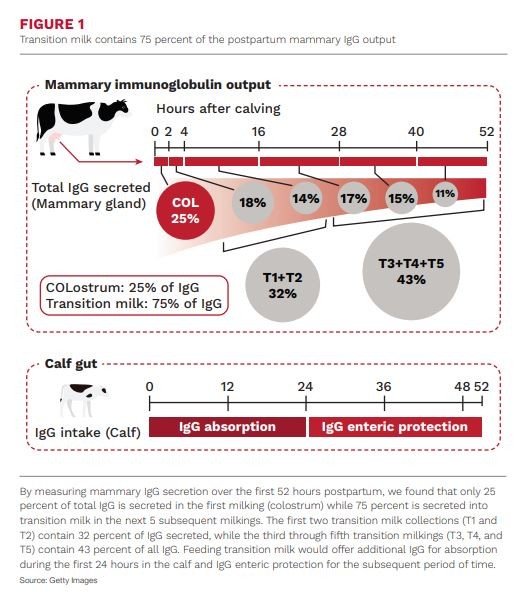
Together with findings that we presented in our companion article "Why there is no such thing as colostrum quality," it is clear that feeding transition milk would have substantial benefits, especially considering that we do not know the full profile of other beneficial immune, growth, and developmental factors that are not present in milk replacers. From a practical standpoint, while transition milk might not look like golden colostrum, it still has very high IgG content (together with other physiological components) and is highly valuable to feed.
HOW COULD PRODUCERS APPLY THIS NEW INFORMATION ON MAMMARY IGG SECRETION KINETICS TO FEED MORE IGG TO THEIR CALVES?
For one approach, we designed a simple postpartum milk collection and calf feeding protocol that is based on our research on mammary IgG secretion kinetics and others' research on the gastric emptying rate and natural suckling patterns of calves. We call this protocol the COLostrumTransition milk feeding method, or COLT feeding method (Figure 2), with COLT2 providing one colostrum (COL) and two transition milk feedings (T2) and COLT5 providing one colostrum (COL) and five transition milk feedings (T5).
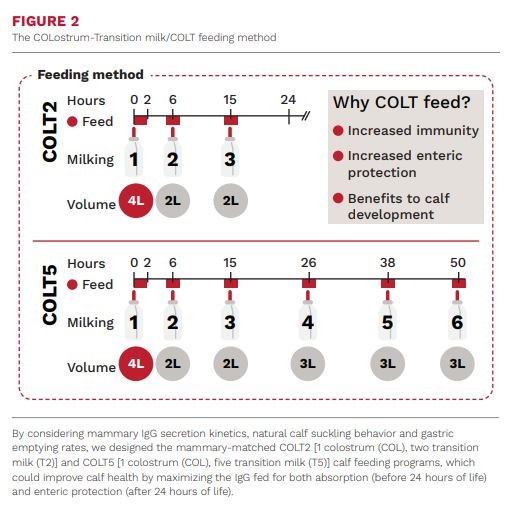
The COLT2 feeding method enables producers to provide about 74 percent more IgG to calves before gut closure compared to only providing a single four-liter feeding. For producers who desire to capture even more immune and developmental benefits of feeding transition milk we suggest the COLT5 feeding method, which provides five transition milk feedings to calves (T5) and would thus provide about 44 percent more IgG to the calf than the COLT2 feeding method.
COULD FEEDING TRANSITION MILK REALLY BE WORTH THE EXTRA TIME AND EFFORT FOR AN ALREADY TIME AND LABOR-STRAPPED HERDS PERSON?
In agreement with some others who have already begun advocating for this approach, we believe it could. First, it allows for producers to take advantage of a free, natural IgG resource to invest in calf immunity upfront, thereby reducing the need to purchase and use antibiotics on sick calves. As antibiotics seriously harm the establishing gut microbiome in calves and are major contributors to the public health threat of antimicrobial resistance (AMR), preventing the need to use them is a good thing. Second, while IgG is primarily talked about in the context of absorption before gut closure, feeding immunoglobulins beyond the timing of gut closure is extremely valuable to extend protection against pathogens in the gut by binding and immobilizing pathogens that cause problems like scours. Third, besides IgG, many researchers have noted that early mammary secretions have key nutrients, growth factors, and other signaling factors that are crucial for both developments of the calf gut and whole body via mechanisms that we are just beginning to understand.
CURRENT LABOR LIMITATIONS VERSUS THE LONG-TERM PAYOFF
While the reality of labor limitations on dairy farms cannot be understated, especially in the United States, an upfront investment into feeding transition milk to neonatal calves could at least help reduce labor spent on the headache of treating and monitoring sick calves. Others' research also suggests an additional return on investment from feeding transition milk, including better animal development, lower age at first pregnancy, and higher milk production later in life. We find the growing dairy science research interest on transition milk to be an exciting opportunity to leverage biology for improved calf health in the industry. Whatever the primary motivation for the producer, we believe that implementation of the COLT2 and COLT5 feeding methods will be a valuable investment into the future milking herd.
Vimal Selvaraj, B.V.Sc., Ph.D. (vs88@cornell.edu), Kasey Schalich, Ph.D. (kms433@cornell. edu), and Rob Lynch, DVM (ral328@cornell.edu) are with the Department of Animal Science, Cornell University.
Acknowledgements: This research was funded by the Northeast Sustainable Agriculture Research and Education (NE-SARE) grant GNE19-220-33243, the Cornell CALS Charitable Trust Research Fund, and startup funds from Cornell CALS.
Reference: Schalich KM, Reiff OM, Nguyen BT, Lamb CL, Mondoza CR and Selvaraj V. (2021). Temporal kinetics of bovine mammary IgG secretion into colostrum and transition milk. Journal of Animal Science. doi:10.1093/jas/skab083.
Field Crops
Dairy
Business
Livestock
Grains
Upcoming Events
Livestock Production Field Day
August 29, 2026 : Livestock Production Field Day
Chaffee, NY and East Aurora, NY,
Join us on visits to Horizon Ridge Farm in East Aurora and Troll Bridge Farm in Chaffee for an introduction to small beef and small diversified livestock enterprises. Through walking farm tours, attendees will learn about management, meat processing, setting prices, and finding local markets. Dinner will be provided. Register by contacting Amy Barkley at amb544@cornell.edu or 716-640-0844.
Poultry Processing Workshop, Naples, NY
September 17, 2026 : Poultry Processing Workshop - Naples, NY
Naples, NY
This program is one of four statewide roadshow stops across the state, offering farmers a full poultry processing experience. The class will teach skills that build confidence, reduce costs, and strengthen your farm's independence. This hands-on workshop gives farmers the chance to process a bird from start to finish, learning every step of the workflow used by small farms across the state.
Large Animal Awareness Training For First Responders
September 19, 2026
Dunkirk, NY
Join the Chautauqua County Technical Rescue Services and NYS Veterinarian, Dr. Kate Card-Allen, for a specialized training on how to safely and effectively respond to large animal incidents. Learn techniques for managing large animals during traffic accidents, rollovers, entrapments and other transportation emergencies.
Announcements
No announcements at this time.