
2021 Corn silage overview by Joe Lawrence and Allison Kerwin
2021 Corn silage overview
by Joe Lawrence and Allison Kerwin
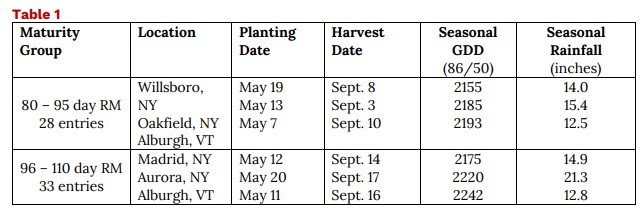
The growing season across much of the Northeast started with average to slightly above average heat unit accumulation and below average precipitation. This provided relatively good conditions for corn planting, with trial locations planted between May 7 and May 19 (Table 1). Conditions remained dry, with most locations receiving designations of abnormally dry or moderate drought from the U.S. drought monitor in May and June. The exception was Aurora, which received more timely rainfall throughout May and June.
At NY locations, this changed in July with rainfall well above average through July and August; however, the Alburgh, VT location remained in Moderate Drought (U.S. Drought Monitor) through harvest. This season provided another example of how seasonal rainfall totals can be misleading in a year such as this but the timing and amount of rainfall at certain stages of plant development can be very impactful. Furthermore, certain areas within the region experienced rainfall extremes far exceeding what is represented in these trials. In these areas, greater shifts in management strategies may be needed to make adjustments in feeding programs.
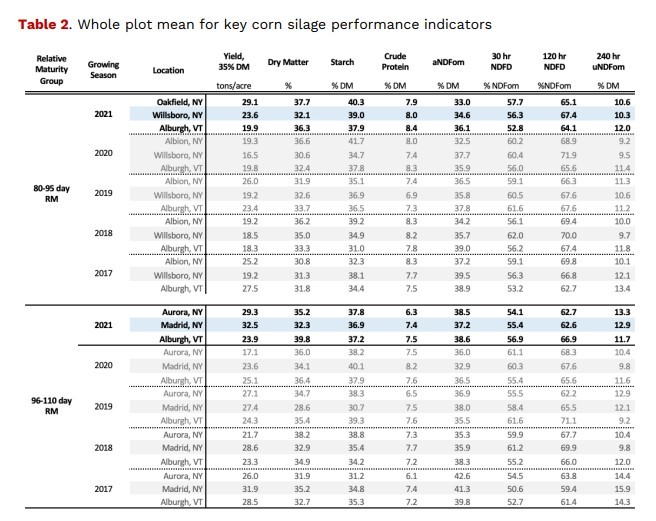
As 2021 corn silage sits in storage, hopefully fermenting for the next few months before being fed out, it is helpful to understand how this crop might feed compared to previous years. Using the trial results as an indicator of corn silage performance gives us an idea of average performance.
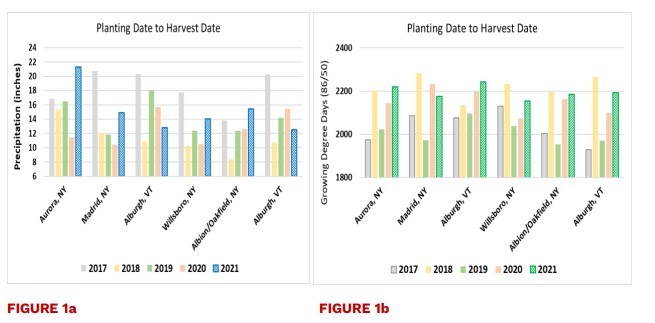
Keep in mind this is an average of certain locations and your conditions may vary. On your own farm, it is helpful to take samples of your forage at harvest and again prior to feed out to understand the opportunities and challenges as you begin to feed this year's crop. We also need to remember that while fresh samples are a very helpful indicator, some characteristics of the forage will change during fermentation, particularly starch digestibility. For the NY locations, the season ended with rainfall amounts greater than 2020 (Figure 1a); however, as noted, the season was defined by two extremes with dry conditions to start the season and excess rainfall in the latter half. Growing Degree Day (GDD) accumulation was generally higher than recent years (Figure 1b).
With these observations in weather patterns, it can be useful to look at key forage quality parameters and how the season impacted their relative values compared to previous years. Figures 2a and 2b show the differences in undigested neutral detergent fiber after 240 hours of digestion (uNDF240) and starch content, respectively. The data in Figure 2 and Table 2 represents the last five growing seasons (2017 - 2021) with results combined from all locations by year. The relatively high accumulation of GDD's with rainfall throughout the ear development stage resulted in a distribution of starch content very similar to 2020 (Figure 2b). However, in contrast to 2020, excessive higher overall rainfall and the timing which it occurred resulted in a higher proportion of samples with greater levels of uNDF240, or less potentially digestible fiber.
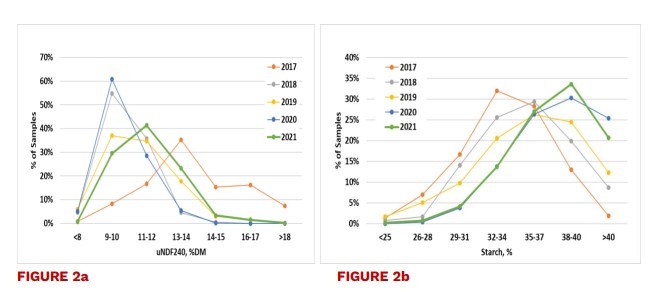
Each year brings its own challenges and opportunities. Given the variation in growing conditions across the region, it is critical to test your own forages to understand the sitespecific impacts of the growing season. It is important to evaluate this data in the context of your farm when selecting hybrids. The top performing hybrid at any one location or in any one category may not be a good fit for your feeding program. Factors that influence this vary by farm but include land base, soil resources, forage inventory, quality of available hay crops, access and cost of supplemental ingredients, and expectations of cow performance. The trial results and location averages serve as a means to calibrate hybrid performance to a particular growing season. These averages can be used in conjunction with a company's data on hybrids in their lineup, including hybrids not entered into these trials, to understand how a hybrid performed relative to what is realistic for a given growing season. For example, in Figure 2, we see that the highest percentage of samples have an uNDF240, percent DM value in the 11 to 12 percent category and over 50 percent of samples have a starch content of 38 percent or greater. This can be used to evaluate how close or far away from these values other hybrids performed in 2021. It is important to recognize the companies that make these trials possible through their entry of hybrids. The following companies participated in the 2021 trials: Brevant, Channel, Dekalb, Growmark FS, Hubner, Local Seed Company, Nutrien Ag Solutions - Dyna-Gro, Pioneer, Redtail (King's Agri-seed), Seed Consultants, Seedway, Syngenta - NK The full report for the 2021 NY VT Corn Silage Hybrid Evaluation Program can be found at: https://blogs.cornell.edu/varietytrials/corn-silage/
Field Crops
Dairy
Business
Livestock
Grains
Upcoming Events
Livestock Production Field Day
August 29, 2026 : Livestock Production Field Day
Chaffee, NY and East Aurora, NY,
Join us on visits to Horizon Ridge Farm in East Aurora and Troll Bridge Farm in Chaffee for an introduction to small beef and small diversified livestock enterprises. Through walking farm tours, attendees will learn about management, meat processing, setting prices, and finding local markets. Dinner will be provided. Register by contacting Amy Barkley at amb544@cornell.edu or 716-640-0844.
Poultry Processing Workshop, Naples, NY
September 17, 2026 : Poultry Processing Workshop - Naples, NY
Naples, NY
This program is one of four statewide roadshow stops across the state, offering farmers a full poultry processing experience. The class will teach skills that build confidence, reduce costs, and strengthen your farm's independence. This hands-on workshop gives farmers the chance to process a bird from start to finish, learning every step of the workflow used by small farms across the state.
Large Animal Awareness Training For First Responders
September 19, 2026
Dunkirk, NY
Join the Chautauqua County Technical Rescue Services and NYS Veterinarian, Dr. Kate Card-Allen, for a specialized training on how to safely and effectively respond to large animal incidents. Learn techniques for managing large animals during traffic accidents, rollovers, entrapments and other transportation emergencies.
Announcements
No announcements at this time.