
Traps being set for black cutworm and armyworm - Watch your fields!
Joshua Putman, Field Crops and Forage Specialist
Southwest New York Dairy, Livestock and Field Crops Program
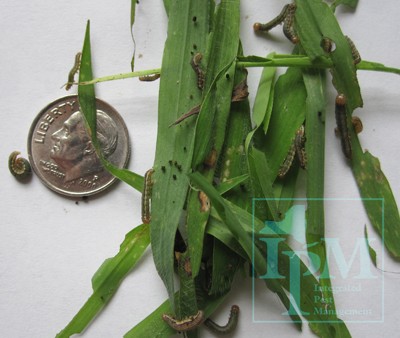
True Armyworm (aka Common armyworm)
Armyworm moths are long-range migrants that arrive on the spring storms from their southern
overwintering locations. Armyworm moth migrations are somewhat sporadic, cyclic from year to
year and difficult to predict. True armyworms are primarily a pest of
plants in the grass family: forage / pasture /grasses (& lawns), wheat, corn and small grains.
Note: Under hunger stress true armyworms will also attack some legumes and other plants.
Moths lay their eggs on weeds and/or grasses along field margins, on leaves of corn, or on small
grains. Larvae hatch about a week later and develop over approximately a 3 week period, feeding
mostly at night.
Fields at most risk for armyworms feeding are:
1) grass or mostly grass hayfields, pastures. (Armyworms will also feed on grass lawns.)
2) wheat and other small grain fields and cut hay fields
3) corn fields that:
a. were planted into a small grain cover crop (such as rye grass)
b. have grassy weeds, quackgrass, crabgrass and bluegrass and other perennials
c. were planted into burned down sods, have grass weed issues, no-till or reduced tillage
fields, fields with crop residue
d. fields near severely infested small grain and cut hay fields, and in no-tillage corn
established in grain stubble or on grassy land.
Field Crops Specialist, Josh Putman, is getting ready to set traps in SWNY with hopes to capture armyworm moths to better help predict potential infestations on your farm. Contact Josh at jap473@cornell.edu or 716-490-5572 for updates on these timely pests.
Field Crops
Dairy
Business
Livestock
Grains
Upcoming Events
Large Animal Awareness Training For First Responders
September 19, 2026
Dunkirk, NY
Join the Chautauqua County Technical Rescue Services and NYS Veterinarian, Dr. Kate Card-Allen, for a specialized training on how to safely and effectively respond to large animal incidents. Learn techniques for managing large animals during traffic accidents, rollovers, entrapments and other transportation emergencies.
Dairy Feeder School
October 29, 2026 : Dairy Feeder School
Freedom, NY
- One day on-farm training for dairy farm feeders
- Offered in English and Spanish
- Stations with hands-on activities/demos
Tax 102: Tax planning and strategies for Farmers
November 4, 2026 : Tax 102: Tax planning and strategies for Farmers
This webinar follows the "Introduction to Income Taxes" webinar from September, going more into depth on topics including: understanding common tax concepts, tax strategies, long-term approaches to managing taxes, and more!
Announcements
No announcements at this time.