
Introduction to Worker Protection Standard
Katelyn Miller, Field Crops and Forage Specialist
Southwest New York Dairy, Livestock and Field Crops Program
The Worker Protection Standard (WPS) is a regulation originally issued by the U.S. Environmental Protection Agency (EPA) in 1992. It covers pesticides used in the production of agricultural plants on farms, forests, nurseries, and greenhouses. The WPS requires employers (agricultural and commercial pesticide handlers) to provide specific information and protections to workers, handlers, and other persons when WPS labeled pesticide products are used in the production of agricultural plants. It's intended to reduce the risk of injury and illness resulting from pesticide exposures on agricultural establishments.
Based on the WPS How to Comply Manual, the WPS applies to you if:
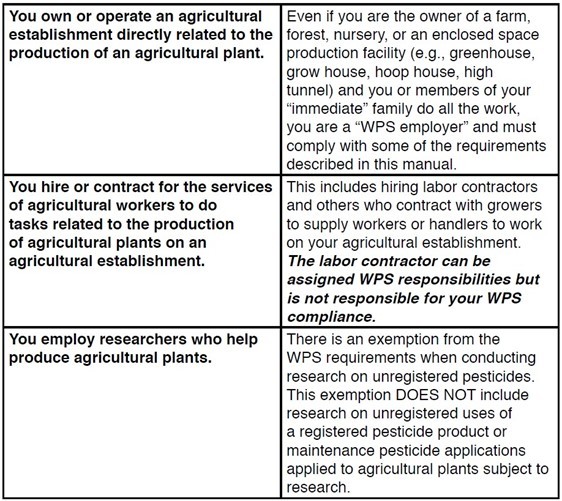
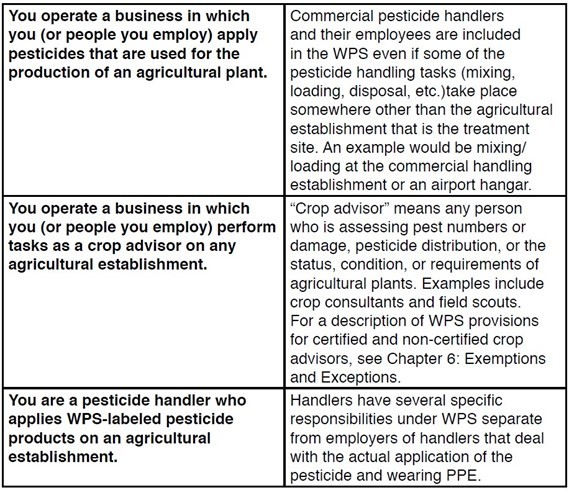
Knowing if you fall under WPS is important, but there are also some definitions that are crucial to understanding when it applies.
Agricultural Plants are plants grown and maintained for commercial or research purposes. Examples include food, feed, fiber plants, seedlings, tress, etcetera.
A worker is anyone who is employed for compensation (including self-employed) and performs tasks like harvesting, pruning, weeding, or watering in the production of agricultural plants.
A handler is anyone who is employed for compensation (including self-employed). They perform tasks such as mixing, loading, or applying pesticides; assisting in pesticide applications; cleaning, repairing, or adjusting spray equipment, or acting as a flagger. A person is not a handler if they only handle pesticide containers that have never been opened or have been emptied and cleaned according to instructions on the pesticide product labeling.
A crop advisor is any person who assesses pest numbers, damage, pesticide distribution, or the status or requirements of agricultural plants.
Other Persons include nonworkers, family members, customers, government officials, and any bystanders.
To determine if you fall under the Worker Protection Standard, or need more information on how to comply, check out the WPS How to Comply Manual at https://www.pesticideresources.org/migrated/wps/htc/htcmanual.pdf, or contact your local DEC office.
DEC Region 8 Regional Headquarters in Avon: 585-226-2466
DEC Region 9 Regional Headquarters in Buffalo: 716-851-7200
WPS How to Comply Manual (pdf; 2415KB)
Field Crops
Dairy
Business
Livestock

Grains
Upcoming Events
Livestock Production Field Day
August 29, 2026 : Livestock Production Field Day
Chaffee, NY and East Aurora, NY,
Join us on visits to Horizon Ridge Farm in East Aurora and Troll Bridge Farm in Chaffee for an introduction to small beef and small diversified livestock enterprises. Through walking farm tours, attendees will learn about management, meat processing, setting prices, and finding local markets. Dinner will be provided. Register by contacting Amy Barkley at amb544@cornell.edu or 716-640-0844.
Poultry Processing Workshop, Naples, NY
September 17, 2026 : Poultry Processing Workshop - Naples, NY
Naples, NY
This program is one of four statewide roadshow stops across the state, offering farmers a full poultry processing experience. The class will teach skills that build confidence, reduce costs, and strengthen your farm's independence. This hands-on workshop gives farmers the chance to process a bird from start to finish, learning every step of the workflow used by small farms across the state.
Large Animal Awareness Training For First Responders
September 19, 2026
Dunkirk, NY
Join the Chautauqua County Technical Rescue Services and NYS Veterinarian, Dr. Kate Card-Allen, for a specialized training on how to safely and effectively respond to large animal incidents. Learn techniques for managing large animals during traffic accidents, rollovers, entrapments and other transportation emergencies.
Announcements
No announcements at this time.