
Pesticide Label Changes Brought on by the Endangered Species Act
Katelyn Miller, Field Crops and Forage Specialist
Southwest New York Dairy, Livestock and Field Crops Program
As you likely know, the Environmental Protection Agency (EPA) oversees all pesticide use. Utilizing pesticides requires an endangered species consultation, determining how certain products may or may not jeopardize listed endangered or threatened species and their habitats. Historically, these reviews have not been appropriately conducted on current or newly registered pesticides, resulting in a lawsuit that was finalized in September of 2023.
The EPA had a few options to settle and manage the concerns presented within the lawsuit, which included:
- Removing all pesticides from the U.S. marketplace.
- Restricting use to only crops/sites in counties or states without listed species or critical habitats.
- Adding mitigations to protect listed threatened and endangered species.
Did you know that every county in the United States has at least one ESA-listed species? There are over 900 species impacted by herbicides and 850 by insecticides. New York is no exception, with every county having at least three ESA-listed species. Knowing this, options one and two would essentially remove every single pesticide product from the marketplace.

So now, mitigation strategies will be added to our pesticide labels. These mitigations are designed to minimize the number of impacted users, allowing use in many crops, sites, and areas. These changes will make their appearance on labels over the coming years, with a few product labels having already been reviewed and updated, including Liberty ULTRA.
There are three types of mitigation updates that can be expected to change on a label. They include:
- Impacts to geographic locations where listed species or their critical habitat are found, known as PULA's (pesticide use limitation areas).
- Spray drift
- Runoff/erosion
Mitigation strategies will look different between each product and crop combinations. Additionally, these strategies will have to be considered for each individual field, not the whole farm. In addition to information being found on the label, you may be directed to Bulletins Live! Two or the Mitigation Menu. If you are directed to additional information, it is considered an extension of the label, and you are required to have with you during application. For PULA's, you must check the website within 6 months of the application you are going to make to check for any limitations. It would be advantageous to you to print off any results from this search with the date as well.
So, what might these mitigations include?
For spray drift, mitigations run on a percent scale, while runoff/erosion utilizes a point system.
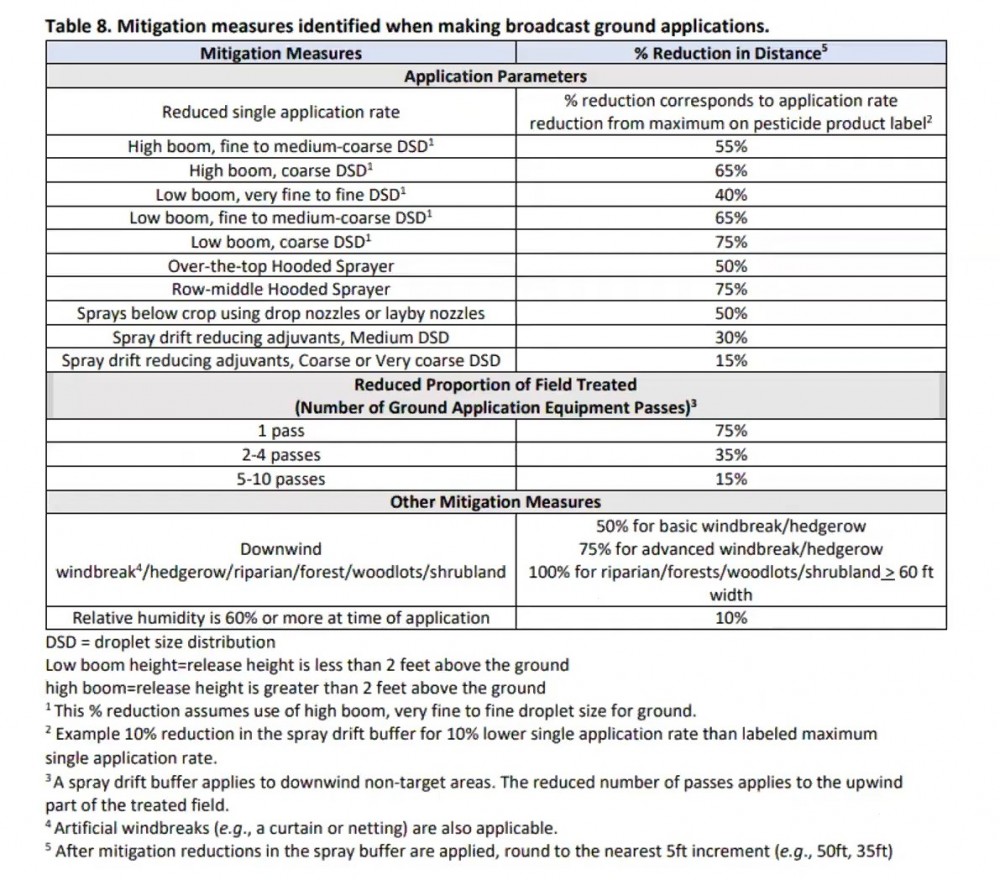
For spray drift, mitigation strategy is represented by buffer distance needed. These buffers are downwind only, designed to protect "unmanaged areas". Managed areas outside of the treated area can be part of the spray drift buffer, such as an agricultural field, roads, CRP land, and mowed areas. There are over 15 ways to reduce buffer distances, as shown in the photo detailing options available from the EPA's herbicide strategy. These measures are additive, meaning that for each mitigation option you select, you would add the percentages together to determine how to reduce the listed spray buffer on the label.
Runoff/erosion mitigation runs on a point system from 0-9. To use a product, you will have to achieve a certain amount of points. This value will vary depending on the product being used and the crop. For example, the Liberty ULTRA label states "You must achieve a minimum of three points for the crop uses listed on this label unless otherwise stipulated below". This mitigation strategy is designed to protect listed species and critical habitat up to 1,000 feet downslope. Some areas outside of the treated area can be included in the 1,000 feet including agricultural fields, roads, gravel surfaces, field buffers, conservation reserve land, etcetera. There are about 40 ways to reduce runoff/erosion mitigations including but not limited to tillage type, slope, soil texture, cover crops, county-based relief, and reduced annual rates.
Changes to labels won't happen overnight. There are over 1,100 active ingredients that need to be reviewed, and all new products will require more intense determinations before registration. As a pesticide applicator, you have the responsibility to follow the label. Remember, the label is the law.
The following information is summarized from the webinar hosted by the Northeastern IPM Center titled "Pesticide Label Changes Brought on by the Endangered Species Act". Every effort has been made to provide correct, complete, and up-to-date recommendations. Changes occur constantly and human errors are still possible. These recommendations are not a substitute for pesticide labeling. Please read the label before applying pesticides.
Resources:
Bulletins Live! Two: https://www.epa.gov/endangered-species/bulletins-live-two-view-bulletins
EPA Mitigation Menu: https://www.epa.gov/pesticides/mitigation-menu
Field Crops
Dairy
Business

Livestock

Grains
Upcoming Events
Poultry Processing Workshop, Canandaigua, NY
September 17, 2026 : Poultry Processing Workshop - Canandaigua, NY
Canandaigua, NY
This program is one of four statewide roadshow stops across the state, offering farmers a full poultry processing experience. The class will teach skills that build confidence, reduce costs, and strengthen your farm's independence. This hands-on workshop gives farmers the chance to process a bird from start to finish, learning every step of the workflow used by small farms across the state.
Tax 101: An Introduction to Income Taxes for Farmers
September 17, 2026 : Tax 101: An Introduction to Income Taxes for Farmers
Join NY Farm Net for a FREE mid-day webinar about income tax basics for farmers. Attendees will learn what documents you need, options for recordkeeping systems, how identify common tax forms and schedules, and more!
Large Animal Awareness Training For First Responders
September 19, 2026
Dunkirk, NY
Join the Chautauqua County Technical Rescue Services and NYS Veterinarian, Dr. Kate Card-Allen, for a specialized training on how to safely and effectively respond to large animal incidents. Learn techniques for managing large animals during traffic accidents, rollovers, entrapments and other transportation emergencies.
Announcements
No announcements at this time.