
Robots show value in feed efficiency, reduced labor, by Tim Terry
Alycia Drwencke, Dairy Management Specialist
Southwest New York Dairy, Livestock and Field Crops Program
Robots show value in feed efficiency, reduced labor by Tim Terry
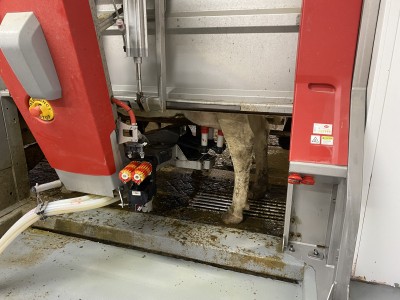
Evaluating Robotics: Consistently feeding and milking in a robotic system can improve cow performance.
I was recently invited to participate in a robotic farming discussion group.
The evening began with a few presentations by a robot manufacture that, surprisingly, were less about sales and more about start-up and management of the systems and the cows.
These proved to be good fodder for a useful discussion amongst the technical service people, dairy farmers and other industry people in attendance, including myself.
The next day, we visited three farms currently using robotic milking systems — two in the Finger Lakes and one in western New York. Both the discussion and the tour brought to light some interesting concepts regarding robotic milking systems.
I managed to glean several pages of notes on these concepts, and in the next couple of weeks I'll try to distill them down into something more manageable to take home.
The three areas where robotic milking systems can have the greatest affects are in feeding, cow management and labor:
Feeding
In any group situation, some cows are underfed and some are overfed. In either case this is very inefficient, both economically and energetically.
The partial mixed ration (PMR) and the grain through the robot allow you to customize the diet to each cow, which can increase feed efficiency. The general rule of thumb for formulating the PMR is herd or group production average minus 15 pounds of milk.
Balance the remainder of the individual requirements with the grain in the robot. This prevents over- or under-feeding but still gives the lower producers in the group some incentive to visit the robot. Some newer robots are allowing for dispensing of multiple feeds in multiple forms — liquid, mash, pellets or a combination.
Some unpublished comparisons of robotic manger sweepers vs. skid loaders or tractor have shown a 3% increase in milk yield for the robotic sweeper as well as more consistent dry matter intakes, likely a function of feed availability.
The robot also produces 75% less carbon dioxide and uses less than 10% of the energy.
I also wonder about the ancillary benefits of consistent DMI — reduced slug feeding and sub-acute rumen acidosis, butterfat drops, other things.
Cow management
The robotic milking system allows a cow's individuality to shine. The boringly consistent process of prepping and milking is just what the cow ordered. The cow spends far less time standing than in a parlor setup — when it's not eating or milking, it's lying down.
Real-time data is collected on every cow and deviations outside of "normal" are flagged for review. As such, symptoms of illness are detected earlier, and treatment regimens are often shorter and more effective.
Labor
On average, changing from a parlor to a robot results in a 40% reduction in labor devoted to milking. This gives you the option of reducing the labor force, reassigning the labor to another enterprise or increasing the herd size without increasing the labor force.
Moreover, you can spend more of your time managing cows and less time on rote labor tasks.
With the advent of a higher minimum wage and overtime pay on farms in New York state, a robotic milking system will have a payback of five to seven years based on labor costs alone.
Furthermore, a robotic system never shows up late, tired or drunk, and it never misses a day of work.
Farmers I talked to on the tour said that one of the main reasons they went with robots was labor costs and the transient, unpredictable labor force on farms. On more than one occasion the farmers had to deal with a sudden workforce reduction due to an ICE raid in the neighborhood.
Cost of ownership
Of the three main milking systems — parlor, pipeline or robotic milking systems — robots tend to have the lowest total cost of ownership. Some of this may be a function of the self-diagnostics in the RMS programming. Robots will alert you to service issues before they become much more expensive to fix. Add to this any lost production due to delays or poor performance.
Robots in sand-bedded herds do require more repairs and maintenance than sawdust or straw-bedded herds due to sand's abrasive nature. However, this only amounts to an average of $250 per system per year.
If the system is servicing 55 to 60 cows and milk is $15 per cwt, this only requires a 0.1 pound per cow per day increase to break even. Many herds have seen an 8- to 10-pound increase after switching to sand.
The better the stalls are maintained and the more comfortable it is, the fewer fetch cows you'll have. We don't know why this is true, but it is what's happening out there.
Terry is a farm planning specialist with Cornell Extension's Harvest NY program.
Field Crops
Dairy
Business
Livestock

Grains
Upcoming Events
Poultry Processing Workshop, Canandaigua, NY
September 17, 2026 : Poultry Processing Workshop - Canandaigua, NY
Canandaigua, NY
This program is one of four statewide roadshow stops across the state, offering farmers a full poultry processing experience. The class will teach skills that build confidence, reduce costs, and strengthen your farm's independence. This hands-on workshop gives farmers the chance to process a bird from start to finish, learning every step of the workflow used by small farms across the state.
Tax 101: An Introduction to Income Taxes for Farmers
September 17, 2026 : Tax 101: An Introduction to Income Taxes for Farmers
Join NY Farm Net for a FREE mid-day webinar about income tax basics for farmers. Attendees will learn what documents you need, options for recordkeeping systems, how identify common tax forms and schedules, and more!
Large Animal Awareness Training For First Responders
September 19, 2026
Dunkirk, NY
Join the Chautauqua County Technical Rescue Services and NYS Veterinarian, Dr. Kate Card-Allen, for a specialized training on how to safely and effectively respond to large animal incidents. Learn techniques for managing large animals during traffic accidents, rollovers, entrapments and other transportation emergencies.
Announcements
No announcements at this time.