
Learn From Your Silage Harvest
By Joe Lawrence: PRO-DAIRY
The number of moving parts and pressure to get everything correct during corn silage harvest can be daunting. It is worthy to recognize that the harvest season is a valuable learning and planning opportunity. Documenting crop progress and challenges throughout the season is a good practice, but information collected during the harvest of the single most utilized ingredient in many dairy rations can be particularly valuable.
There are numerous resources — from seed selection and plant nutrition to pest management — for growing a good corn crop. Late-season evaluation of these factors is critical to an accurate analysis of what worked well and what needs more attention.
Particularly in the era of pest resistance challenges, end-of-season scouting and documentation of pest damage are critical to informing crop rotation, trait selection, and pest management plans for next season. Whether it is goosenecked corn in a field planted with a hybrid containing a Bacillus thuringiensis (Bt) protein for corn rootworm or a concerning patch of an unfamiliar weed, it is critical to stay on top of potential pest control breakdowns.
Corn rootworm damage can be confirmed by checking roots, and if observed, review hybrid trait packages, crop rotation, and documented resistance in your area. Trait information can be obtained from your seed supplier or the "Handy Bt Trait Table" (https://bit.ly/HFG-traits), which provides an overview of all traits and notes those with known resistance challenges.
Many weeds found in cornfields are prolific seed producers, and a small breakthrough of an herbicide-tolerant weed can quickly turn into field- and farm-wide challenges. If this is noticed, immediately acquire a proper identification of the weed and review your spray program. If a breakthrough is suspected, check with an extension weed specialist on known resistance cases in the area and evaluate your next steps.
Harvest is also a good time to assess your plant nutrition program. It is often difficult to pinpoint the cause of underperforming fields, but too often, resources are wasted on extra fertilizer when the real culprit may have been weather, soil compaction, or a pest. Any opportunities to parse this out are enhanced with late-season documentation to accurately connect the dots between how the fertility program was implemented and the outcomes.
Quality counts
Beyond the focus of growing a good corn crop, the importance in dairy diets has created an immense interest in gaining a better understanding of what factors most influence corn silage's nutritional value. When considering the various metrics that make corn silage a valuable feed ingredient, each is impacted by the growing environment and production decisions to varying degrees. While there is still more to learn in this area of research, applying current knowledge and collecting farm-specific information are both valuable to optimizing the utilization of this feedstuff.
As the industry continues to study specific mechanisms responsible for differences in forage nutritional value, certain trends are becoming clear. The New York and Vermont Corn Silage Hybrid Evaluation Program has added to this body of evidence. It has shown that when corn is grown following best agronomic practices, differences in growing environment (precipitation, heat, and soil characteristics) between locations result in greater differences in crop performance than the impact of agronomic inputs and management within a location.
A two-year study by Cornell, the University of Vermont, and Penn State University evaluated a common set of hybrids grown at multiple locations across the three states to assess differences in yield, fiber digestibility, and starch content. For these parameters, the difference in measured values were three to four times greater between locations than between hybrids at the same location. For example, neutral detergent fiber digestibility at 30 hours (NDFD30) varied seven to eight points between locations, while the greatest range in values between different hybrids at the same location was only two points.
A machine-learning exercise, utilizing seven years of Cornell hybrid evaluation program data, examined factors with the greatest influence on several key forage metrics. Seasonal precipitation and year/location were the common factors of greatest influence for overall yield, starch content, fiber digestibility, and crude protein content.
In rainfed cropping systems, there is little that can be done to influence the growing environment; however, understanding the impact can refine decision-making. For example, seasons with high precipitation are associated with lower fiber digestibility. When experiencing a higher precipitation growing season compared to previous crop year, lower fiber digestibility would be expected in the new crop. With this information, begin discussions with the farm team regarding how this new crop will affect the ration and feeding program.
Moreover, this information provides valuable insight into hybrid selection. Public data sources, such as land-grant university hybrid trials, along with seed company data, provide a benchmark for nutritional metrics to calibrate expectations for the growing season. Understanding if the average corn silage in each season had exceptionally high or low fiber digestibility helps determine if the data presented on a given hybrid represents average performance or a hybrid that really stood out relative to the growing season.
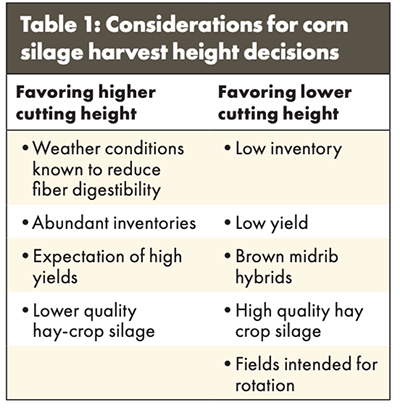
Several studies have evaluated the impact of chop height on corn silage. While the magnitude of the impact varies by study, the overall conclusion is chopping corn silage higher results in less yield, but higher fiber digestibility and starch content. Considering this information in the context of the current growing season can help you refine your harvest strategy (see Table 1). In the event of a wet growing season, we might expect average to above average yields with lower fiber digestibility. Coupling this outlook with adequate feed inventory would suggest that a higher cutting height could help offset the effects of the wet season.
Take notes and samples
With the recognition that growing environment plays a significant role in the nutritional value of corn silage, it can still be beneficial to track trends at the farm level. Understanding the influence of field level interactions (hybrid, population, agronomic inputs, soil characteristics, and chop height) allows a farm to evaluate the suitability of a specific hybrid under certain practices or micro-climates.
In addition to note-taking, collecting field-specific fresh samples during harvest is a valuable tool for evaluation and decision-making. Collecting this data for one season is often not sufficient to determine if changes are warranted to impact the nutritional content of the forage; however, accumulating data over several years can help identify trends.
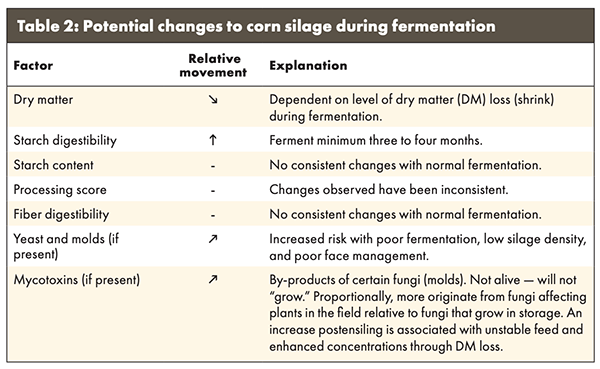
Fresh-chopped samples are also a useful way to begin strategizing for feedout. Except for starch digestibility, which improves with fermentation, there are few significant changes that take place during storage. Table 2 provides general trends and considerations for key silage metrics.
While samples of the fermented silage should be used for final ration formulation, pairing green sample data with the location of the silage in storage is valuable for determining which feed should be used for a specific group of animals and noting any changes to other ingredients in the ration that may be needed with each silage.
A successful harvest season requires planning and assuring each member of the team understands their role. Identifying a member of the harvest team to record observations, monitor chopping performance, and collect samples can significantly enhance your ability to manage the crop during feedout, begin strategizing for next season, and help to understand long-term trends.
Field Crops
Dairy
Business
Livestock
Grains
Upcoming Events
Livestock Production Field Day
August 29, 2026 : Livestock Production Field Day
Chaffee, NY and East Aurora, NY,
Join us on visits to Horizon Ridge Farm in East Aurora and Troll Bridge Farm in Chaffee for an introduction to small beef and small diversified livestock enterprises. Through walking farm tours, attendees will learn about management, meat processing, setting prices, and finding local markets. Dinner will be provided. Register by contacting Amy Barkley at amb544@cornell.edu or 716-640-0844.
Large Animal Awareness Training For First Responders
September 19, 2026
Dunkirk, NY
Join the Chautauqua County Technical Rescue Services and NYS Veterinarian, Dr. Kate Card-Allen, for a specialized training on how to safely and effectively respond to large animal incidents. Learn techniques for managing large animals during traffic accidents, rollovers, entrapments and other transportation emergencies.
Cows, Crops & Critters - Southwest New York Dairy, Livestock & Field Crops Newsletter Sponsorship
December 18, 2026
Our two forms of publications feature research-based and timely information from our four specialists, listed to the right, along with local event notifications and Cornell University outreach. This information is provided to participants who range from dairy, livestock, and field crops producers to agricultural suppliers and consultants.
Weekly Email Update: Shared with 625+ households who have signed up with our program.
Monthly Paper Mailer: To reach our stakeholders and farmers who lack internet access, we send out a monthly mailer where your company's logo and contact information would be featured with a mailing list of 330+ households.
If you sponsor our weekly and monthly publications you reach approximately 955 households.
Visit our website to view our newsletters!
Announcements
No announcements at this time.