
It is Time to Check the Planter
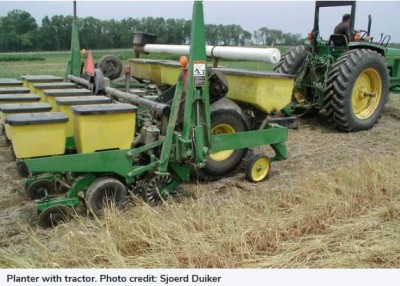
By Sjoerd Willem Duiker; Penn State Extension
Planter maintenance is critical because delayed planting caused by breakdowns can result in significant yield penalties. And even if it works, poor stands are the result if a planter is in poor condition.
Planter maintenance is especially crucial in no-till. A no-till planter has to be able to plant through heavy crop residue, penetrate firm soil, open a perfect 'V' slot, place singulated seeds at equal distances and at uniform depth, close the seed slot so seeds have proper seed-to-soil contact, not cause side-wall compaction, and not excessively compact soil on top of the seed. All these things while driving 4-6 miles per hour, dropping 10-20 seeds per second. Suboptimal planter performance results in irregular seed depth, seeds at the soil surface, open seed slots, compacted soil on top of the seeds, hairpinning, sidewall compaction, and skips, doubles and triples.
To avoid planting problems, first check that your equipment is working properly. Then, regularly check planter performance in the field and adjust settings for soil conditions at planting time. Here follows a checklist for winter planter maintenance:
- Meters. Dysfunctional metering units result in skips, doubles and triples. To guarantee optimal performance, take metering units apart every winter. Remove dirt and clean the hood with soapy water (no kerosene, diesel or oil should ever be used in metering units!). Replace cracked plastic covers. Replace broken fingers in a finger-pickup meter. Use a feeler gauge to check tension on the fingers, then tighten them correctly. Check back plate and seed brushes for wear, and replace as needed. The belt (in finger pick-up meters) should be flexible, have no cracks, and should be clean. Clean with soapy water and let it dry before replacing. When putting the metering unit back together, make sure the rubber belt is placed in the right direction. You can lubricate with graphite (NO OIL or WD-40). It is recommended to take your finger pick-up metering unit to a dealer to have it calibrated every 100-150 acres or at least every 3-4 years. Take a bag of your own seed with you and give the correct speed at which you'll be driving. If you have a vacuum or air meter, check that vacuum or air pressure is correct, check for leaks and wear on knock-off brushes and repair/replace as needed.
- Planter Unit. Accurate depth placement can be compromised if planter units are loose or wobbly. You should not be able to easily lift up a planter unit or move it sideways. Look across your planter units from the side with the planter parked on a level surface. Are they all at the same height? If one unit is either up or down compared to the others, it needs work. A common problem is that some bolts are loose or additional bushings are needed. You also need to replace cracked or broken seed hoppers.
- Seed opener disks. Seed opener disks need to have a minimum diameter (check operator manual) or they will not place the seed at the appropriate depth. Seed opener disks also need to come together in the front (they should touch for 3 inches for old blades but only 1-1.5 inches on newer blades). Stick two business cards between the openers and move them as close together as possible to check this. If opener disks are worn too much you will get a "W" shaped seed slot instead of the desired "V" slot, and seed depth will be compromised.
- Seed tubes. The end of seed tubes may wear to the extent that they curl inwards, catching seeds. There is often a hook halfway up that can easily break off. Seed tube guards need to have their minimum width and be fastened correctly, or damage to the seed tube is likely. Clean seed sensors if you have them.
- Seed firmers.These help to press the seed down in the furrow, guaranteeing more accurate depth placement of the seeds. The tension can be adjusted with a bolt. If the seed firmers are worn too much they need to be replaced. If equipped with popup fertilizer - make sure the tubes are intact and clean.
- Depth wheels. Depth wheels should run tight against disks. Change washers from in- to outside (or vice versa) of depth wheel if necessary. If this doesn't resolve the problem, the depth wheel arm needs to be replaced.
- Coulters. Check the diameter of the coulters, and replace them if needed. You should adjust the depth setting of worn coulters that are still usable.
- Row cleaners. Check for wear. Adjust to compensate for wear, or replace if worn too much.
- Closing wheels. Closing wheels need to have an intact spring that needs to be checked for damage or wear. Bearings cannot be wobbly or too tight. The bottoms of rubber or cast iron closing wheels need to be 1.5"-2" apart. The closing wheel arm cannot have too much play. If so, bushings or the entire arm may need replaced.
- Alignment of coulters, opener disks, and closing wheels. Take a rope and pull it straight from the front coulter to the closing wheels. The firming wheels, seed openers, and coulters should all be in line. Closing wheels should not run on top of the seed furrow. Make sure alignment also holds on side slopes.
- Insecticide boxes. The insecticide boxes should have no holes or cracks. Tubes should be blown out with air as well as the slot on bottom of meter.
- Fertilizer unit. Fertilizer opener disks should have a minimum diameter (check manual). The bearings should not be wobbly or too tight. Hang a bucket below the tube of the unit, and do a test run of 175 feet in the field. Weigh the fertilizer in the bucket, multiply by 100, and you have the fertilizer you'll put on in pounds per acre (at 30" row spacing). Adjust as needed.
- Chains and sprockets. Check all chains and their sprockets. If they are worn or chain links are stiff, they need to be replaced. Chains need to have the appropriate tension and should be lubricated properly. Chain tighteners should not push the chain sideways - if so worn bushings in the tightener pivot may need to be replaced.
- Tire pressure. Inflate tires to correct pressure.
- Clean electrical connections. Use compressed air (not water) to keep moisture away from the wires.
- Store planter in a dry place to protect against rodents. Make sure no grain is left in the planter, and store it so that rodents cannot climb into it. They often chew on wires and tubes.

Field Crops
Dairy
Business

Livestock

Grains
Upcoming Events
Livestock Production Field Day
August 29, 2026 : Livestock Production Field Day
Chaffee, NY and East Aurora, NY,
Join us on visits to Horizon Ridge Farm in East Aurora and Troll Bridge Farm in Chaffee for an introduction to small beef and small diversified livestock enterprises. Through walking farm tours, attendees will learn about management, meat processing, setting prices, and finding local markets. Dinner will be provided. Register by contacting Amy Barkley at amb544@cornell.edu or 716-640-0844.
Large Animal Awareness Training For First Responders
September 19, 2026
Dunkirk, NY
Join the Chautauqua County Technical Rescue Services and NYS Veterinarian, Dr. Kate Card-Allen, for a specialized training on how to safely and effectively respond to large animal incidents. Learn techniques for managing large animals during traffic accidents, rollovers, entrapments and other transportation emergencies.
Cows, Crops & Critters - Southwest New York Dairy, Livestock & Field Crops Newsletter Sponsorship
December 18, 2026
Our two forms of publications feature research-based and timely information from our four specialists, listed to the right, along with local event notifications and Cornell University outreach. This information is provided to participants who range from dairy, livestock, and field crops producers to agricultural suppliers and consultants.
Weekly Email Update: Shared with 625+ households who have signed up with our program.
Monthly Paper Mailer: To reach our stakeholders and farmers who lack internet access, we send out a monthly mailer where your company's logo and contact information would be featured with a mailing list of 330+ households.
If you sponsor our weekly and monthly publications you reach approximately 955 households.
Visit our website to view our newsletters!
Announcements
No announcements at this time.