
Winter Wheat Fields Are Greening Up
By D. Carrijo and D. Lingenfelter; Penn State Extension
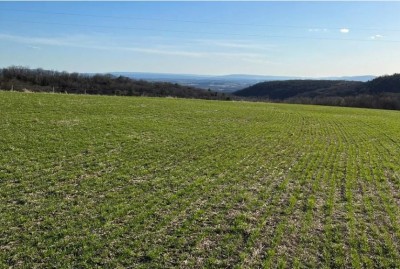
Spring green up. What does that mean?Spring green up is an important time for assessing and managing winter wheat. Green up is not a growth stage per se, but it is a literal reference to how the field looks a darker green color at the end of the tillering phase and as the weather warms up in the spring and plants come out of dormancy. In PA, fields usually get this appearance when plants are at Feekes 4, which is the growth stage at which the leaf sheaths begin to lengthen, and plants become less prostate and more upright. However, the growth stage at green-up will depend on planting date and weather conditions, so it is important to scout the field for accurate growth staging.
Why is green up important?As the plants are coming out of dormancy, this is a time of fast growth and requires timely management decisions.
What to look for:1) Growth stage:
This guide from the University of Wisconsin is an excellent resource for staging fields. Pay attention to fields at the Feekes 5 stage (developing head is located just above the crown and is less than 1/8" long). This is the last stage that some herbicides can be used without causing leaf injury. Further, after this stage the developing head moves above the soil surface and yield potential is decreased by wheel traffic damage.
2) Winter survival and yield potential:
Winter survival can be assessed by digging up plants from the field and looking for root regrowth (bag test, Figure 1). See how to do a bag test at the end of this article. If winter survival was less than excepted, a further stand count may be helpful to determine yield potential. See this video explaining how to perform a stand count. Yield potential of winter wheat is decreased when the number of (alive) plants fall below 20-25 plants per square foot. These numbers are based on an average of 3 heads per plant. Therefore, it is also important to look at the condition of the tillers. For example, even if there are 20-25 (alive) plants per square foot, but plants have less than 3 healthy looking (usually with 3 or more leaves) tillers, yield potential will likely be decreased. Note: it is critical to perform these assessments related to winter survival at green-up. If these assessments are made earlier when the weather is still cold, yield potential will likely be underestimated.

Figure 1. New roots growing after 2 days in the bag test.
Management decisions:1) Nitrogen fertilizer:
Spring green up is an important time for N application, because it precedes an increase in N uptake. For fields that reached the green-up phase at Feekes 3 (e.g., fields planted early in the fall), split applications between Feekes 3 and 5 may reduce N losses in wet springs. The optimum N rate at green-up is specific to each field and year, but a general rule of thumb based on PA research is to apply 1 lb of N per bushel of expected yield. For fields with heavy manure history, taking leaf samples for measuring N concentration can inform whether an additional N application is needed (see Table 1 in this article).
2) Herbicides:
As wheat approaches the stem elongation and jointing growth stage, be cautious of certain herbicide applications. Once wheat has passed Feekes 6 (i.e., when the first node of stem is visible), the risk of herbicide injury from 2,4-D, MCPA, Clarity/dicamba, or Curtail increases and application of these herbicides is not recommended. In this situation, the remaining herbicide options for broadleaf weed control are Harmony Extra (similar products: Edition, Treaty Extra, Nimble, others), Harmony SG (similar products: Treaty, Harass, Volta), and Finesse can be applied to wheat until the flag leaf is visible (before Feekes 8). While Maestro, Huskie, Stinger and Starane can be applied to wheat up to boot stage (before Feekes 9). Refer to wheat growth stage graphic (Figure 2.5-1, pg. 465) from the 2023-24 Penn State Agronomy Guide for more details.
Each spring there are questions about the risks associated with 2,4-D or MCPA application to wheat past Feekes 6. Wheat tolerance of 2,4-D is highest between Feekes 3 and 6 and is lowest in Feekes 9 and 10. Between stages 6 and 9, sensitivity to 2,4-D gradually increases as wheat growth stage advances. Thus, the risk of injury increases as wheat growth stage advances between stages 6 and 9. Severe injury is highly probable when 2,4-D is applied at Feekes 9 and 10. In most cases, herbicide injury can set back growth of the crop and potentially cause reduced yields since the crop can't recover in a timely manner.
It is recommended that the application of 2,4-D to wheat be made after wheat has reached Feekes 3 but prior to Feekes 6. If growers choose to apply 2,4-D at later stages, they need to understand the associated risk. This risk can be minimized by applying the amine form of 2,4-D or reducing the rate of a 2,4-D ester. A much better alternative on wheat past Feekes 6 is to use another broadleaf herbicide with a wider application window that is effective on the weeds present in the field.
3) Tank mixing liquid N with herbicides:
Liquid urea-ammonium nitrate fertilizer (UAN) is a common spray solution carrier for herbicides in wheat in our region. We typically recommend no more than a 50:50 water/UAN ratio. The most common herbicide used in this manner is 2,4-D ester at 1 pint/A (2,4-D amine is difficult to mix in UAN). Application of herbicide in liquid nitrogen can cause leaf burn from the nitrogen, especially under hot, humid conditions; and the addition of other herbicides or fungicides to these mixtures will likely increase the risk for crop injury. This risk increases with later wheat growth stages because more leaf area is exposed to the treatment and recovery time is shorter. Applications of 2,4-D should be made in the spring to actively growing wheat following tillering (Feekes 3) but prior to jointing (Feekes 6). To minimize this risk:
- Do not apply more than 20 lbs of nitrogen per acre in the form of UAN when using a surfactant with herbicide.
- Do not apply more than 40 lbs of nitrogen per acre in the form of UAN when no surfactant is used.
- Avoid high-temperature, high-humidity days. Late afternoon applications carry less risk of leaf burn.
4) Plant growth regulators:
The application window for some plant growth regulators may coincide or follow the green up phase. For example, the window for Palisade EC (trinexapac-ethyl) application on wheat is Feekes 4 -7.
Field Crops
Dairy
Business
Livestock
Grains
Upcoming Events
Livestock Production Field Day
August 29, 2026 : Livestock Production Field Day
Chaffee, NY and East Aurora, NY,
Join us on visits to Horizon Ridge Farm in East Aurora and Troll Bridge Farm in Chaffee for an introduction to small beef and small diversified livestock enterprises. Through walking farm tours, attendees will learn about management, meat processing, setting prices, and finding local markets. Dinner will be provided. Register by contacting Amy Barkley at amb544@cornell.edu or 716-640-0844.
Large Animal Awareness Training For First Responders
September 19, 2026
Dunkirk, NY
Join the Chautauqua County Technical Rescue Services and NYS Veterinarian, Dr. Kate Card-Allen, for a specialized training on how to safely and effectively respond to large animal incidents. Learn techniques for managing large animals during traffic accidents, rollovers, entrapments and other transportation emergencies.
Cows, Crops & Critters - Southwest New York Dairy, Livestock & Field Crops Newsletter Sponsorship
December 18, 2026
Our two forms of publications feature research-based and timely information from our four specialists, listed to the right, along with local event notifications and Cornell University outreach. This information is provided to participants who range from dairy, livestock, and field crops producers to agricultural suppliers and consultants.
Weekly Email Update: Shared with 625+ households who have signed up with our program.
Monthly Paper Mailer: To reach our stakeholders and farmers who lack internet access, we send out a monthly mailer where your company's logo and contact information would be featured with a mailing list of 330+ households.
If you sponsor our weekly and monthly publications you reach approximately 955 households.
Visit our website to view our newsletters!
Announcements
No announcements at this time.