
Selection for Calving Ease
Amy Barkley, Team Leader & Livestock Specialist
Southwest New York Dairy, Livestock and Field Crops Program
Selection for Calving Ease
Mark Z. Johnson, Oklahoma State University Extension Beef Cattle Breeding Specialist
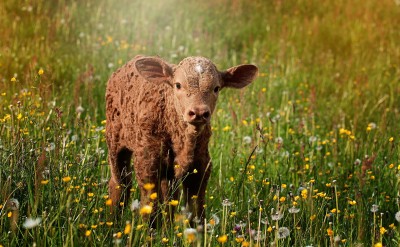
With bull turnout and breeding season in mind, we continue to discuss considerations about the bulls we'll be turning out. Specifically, selection for calving ease. If we intend to breed a set of heifers this spring, calving ease becomes an economically important trait in our next calf crop. Dystocia (calving difficulty, typically caused by a large or awkwardly positioned fetus) is far more likely to occur in first calf heifers and typically not a significant issue in mature beef cows. With no dystocia, calf death loss within 24 hours of birth is less than 5% but this percentage can increase by as much as 2 - 4 times if calving assistance is required. Heifers that calve unassisted do a better job of raising that calf, have shorter rebreeding intervals and calf earlier the following year. Obviously, we would like to avoid calving difficulty and if we have identified it as a priority, several selection tools are available.
First, sire selection is critical. Over time, 90% of genetic change is a result of sire selection because bulls sire more calves in a breeding season than a cow will produce in her lifetime. Effective sire selection should be based on EPDs resulting from genetic prediction. Selection based on EPDs is 7 - 9 times more effective than selection based on weights or within herd ratios alone. EPDs are more effective because they are calculated based on individual weights, within herd ratios, pedigree relationship and the performance of all relatives, as well as DNA.
So when calving ease is important consider the following EPDs: Calving Ease Direct (CED), is expressed as a difference in percentage of unassisted births, with a higher value indicating greater calving ease in first-calf heifers. It predicts the average difference in ease with which a sire's calves will be born when he is bred to first-calf heifers. Example: - Bull A has CED of 5 - Bull B has a CED of 16 If we mate both bulls to a set of virgin replacement heifers, we are 11% less likely to pull a calf sired by bull B Birth Weight EPD (BW), expressed in pounds, is a predictor of a sire's ability to transmit birth weight to his progeny compared to that of other sires. Example: - Bull C has a Birth Weight EPD of -0.7 - Bull D has a Birth Weight EPD of 3.3 Calves sired by bull C will weigh 4 lbs. less at birth, on average
If you will be keeping replacement heifers sired by bulls you'll be turning out this year, consider:
Calving Ease Maternal (CEM), is expressed as a difference in percentage of unassisted births with a higher value indicating greater calving ease in first-calf daughters. It predicts the average ease with which a sire's daughters will calve as first-calf heifers when compared to daughters of other sires. Because it is a trait expressed when the bull's daughters are having their first calves it is a "next generation" maternal predictor. Example - Bull E has a CEM of 8 - Bull F has a CEM of 13
If we are calving out the daughters of both bulls which are mated to the same sire, we are 5 % less likely to pull a calf from one of bull F's daughters
Bottom line: Selection of genetically superior sires is the fastest approach to herd improvement and profitability. Genetic improvement is cumulative and permanent. Investing in improved genetics now will pay dividends for generations to come.
To view Dr. Johnson's segment on Sunup TV Cow-Calf Corner from March 13, 2021 on using EPDs for bull selection to improve your herd: Cow-Calf Corner - EPDs 3/13/21 — SUNUP TV (okstate.edu)
To receive "Cow/Calf Corner", contact email Paul Beck (paul.beck@okstate) or Derrell Peel (derrell.peel@okstate.edu) to get added to our email list.
Field Crops
Dairy
Business
Livestock
Grains
Upcoming Events
Livestock Production Field Day
August 29, 2026 : Livestock Production Field Day
Chaffee, NY and East Aurora, NY,
Join us on visits to Horizon Ridge Farm in East Aurora and Troll Bridge Farm in Chaffee for an introduction to small beef and small diversified livestock enterprises. Through walking farm tours, attendees will learn about management, meat processing, setting prices, and finding local markets. Dinner will be provided. Register by contacting Amy Barkley at amb544@cornell.edu or 716-640-0844.
Large Animal Awareness Training For First Responders
September 19, 2026
Dunkirk, NY
Join the Chautauqua County Technical Rescue Services and NYS Veterinarian, Dr. Kate Card-Allen, for a specialized training on how to safely and effectively respond to large animal incidents. Learn techniques for managing large animals during traffic accidents, rollovers, entrapments and other transportation emergencies.
Cows, Crops & Critters - Southwest New York Dairy, Livestock & Field Crops Newsletter Sponsorship
December 18, 2026
Our two forms of publications feature research-based and timely information from our four specialists, listed to the right, along with local event notifications and Cornell University outreach. This information is provided to participants who range from dairy, livestock, and field crops producers to agricultural suppliers and consultants.
Weekly Email Update: Shared with 625+ households who have signed up with our program.
Monthly Paper Mailer: To reach our stakeholders and farmers who lack internet access, we send out a monthly mailer where your company's logo and contact information would be featured with a mailing list of 330+ households.
If you sponsor our weekly and monthly publications you reach approximately 955 households.
Visit our website to view our newsletters!
Announcements
No announcements at this time.