
Who Invited Knapweed?
Katelyn Miller, Field Crops and Forage Specialist
Southwest New York Dairy, Livestock and Field Crops Program
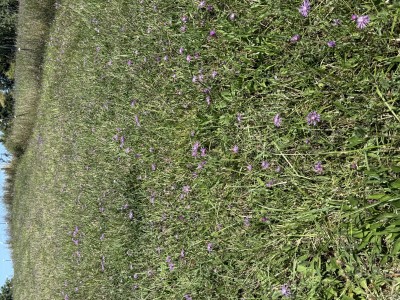
You've likely noticed this weed in your hayfields, pastures, on the roadside, or anywhere in between. Referred to as knapweed, it's an aggressive weed that spreads rapidly and reduces the quality of fresh and baled forages. But, calling it knapweed is only part of the story, as there are 21 species of knapweed present in North America. Each of these species is differentiated by their leaves, bracts, flower size and color. In New York State, we typically see spotted and brown knapweed.
In the late summer months, it easily stands out with its striking purple-pink colored flowers. Spotted knapweed is classified as a biennial to short-lived perennial, as it forms a rosette in the first year. Brown knapweed is a perennial that spreads by seed. So, what can we do about this class of weeds? This should not come as a surprise, but there is no silver bullet of control.
In the early 2000s, there was some research done at Cornell University, as well as farmer-led grants through SARE on controlling spotted knapweed in New York State. While slightly outdated, there are still some strong principles that can be applied today. Those include:
Mowing: A classic weed management strategy designed to reduce weed seed development and spread. Make a pass when flowers appear to help cut the development of seeds. Late spring and late summer mowings are more effective than late spring and mid-summer mowing.
Fertility: Weeds thrive in any conditions. Make sure your soil can support your desirable species by having enough nutrition and the appropriate pH. This will make your forage more competitive against weeds.
Grazing Pressure: Young knapweed is relatively palatable to cattle. Encourage intensive grazing and/or apply a high stocking rate early in the season. Troy Bishopp with the National Grazing Lands Coalition (AKA The Grass Whisperer) is testing this out on his own farm currently. Be sure to closely manage this style of grazing so as to not hurt the longevity of your stand.
Herbicides: Recommending herbicides is tough for this weed, in part because of labeling. Products may have one species like spotted knapweed listed, but not brown knapweed (or vice versa) or have no knapweed species listed. The label is the law, and the weed that you are spraying for MUST be listed on the label, or it is considered off-label use. A What's Cropping Up blog post showed promise for the herbicide Milestone (aminopyralid) which is a synthetic auxin/growth regulator, which are Group 4's. It's the same site-of-action as 2,4-D and Banvel/Clarity (active ingredient dicamba) but is from a different chemical family. Unfortunately, this product is not listed for use in pastures in New York State, so it's not a viable option. The study conducted suggests that our Group 4's are not likely to have strong efficacy against knapweed, at least not alone in a spray tank.
Knapweed is an aggressive weed and will spread rapidly if left unchecked. There is no silver bullet for the management of any weeds. They require an integrated approach. If you have any questions about knapweed, or other pasture weeds, contact Katelyn Miller at 716-640-2047.
Field Crops
Dairy
Business
Livestock
Grains
Upcoming Events
Poultry Processing Workshop, Canandaigua, NY
September 17, 2026 : Poultry Processing Workshop - Canandaigua, NY
Canandaigua, NY
This program is one of four statewide roadshow stops across the state, offering farmers a full poultry processing experience. The class will teach skills that build confidence, reduce costs, and strengthen your farm's independence. This hands-on workshop gives farmers the chance to process a bird from start to finish, learning every step of the workflow used by small farms across the state.
Tax 101: An Introduction to Income Taxes for Farmers
September 17, 2026 : Tax 101: An Introduction to Income Taxes for Farmers
Join NY Farm Net for a FREE mid-day webinar about income tax basics for farmers. Attendees will learn what documents you need, options for recordkeeping systems, how identify common tax forms and schedules, and more!
Large Animal Awareness Training For First Responders
September 19, 2026
Dunkirk, NY
Join the Chautauqua County Technical Rescue Services and NYS Veterinarian, Dr. Kate Card-Allen, for a specialized training on how to safely and effectively respond to large animal incidents. Learn techniques for managing large animals during traffic accidents, rollovers, entrapments and other transportation emergencies.
Announcements
No announcements at this time.