
Can Feeding Time Alter Birthing Time?
Amy Barkley, Team Leader & Livestock Specialist
Southwest New York Dairy, Livestock and Field Crops Program
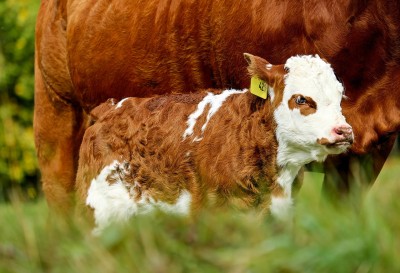
Food for Thought: Can you manage ruminant birthing schedules through targeted feeding strategies?
While lambing, kidding, and calving seasons are nearly over, your mind may still be back in the barn, fussing with animals giving birth in the wee hours on the coldest nights, and wondering "what can I do to prevent this in the future?" Dr. tatiana Stanton shares that while there are many factors that influence birthing schedules, one of the ones that we can control is when we feed our animals. Unlike cattle, which can give birth any time of day, sheep and goats tend to give birth during the times they are normally awake and not sound asleep. So, most sheep and goats give birth during the daytime naturally. But, you may be wondering: If that's the case, then why do our small ruminants give birth in the wee hours of the morning? Well, it's partly our fault.
If you're in the habit of working in the barn late at night and so you feed your sheep or goats late, they'll be more likely to give birth overnight because they are more likely to be awake. Or, if you putter around in the barn, drive equipment, or otherwise be noisy around your barn and wake the animals up, causing them to take time to eat, that could convince them to go into labor too. Interestingly, we don't see this trend in cattle. There is a negative correlation with rumen contractions and uterine contractions if they're not already in active labor, so feeding forage in the evening can inhibit overnight labor. Studies indicate this strategy works best when you restrict forage feeding to the night rather than day.
Interested in learning more? The review of the research and more can be found in, "Low Input Lambing and Kidding", found at: https://blogs.cornell.edu/goats/research/low-input-lambing-kidding/
Field Crops
Dairy
Business
Livestock
Grains
Upcoming Events
Poultry Processing Workshop, Canandaigua, NY
September 17, 2026 : Poultry Processing Workshop - Canandaigua, NY
Canandaigua, NY
This program is one of four statewide roadshow stops across the state, offering farmers a full poultry processing experience. The class will teach skills that build confidence, reduce costs, and strengthen your farm's independence. This hands-on workshop gives farmers the chance to process a bird from start to finish, learning every step of the workflow used by small farms across the state.
Tax 101: An Introduction to Income Taxes for Farmers
September 17, 2026 : Tax 101: An Introduction to Income Taxes for Farmers
Join NY Farm Net for a FREE mid-day webinar about income tax basics for farmers. Attendees will learn what documents you need, options for recordkeeping systems, how identify common tax forms and schedules, and more!
Large Animal Awareness Training For First Responders
September 19, 2026
Dunkirk, NY
Join the Chautauqua County Technical Rescue Services and NYS Veterinarian, Dr. Kate Card-Allen, for a specialized training on how to safely and effectively respond to large animal incidents. Learn techniques for managing large animals during traffic accidents, rollovers, entrapments and other transportation emergencies.
Announcements
No announcements at this time.