
Ask Extension: Can I Raise Pigs on Pasture? by Nancy Glazier
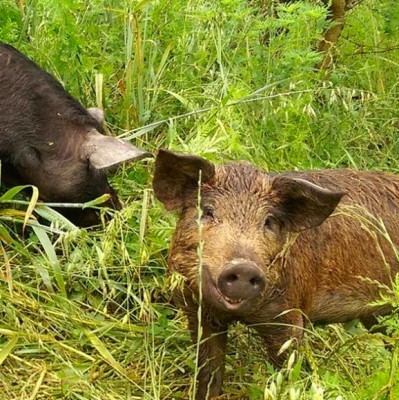
Ask Extension: Can I Raise Pigs on Pasture?
by Nancy Glazier, Livestock Specialist with the CCE NWNY Dairy, Livestock, and Field Crops Team
The answer is yes, with good management. I've had a few calls recently regarding outdoor production. I can't cover all the details in a phone call but can attempt to provide an overview in an article.
Breeds: Choose breeds that are not from commercial production lines. They won't perform well outdoors. Look for these breeds or crosses: Yorkshire (not from a production system), Large Black, Gloucestershire Old Spot, Berkshire, Tamworth, or Hampshire. There are a few other breeds that are touted as pasture breeds; some farmers have tried them and gone back to the ones listed. There are some hybrids which have been developed for pasture production. Beware of the sun with the light skinned breeds as they will sunburn.
Fence: Electric fence is most commonly used, but farmers have also used woven or welded fences. Training needs to begin early, sometimes as early as 3-5 days of age. You'll need a secure perimeter with 2 strands of polywire or tape with step in posts. One strand 6", second strand at their chin height with both electrified. You'll need a back fence to keep them off where they have grazed. They need to be kept secure so there are no escapes; pigs and cats are the top two animals that can quickly go feral!
Rotation: Pigs cannot get their full nutrition from pasture as they are simple stomached mammals, like humans. They cannot be left in the woods for the summer and be expected to survive. Anyone looking to get into outdoor production needs to be environmentally conscientious and prevent runoff and erosion. Bare ground can lead to concentrated manure/ponding areas that can lead to increased parasitism and slower growth. Pigs need to be rotated to a new paddock when 70% of the vegetation remains. Some farms will do mob grazing, moving a group to a new paddock a few times a day. As an example, the Rodale Institute in PA raises 80 pigs a year on about 7 acres of pasture. A conservative estimate is 1 lb of pig/sq ft on perennial pastures, ¼ lb. of pig/sq ft on annuals.
Pasture Plant Selection: Do you have perennial or annual plants in the pasture? A mix of legumes and grasses works well for a robust pasture and diverse nutritional profile. Annual planting mixes could consist of a small grain and a type of peas or soybeans. Some farmers will allow the pigs to root and develop wallows in an annual crop prior to reseeding. Make sure you have tillage equipment to handle ruts and rough ground.
Feed: I've read pasture can reduce concentrate feed by 15-50%. That said, it's important to reiterate that pasture is a supplement feed, not vice versa. Feed is the largest cost with feeding any livestock, and they will consume more feed when raised outdoors, and heritage breeds may be less efficient with feed conversion. Feed according to the stage of growth. Waste products, such as distillers or brewery spent grains, bakery waste, apple seconds, and vegetable scraps can be fed, but no meat! This can lead to disease transmission. NYS Ag & Markets law (Article 5 Sec. 72a) states, "…certain discarded foods are NOT considered garbage: dairy and cheese waste, including outdated foodstuffs removed from supermarkets (except meat products); outdated eggs, stale baked goods; discarded vegetables and fruit". If food waste is fed on pasture, pigs will still need some purchased feed to fill in the nutritional gaps.
Shelter: This is a key piece to outdoor production; it reduces the risk of sunburn in the summer and provides a place to keep them warm in the winter. In cold months they will need deep bedding. Hay works well since they will eat some of it, but they need lots to snuggle down in.
Water: Pigs always need a clean, constant supply of water. Use of nipple waterers works well for warmer months. Water will need to be warm in colder months.
Marketing: Remember, you are raising a premium meat product, so charge accordingly. Track your costs to have a handle on pricing. Your marketing should begin early in the process.
Field Crops
Dairy
Business
Livestock
Grains
Upcoming Events
Livestock Production Field Day
August 29, 2026 : Livestock Production Field Day
Chaffee, NY and East Aurora, NY,
Join us on visits to Horizon Ridge Farm in East Aurora and Troll Bridge Farm in Chaffee for an introduction to small beef and small diversified livestock enterprises. Through walking farm tours, attendees will learn about management, meat processing, setting prices, and finding local markets. Dinner will be provided. Register by contacting Amy Barkley at amb544@cornell.edu or 716-640-0844.
Poultry Processing Workshop, Naples, NY
September 17, 2026 : Poultry Processing Workshop - Naples, NY
Naples, NY
This program is one of four statewide roadshow stops across the state, offering farmers a full poultry processing experience. The class will teach skills that build confidence, reduce costs, and strengthen your farm's independence. This hands-on workshop gives farmers the chance to process a bird from start to finish, learning every step of the workflow used by small farms across the state.
Large Animal Awareness Training For First Responders
September 19, 2026
Dunkirk, NY
Join the Chautauqua County Technical Rescue Services and NYS Veterinarian, Dr. Kate Card-Allen, for a specialized training on how to safely and effectively respond to large animal incidents. Learn techniques for managing large animals during traffic accidents, rollovers, entrapments and other transportation emergencies.
Announcements
No announcements at this time.