
EPA Announces 2020 Dicamba Registration Decision
Joshua Putman, Field Crops and Forage Specialist
Southwest New York Dairy, Livestock and Field Crops Program
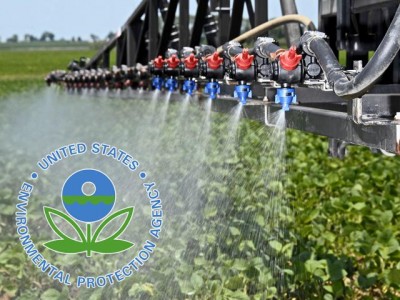
Brooklet, Ga. (October 27, 2020) — At the Cromley Farm, U.S. Environmental Protection Agency (EPA) Administrator Andrew Wheeler announced that EPA is approving new five-year registrations for two dicamba products and extending the registration of an additional dicamba product. All three registrations include new control measures to ensure these products can be used effectively while protecting the environment, including non-target plants, animals, and other crops not tolerant to dicamba.
"With today's decision, farmers now have the certainty they need to make plans for their 2021 growing season," said EPA Administrator Andrew Wheeler. "After reviewing substantial amounts of new information, conducting scientific assessments based on the best available science, and carefully considering input from stakeholders we have reached a resolution that is good for our farmers and our environment."
Through today's action, EPA approved new registrations for two "over-the-top" (OTT) dicamba products—XtendiMax with VaporGrip Technology and Engenia Herbicide—and extended the registration for an additional OTT dicamba product, Tavium Plus VaporGrip Technology. These registrations are only for use on dicamba-tolerant (DT) cotton and soybeans and will expire in 2025, providing certainty to American agriculture for the upcoming growing season and beyond.
To manage off-site movement of dicamba, EPA's 2020 registration features important control measures, including:
- Requiring an approved pH-buffering agent (also called a Volatility Reduction Agent or VRA) be tank mixed with OTT dicamba products prior to all applications to control volatility.
- Requiring a downwind buffer of 240 feet and 310 feet in areas where listed species are located.
- Prohibiting OTT application of dicamba on soybeans after June 30 and cotton after July 30.
- Simplifying the label and use directions so that growers can more easily determine when and how to properly apply dicamba.
The 2020 registration labels also provide new flexibilities for growers and states. For example, there are opportunities for growers to reduce the downwind spray buffer for soybeans through use of certain approved hooded sprayers as an alternative control method. EPA also recognizes and supports the important authority FIFRA section 24 gives the states for issuing locally appropriate regulations for pesticide use. If a state wishes to expand the federal OTT uses of dicamba to better meet special local needs, the agency will work with them to support their goals.
This action was informed by input from state regulators, grower groups, academic researchers, pesticide manufacturers, and others. EPA reviewed substantial amounts of new information and conducted assessments based on the best available science, including making Effect Determinations under the Endangered Species Act (ESA). With this information and input, EPA has concluded that these registration actions meet Federal Insecticide, Fungicide and Rodenticide Act (FIFRA) registration standards. EPA believes that these new analyses address the concerns expressed in regard to EPA's 2018 dicamba registrations in the June 2020 U.S. Court of Appeals for the Ninth Circuit. Further, EPA concluded that with the control measures now required on labels, these actions either do not affect or are not likely to adversely affect endangered or threatened species.
To view the final registration of the dicamba products, visit docket EPA-HQ-OPP-2020-0492 at www.regulations.gov.
Background
The United States is the world's leading soybean producer and second-leading soybean exporter and also serves as the world's third-largest cotton producer and the leading cotton exporter. Today, there are limited cost-effective options to control herbicide-resistant weeds affecting these commodities. In 2018, approximately 41 percent of U.S. soybean acreage was planted with dicamba-tolerant (DT) seed and almost 70 percent of U.S. cotton acreage was planted with DT seed in 2019. Relative to alternative herbicide programs, postemergence dicamba may reduce weed control costs for some growers, possibly by as much as $10 per acre, or over five percent of net operating revenue, not accounting for all measures growers will have to take to control off-field movement of dicamba.
Following reports of damage resulting from the off-site movement of dicamba, EPA amended the dicamba registration labels in 2017 and in 2018. In June 2020, the U.S. Court of Appeals for the Ninth Circuit vacated the registrations for three dicamba products: XtendiMax with VaporGrip Technology, Engenia Herbicide, and DuPont FeXapan Herbicide. As a result of the Court's decision, EPA issued cancellation orders outlining limited circumstances under which existing stocks of the three affected products could be distributed and used until July 31, 2020.
Contact Us to ask a question, provide feedback, or report a problem.

Field Crops
Dairy
Business

Livestock

Grains
Upcoming Events
Dairy Feeder School
October 29, 2026 : Dairy Feeder School
Freedom, NY
- One day on-farm training for dairy farm feeders
- Offered in English and Spanish
- Stations with hands-on activities/demos
Tax 102: Tax planning and strategies for Farmers
November 4, 2026 : Tax 102: Tax planning and strategies for Farmers
This webinar follows the "Introduction to Income Taxes" webinar from September, going more into depth on topics including: understanding common tax concepts, tax strategies, long-term approaches to managing taxes, and more!
Labor Roadshow: Practical Workforce Strategies for Agricultural Professionals Across New York
November 30, 2026
December 21, 2026
The Agricultural Workforce Development Council of New York State (AWDC) will celebrate a decade of connecting and educating agricultural professionals when Labor Roadshow X returns this December with five in-person events and two webinars across New York State.
For nearly ten years, the Labor Roadshow has brought agricultural professionals together to learn, connect, and navigate the evolving challenges of agricultural labor. The 2026 event will continue that tradition with timely, expert-led discussions focused on the issues affecting farms and agricultural employers today—including labor law and compliance, employee engagement, retention, and workplace culture.
Announcements
No announcements at this time.