
Does Fungicide Application Pay in Corn?
Katelyn Miller, Field Crops and Forage Specialist
Southwest New York Dairy, Livestock and Field Crops Program
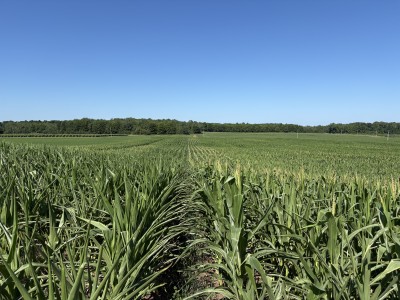
On July 21st, tar spot was identified for the first time this growing season in WNY. Last year, it was July 30th, and years previously, it was not identified until mid-August. With disease pressure appearing to arrive sooner, along with other foliar diseases like northern corn leaf blight and gray leaf spot, the question remains: Does it pay to spray a fungicide?
The goal of a fungicide application is to protect the ear leaf and the leaves above it, which are most critical to grain production. Based on research from a variety of universities (Michigan, Purdue, etc.) the best time to apply fungicides to protect against disease pressure is between tasseling (VT) and milk (R3) stages. While the research shows that this is the most effective time to spray, it doesn't mean the decision to do so is economically justified. There are a variety of factors that impact ROI on a fungicide application.
Planting Date
Much like last year, our planting dates were quite extended, and our later planted fields could be at risk for increased disease pressure. Research out of Iowa State University (ISU) has shown that corn planted in mid-May has more severe pressure from diseases than corn planted in mid-April.
Historic Disease Pressure
We can't discuss diseases and forget about our disease triangle: host, environment, and pathogen. For a disease to infect a host crop, all three pieces have to be present. If we are referencing tar spot specifically, we have the host (corn) in spades, and the disease is classified as endemic to WNY, meaning that we have the spores present locally that can infect our crop. The biggest question is will the weather conditions be ideal for disease development. We have to consider other weather patterns in this too, such as large storms. Wind currents can move pathogens as well, as is the conversation with southern rust, which hasn't made its way to NY yet technically, but could under the right conditions.
Equipment Accessibility
Equipment access is one of the largest hiccups, in my opinion, to fungicide adoption here in SWNY. There is limited access to tall-boys, and while crop dusters are available for hire, many of our fields are too small and/or are in too populated of areas to justify. This is one of the reasons why drone spraying has taken off in many circles with multiple startups here in WNY.
Disease Resistance & Seed Treatments
Genetic resistance is designed to curtail disease, not eliminate it entirely. Many hybrids have moderate resistance to common leaf diseases, which is often sufficient in years with lower disease pressure. Susceptible hybrids should be monitored for disease symptoms before making a fungicide decision. Most corn seeds also come with fungicide seed treatment. While these protect the seedling from possible fungal issues, they will not have extended protection into later vegetative and reproductive stages.
Application Cost & Crop Value
All products and their associated costs are not equal. You need to, at minimum, cover applications costs with the associated yield response of applying the product. The more expensive the product, the bigger the yield response needs to be to justify it. Overall yield potential also plays a role, as poorer stands (ie population concerns, weather, compaction) have lower potential and are less likely to pay.
In Indiana, fungicide trials for tar spot have shown both healthy gains and losses depending on disease severity. Under high severity, yield responses ranged from 0.1 bu/A to 20.7 bu/A and returns of $11.9 loss to $83.9/A gain. Under low severity, yield responses ranged from -7.5 bu/A to 1.3 bu/A and returns of $46.5 loss to a $5.8/A loss.
As per the Western NY Energy, October 2026 corn futures are sitting at approximately $4.80 as of July 28th. It goes without saying that the amount of yield you need to get at $5 corn looks different than $7 corn. The Crop Protection Network (CPN) has a fungicide ROI calculator that can be used to help make a fungicide decision based on market prices, input costs, and production outcomes that you may find useful: https://cropprotectionnetwork.org/roi-calculators.
With our first reports of foliar diseases coming in this season, some of you may be considering making a fungicide application to protect yield. Making this decision, however, is not a clear go or no go, and depends on a variety of factors.
Resources:
https://www.farmprogress.com/management/yes-you-can-lose-money-applying-a-fungicide
https://wnyenergy.com/corn-bids/
Field Crops
Dairy
Business

Livestock
Grains
Upcoming Events
Dairy Feeder School
October 29, 2026 : Dairy Feeder School
Freedom, NY
- One day on-farm training for dairy farm feeders
- Offered in English and Spanish
- Stations with hands-on activities/demos
Tax 102: Tax planning and strategies for Farmers
November 4, 2026 : Tax 102: Tax planning and strategies for Farmers
This webinar follows the "Introduction to Income Taxes" webinar from September, going more into depth on topics including: understanding common tax concepts, tax strategies, long-term approaches to managing taxes, and more!
Labor Roadshow: Practical Workforce Strategies for Agricultural Professionals Across New York
November 30, 2026
December 21, 2026
The Agricultural Workforce Development Council of New York State (AWDC) will celebrate a decade of connecting and educating agricultural professionals when Labor Roadshow X returns this December with five in-person events and two webinars across New York State.
For nearly ten years, the Labor Roadshow has brought agricultural professionals together to learn, connect, and navigate the evolving challenges of agricultural labor. The 2026 event will continue that tradition with timely, expert-led discussions focused on the issues affecting farms and agricultural employers today—including labor law and compliance, employee engagement, retention, and workplace culture.
Announcements
No announcements at this time.