
Don't Become a Statistic: Grain Bin Safety Tips
By Kristina TeBockhorst: Iowa State Extension
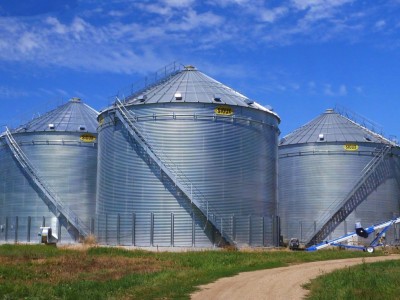
Many across the US have set aside February 20-26 as Grain Bin Safety Week in order to grow awareness of the hazards associated with grain storage. Many of the ways to increase safety when working and living around grain storage involve basic safety practices, but more education and enforcement is needed on the farm.
Over two-thirds of US grain is stored on the farm without OSHA standards for safety protocols. It is up to you to keep yourself, your employees, your spouse, kids, and grandkids safe from grain bin hazards.
Flowing grain can trap someone standing on the grain in just 4 to 5 seconds and that person will be completely covered in grain in about 22 seconds, according to the Grain Handling Safety Coalition.
There were over 35 reported entrapment incidents in the US in 2020 and 20 of them were fatal, based on a report by Purdue University. Also based on Purdue's report, the average age of grain entrapment victims is 58, however, youth under the age 21 have accounted for 20% of annual cases in the past. Parents and employers should take responsibility for keeping youth safe from grain bin incidents by educating them on grain bin hazards and by assigning safe and appropriate tasks.
The most dangerous scenarios around stored grain involve flowing grain, bridged grain, and vertical grain walls.
- Flowing grain accounts for the majority of the grain engulfment incidents and has become more dangerous as newer grain unloading equipment unloads at faster rates. When grain is unloaded from below, such as in grain bins, grain piles, trucks, and even grain wagons, anyone standing on the grain can be pulled down toward the outlet and are often stuck faster than they can react.
- Bridged grain occurs when a crust or clumps of spoiled grain forms on top of the grain and grain is removed, leaving a void space below the crust. The crust can collapse under a person's weight, potentially burying them in the shifting grain.
- Vertical grain walls form when spoiled grain clumps stick to the wall and become dangerous when grain is dislodged and falls like an avalanche.

Out-of-condition grain increases the risk of entrapment.
Make grain condition monitoring a weekly task on the farm, especially when temperatures start to rise in the spring. Check grain for signs of spoilage, such as crusting, damp/warm spots, musty or sour odors, or rising CO2 levels.
A few good grain storage practices to keep grain in good condition include:
- only store good quality and clean grain,
- store at the recommended moisture content,
- don't attempt to store longer than half of the maximum allowable storage life,
- run aeration cycles to maintain cool and even temperatures,
- core every grain bin (or clean the grain) to remove fines and broken kernels.
Find more grain storage tips in a recent article and find other grain storage resources here.
Safety practices everyone should follow:
- Post warning signs on bins and at all entry points to make everyone aware of the hazards.
- Restrict access to bins and piles so that unauthorized people and youth can't enter.
- Work from outside the bin and above the highest point of grain.
- Aim for zero entry into the bin.
- If entry is essential, use proper safe entry procedures including:
- locking out and tagging out all grain unloading equipment,
- having an observer,
- using a life harness.
Other grain bin related injuries or deaths can come from respiratory hazards of grain, falls, electrocution, or dust explosions. To avoid these:
- wear NIOSH-approved respirators certified for grain dusts,
- upgrade ladders with cages or use staircases,
- steer clear of overhead power lines and lower augers before moving,
- conduct regular dust cleaning and servicing of bearings in elevators and grain legs.
Additional Resources:
Home | Grain Handling Safety Coalition (grainsafety.org)
Summary of Grain Entrapments (purdue.edu)
2021 Stored Grain Management | Integrated Crop Management (iastate.edu)
Grain Storage Resources | Iowa Grain Quality Initiative (iastate.edu)
Field Crops
Dairy
Business
Livestock

Grains
Upcoming Events
Dairy Feeder School
October 29, 2026 : Dairy Feeder School
Freedom, NY
- One day on-farm training for dairy farm feeders
- Offered in English and Spanish
- Stations with hands-on activities/demos
Tax 102: Tax planning and strategies for Farmers
November 4, 2026 : Tax 102: Tax planning and strategies for Farmers
This webinar follows the "Introduction to Income Taxes" webinar from September, going more into depth on topics including: understanding common tax concepts, tax strategies, long-term approaches to managing taxes, and more!
Labor Roadshow: Practical Workforce Strategies for Agricultural Professionals Across New York
November 30, 2026
December 21, 2026
The Agricultural Workforce Development Council of New York State (AWDC) will celebrate a decade of connecting and educating agricultural professionals when Labor Roadshow X returns this December with five in-person events and two webinars across New York State.
For nearly ten years, the Labor Roadshow has brought agricultural professionals together to learn, connect, and navigate the evolving challenges of agricultural labor. The 2026 event will continue that tradition with timely, expert-led discussions focused on the issues affecting farms and agricultural employers today—including labor law and compliance, employee engagement, retention, and workplace culture.
Announcements
No announcements at this time.