
It's Go Time for Winter Cereals
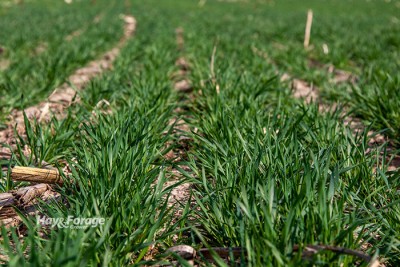
By Mike Rankin: Hay and Forage Grower Magazine
Winter annual forages are a valued feed source across the United States, but this year they will offer extra benefits to those areas that have been stricken with drought. The beauty of winter annuals is that they work just about anywhere, assuming there is sufficient moisture.
"Winter annual cereals and spring oats can provide a cost-effective tool to provide gains for stockers and increase weight on thin cows," says Jaymelynn Farney, an extension beef systems specialist with Kansas State University. She offers the following advice for successful utilization of these forage types.
Spring oats
In Kansas, spring oats are usually planted in late February or March; however, spring oats can also be planted in August or early September. This latter approach will produce abundant fall forage compared to other winter annual cereal forages.
"Spring oats can also be planted in a mixture with a winter small grain," Farney notes. "The spring oat will produce most of the forage in the fall and then most likely winterkill. The winter small grain will overwinter and produce forage in the spring, but the amount might be less than if it was planted alone. Still, the combination of oat and winter small grain biomass will most likely be higher than if the winter small grain was planted alone," she adds.
If a mixture is used, the beef specialist suggests planting oats at 50% of its normal seeding rate and winter cereal at a 100%.
Winter wheat
Winter wheat is often used as a dual-purpose crop for both grazing and grain. These systems are usually balanced between getting good forage and good grain yields, without maximizing yields of either.
If cattle are removed in the spring prior to the first hollow stem, there is a lower probability for significant grain yield reduction. Research has shown that grazing wheat during late fall, winter, and early spring reduces grain yields by an average of 7% compared to wheat managed for grain only.
If spring conditions are unfavorable because of a late spring freeze or dry conditions, grazed wheat may outyield ungrazed wheat because moderate to heavy grazing will often delay maturity and reduce the lush fall growth of early planted wheat.
Kansas State specialists suggest that dual-purpose wheat be planted at seeding rates one and a half to two times greater than that for grain-only utilization.
Winter barley
Farney notes that there are currently improved varieties of winter barley available that have enhanced winterhardiness, especially under grazing. Many of these varieties also produce higher yields than older varieties.
"Barley produces fast, palatable growth in the fall under favorable conditions," Farney explains. "It's considered superior to other cereals for fall and early winter pasture, but wheat, triticale, and rye provide better late winter and spring grazing."
Barley has excellent drought and heat tolerance. Winter barley forage is typically the most palatable of the small grain cereals, and its forage quality is excellent, although the tonnage of barley is usually less than that of triticale or rye.
Winter rye
Rye is fast to establish in the fall and regrows rapidly in late winter and early spring. It matures quickly and becomes unpalatable earlier in the spring compared to other cereals, according to Farney.
"Since rye is less palatable and higher in fiber than wheat or barley, cattle gains during grazing are normally greater on oat, wheat, triticale, and barley pasture than on rye pasture," the beef specialist notes. On the plus side, rye is extremely winterhardy and possesses a high tolerance to drought, heat, and poor soil conditions.
Winter triticale
Farney says that triticale, which is a cross between wheat and rye, offers the toughness of rye along with the quality of wheat. Triticale and rye can be planted about a month earlier than wheat with a lower risk of wheat streak mosaic.
Early triticale or rye planting enhances the amount of fall forage available compared to winter wheat. Triticale has a longer spring grazing duration than rye but shorter than wheat. Depending on the variety, winter triticale will head later than rye so the forage can remain higher in quality later into the spring. "Heading date on all winter cereals should be a consideration if spring grazing is the goal," Farney asserts.
Graze them right
Implementing sound fall grazing strategies will help livestock producers get the most from their cereal forages. Farney suggests starting to graze when the plants are well rooted and tillered, usually about six to eight weeks after planting.
"If the foliage is too tall when the animals are introduced, or if the crop is overgrazed, the plants will be more susceptible to winterkill," she says. "Make sure some green leaves remain below the grazing level. The minimum stubble height should be about 3 to 4 inches. Rye has a more upright growth pattern than most wheat varieties, so it should not be grazed as low."
Finally, Farney reminds that cows with high milk production grazing small grain pastures in the spring can experience grass tetany. To prevent this, she recommends providing a high magnesium mineral supplement. Cattle should be started on the mineral two weeks prior to grazing the cereal forage.
Field Crops
Dairy
Business
Livestock
Grains
Upcoming Events
Poultry Processing Workshop, Canandaigua, NY
September 17, 2026 : Poultry Processing Workshop - Canandaigua, NY
Canandaigua, NY
This program is one of four statewide roadshow stops across the state, offering farmers a full poultry processing experience. The class will teach skills that build confidence, reduce costs, and strengthen your farm's independence. This hands-on workshop gives farmers the chance to process a bird from start to finish, learning every step of the workflow used by small farms across the state.
Tax 101: An Introduction to Income Taxes for Farmers
September 17, 2026 : Tax 101: An Introduction to Income Taxes for Farmers
Join NY Farm Net for a FREE mid-day webinar about income tax basics for farmers. Attendees will learn what documents you need, options for recordkeeping systems, how identify common tax forms and schedules, and more!
Large Animal Awareness Training For First Responders
September 19, 2026
Dunkirk, NY
Join the Chautauqua County Technical Rescue Services and NYS Veterinarian, Dr. Kate Card-Allen, for a specialized training on how to safely and effectively respond to large animal incidents. Learn techniques for managing large animals during traffic accidents, rollovers, entrapments and other transportation emergencies.
Announcements
No announcements at this time.