
Feed Quality Doesn't Stop at the Chopper
Katelyn Miller, Field Crops and Forage Specialist
Southwest New York Dairy, Livestock and Field Crops Program
For those who own livestock, your goals each year are likely to include some connection to remaining in business revolving around finances and strong production. While this is simplifying it to only a few words, it cannot be denied that feed is a large component of reaching your goals. Feed costs represent approximately 50% of operating expenses on dairy farms, with large investments in home-grown forages. It cannot be denied that there are many factors that impact our ability to harvest quality forages, both within and outside of our control, but the job isn't done once it runs through the chopper. The same prioritization of management and resources should also be allocated to maintaining quality as it enters storage.
There are many factors to silage management that can be utilized to maintain quality, one of which being inoculant use. I wrote an article about selection and best management practices in September's issue of Crops Cows & Critters if you want to check it out. To achieve a high-quality forage, it needs to be high quality as its entering storage and be paired with excellent management. If either component falls short, then quality suffers as a result. Additional bunk management opportunities can be employed to preserve the quality of forages you invested countless resources in.
One of the biggest areas of opportunity is to reduce dry matter (DM) losses, also called shrink. These losses impact tonnage available, as well as palatability and nutritional value. When forage is in storage, we want to minimize DM losses, ensure a consistent feed source within the ration, and maximize our storage footprint. Managing density of the bunk is a great way to manage DM losses.
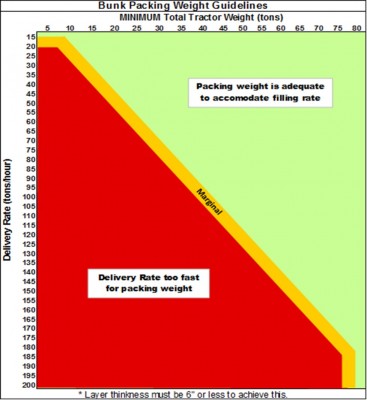
A large component of achieving the desired density is packing strategies. Ensuring you have enough packing weight for the delivery rate of forage and building a good base will both strongly impact the density you are able to achieve. Proper packing allows you to maximize storage footprint and aids fermentation by reducing oxygen. While packing, you want to utilize the "rule of 800", which means utilizing a minimum of 800 lbs/ton of forage coming in per hour.
For example:
45 tons/hour x 800 lbs = 36,000 lbs. With a tractor only packing about 60% of the time, 36,000 lbs x 0.60 = 16,800 lbs of packing weight would be needed. At minimum, a bunk should have a density of 15 lbs DM/ cu. ft. (45 lbs as fed/ cu. ft.). Ideally, it would be great to achieve 18+ lbs DM/ cu. ft. (50+ lbs as fed/ cu. ft.).
Postcard that can be used to calculate packing weight as it correlates to delivery rate to ensure proper packing density. Developed by Ron Kuck with CCE.
To achieve the desired density, each layer being added onto the pile should be 6 inches or less. When layers are too thick, or delivery rate is too high, density values will suffer. The photo above is a postcard that can be printed to calculate delivery rate and packing weight to help you achieve your desired density value. Additionally, a well packed base is necessary to build upon. If the base is poorly packed, it doesn't matter how much you pack the top layers.
When talking about density, we can't forget about safety and the role it plays. Having appropriately sized storage will help reduce safety hazards such as piles extending above walls and unsafe slopes. Everyone has seen, with many personally experiencing the 'clutch your pearls' moments of trying to pack on high piles or steep slopes. How well do you think those sections of the bunk are getting packed? Packing density suffers in these situations, hurting quality in the long term, as it also usually impacts our ability to effectively cover and manage feedout.
Shrink is unavoidable in the fermentation process, but the percentage of loss can be managed. Your feed in storage is an investment; losing it costs you money and requires additional acreage to meet forage requirements. With prices continuing to skyrocket, improving efficiency through management like your bunk is crucial.
Resources:
- "Quality Silage: Bunk Silos & Piles": presentation developed by Joe Lawrence, PRO-DAIRY
Field Crops
Dairy
Business
Livestock

Grains
Upcoming Events
Poultry Processing Workshop, Canandaigua, NY
September 17, 2026 : Poultry Processing Workshop - Canandaigua, NY
Canandaigua, NY
This program is one of four statewide roadshow stops across the state, offering farmers a full poultry processing experience. The class will teach skills that build confidence, reduce costs, and strengthen your farm's independence. This hands-on workshop gives farmers the chance to process a bird from start to finish, learning every step of the workflow used by small farms across the state.
Tax 101: An Introduction to Income Taxes for Farmers
September 17, 2026 : Tax 101: An Introduction to Income Taxes for Farmers
Join NY Farm Net for a FREE mid-day webinar about income tax basics for farmers. Attendees will learn what documents you need, options for recordkeeping systems, how identify common tax forms and schedules, and more!
Large Animal Awareness Training For First Responders
September 19, 2026
Dunkirk, NY
Join the Chautauqua County Technical Rescue Services and NYS Veterinarian, Dr. Kate Card-Allen, for a specialized training on how to safely and effectively respond to large animal incidents. Learn techniques for managing large animals during traffic accidents, rollovers, entrapments and other transportation emergencies.
Announcements
No announcements at this time.