
Growing Degree Days: Another Tool in the Harvest Toolbox
Katelyn Miller, Field Crops and Forage Specialist
Southwest New York Dairy, Livestock and Field Crops Program
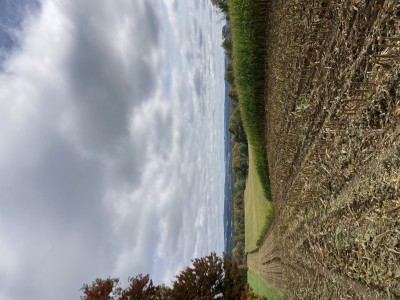
Growing degree days (GDD), or heat units, help estimate the growth and development of certain crops. Research shows that using GDD accumulations, instead of calendar days, gives a more accurate estimate of physiological development. To calculate GDD, add the high and low temperatures for the day, divide by two to get the average, then subtract the base temperature.
Formula: GDD = (Tmax + Tmin) / 2 - Base temperature
We use base and maximum temperatures because little plant growth occurs outside of the designated values. For corn and soybeans, we use the base temperature of 50?°F and a maximum temperature of 86?°F, also referred to as the 86/50 method. For example:
- Recorded high temperature: 80?°F
- Recorded low temperature: 60?°F
- GDD = (80 + 60) / 2 - 50 = 70 - 50 = 20 GDD
GDD's can help predict corn maturity. Certain seed brands provide estimates of GDD's needed for different hybrids, but these numbers need to be used with caution.
- The listed values are often from planting to physiological maturity (black layer), which is past silage harvest timing. A rule of thumb is to subtract 150 GDD's from this number to estimate the number needed for silage harvest.
- Studies have shown some variation in the GDD's required from planting to silking. This variability can happen because of factors other than heat, such as moisture and fertility.
Research conducted by Dr. Bill Cox shows that there is reduced variability tracking GDD accumulation from silking to harvest timing. While there is still some variability in this measurement, it takes out the inconsistency in the early season from planting to silking. For whole plant dry matter (DM) at harvest, a target of 32% DM is used in this study, though 35% DM is ideal. Therefore, the GDD values listed in the chart below offer a warning for harvest.

Table: Approximate Growing Degree Days needed from silking to silage harvest
Once corn begins dry down, we can anticipate an average rate of dry down of 0.5% per day. This indicates that the crop may reach 35% DM approximately six days after reaching the targets for 32% DM. At this point, sample the field and measure DM. This will help further refine harvest timing, as GDD's should not be used as a standalone tool.
You can also use GDD's to track alfalfa harvest, but it's a bit more challenging. For alfalfa, the base temperature is 41?°F, but there is not a well-established maximum temperature. Alfalfa growth is optimal between 60 - 80?°F, and temperatures over 86?°F can slow or stop growth. For alfalfa, GDD's are primarily used to estimate alfalfa's nutritive value, especially for first cutting. Generally, 700-750 GDD's will help achieve an NDF value between 35 and 40%. Later in the season, physical measurements of maturity and height are used to estimate nutritive value.
Growing Degree Days (GDD) are a valuable tool for estimating crop development and optimal harvest timing. Whether tracking corn maturity or alfalfa harvest, using GDDs alongside other measurements can help improve decision-making and ensure better crop management. Tools like the Climate Smart Farming Growing Degree Day Calculator can simplify the process and offer more precise estimates for your specific location.
Resources
"Record silking/tasseling dates for corn fields": https://ecommons.cornell.edu/server/api/core/bitstreams/5a5c472d-0fa1-452a-abd4-929ebcb9feec/content
Climate Smart Farming Growing Degree Day Calculator: https://climatesmartfarming.org/tools/csf-growing-degree-day-calculator/
Field Crops
Dairy
Business
Livestock
Grains
Upcoming Events
Poultry Processing Workshop, Canandaigua, NY
September 17, 2026 : Poultry Processing Workshop - Canandaigua, NY
Canandaigua, NY
This program is one of four statewide roadshow stops across the state, offering farmers a full poultry processing experience. The class will teach skills that build confidence, reduce costs, and strengthen your farm's independence. This hands-on workshop gives farmers the chance to process a bird from start to finish, learning every step of the workflow used by small farms across the state.
Tax 101: An Introduction to Income Taxes for Farmers
September 17, 2026 : Tax 101: An Introduction to Income Taxes for Farmers
Join NY Farm Net for a FREE mid-day webinar about income tax basics for farmers. Attendees will learn what documents you need, options for recordkeeping systems, how identify common tax forms and schedules, and more!
Large Animal Awareness Training For First Responders
September 19, 2026
Dunkirk, NY
Join the Chautauqua County Technical Rescue Services and NYS Veterinarian, Dr. Kate Card-Allen, for a specialized training on how to safely and effectively respond to large animal incidents. Learn techniques for managing large animals during traffic accidents, rollovers, entrapments and other transportation emergencies.
Announcements
No announcements at this time.