
Herbicide-Resistant Weed Management Strategies
By Mike Hunter; Field Crop Specialist NCRAT, Adopted from PRO-DAIRY The Manager
According to the International Survey of Herbicide Resistant Weeds, there are currently 515 unique cases (site of action x species) of herbicide resistant weeds globally. This organization also reports that weeds have evolved resistance to 21 of the 31 known herbicide sites of action and 165 different herbicides.
One or more herbicide resistant weed species can be found in every state in the Northeast and are present in major crop production areas across the country. Herbicide resistant weeds are not new. In 1977, a population of triazine resistant common lambsquarter found in a New York corn field was the first confirmed herbicide resistant weed in the Northeast. The list of herbicide resistant weed cases throughout the Northeast continues to grow as time goes on. Populations of horseweed (marestail) with resistance to both glyphosate and acetolactate synthase (ALS) herbicides are rapidly expanding. Herbicide resistant Palmer amaranth and tall waterhemp are found in the Northeast with reported cases of populations resistant to glyphosate, atrazine, and ALS herbicides.
This situation has prompted refinements to control recommendations for these multiple resistant annual broadleaf weeds in field corn, soybeans, and wheat. Triazine, glyphosate and ALS herbicides have played, and will continue to play, an important role in field corn weed control programs. However, effective control programs for these resistant strains will involve the use of crop rotation and cultivation along with herbicide rotation and/or use of herbicide combinations that include herbicides with different sites of action (SOA). The SOA is the location in the plant where the herbicide acts or has its effect on the plant. These practices will also delay development of weed populations to these and other herbicide groups.
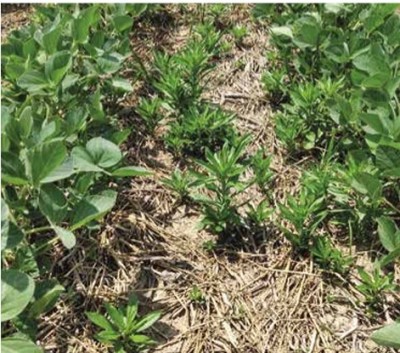
The first line of defense for herbicide resistant weed management is knowing what weeds are present - proper identification and frequent monitoring of weed populations for early detection of any potential resistant weeds present. If resistant weed populations are identified early, it provides growers an opportunity to contain and minimize the spread to additional acres across the farm operation.
Start clean, stay clean, control emerged weeds prior to planting the crop
This can be achieved by using either tillage or a preplant burndown herbicide. This reduces the risk of not controlling the weeds after the crop has emerged. Once the crop has emerged, many of our effective preplant burndown herbicides are no longer an option to use. Utilizing practices that maintain weedfree fields, such as the use of soil residual herbicides or inter-row crop cultivation, reduces the chances for additional weed seed production.
MINIMIZE HERBICIDE SELECTION PRESSURE
Minimizing herbicide selection pressure on the weed populations is an effective strategy to delay the development of resistance. Rotating herbicides with different sites of action and the use of tank mixes or sequential applications that involve herbicides with different sites of action are key elements in herbicide resistance management plans. Emphasis should be placed on using herbicides with different sites of action in the tank mix. For this strategy to work, there must be products with at least two different sites of action that are effective on the targeted weed.
To do this most effectively, everyone involved in decisions about weed management must have site of action classification for the herbicides readily available. The Weed Science Society of America (WSSA) has approved a numbering system to classify herbicides by their site of action (Mallory-Smith, C.A. and Retzinger, E.J. 2003. Revised classification of herbicides by site of action for weed resistance management strategies. Weed Technol. 17:605-619). In this system, a group number is given to all herbicides with the same site of action. Take Action has a very handy SOA(s) herbicide lookup tool app found at: iwilltakeaction.com/app.
CROP ROTATION
Crop rotation can be another effective herbicide resistant weed management tool. Planting different crops allows for rotation of herbicides with different sites of action, reducing the weed's exposure to the same chemistry in consecutive years. Diversity of crops in the rotation that have different planting dates, uses, and harvest schedules can disrupt the weed life cycle and competitiveness. For example, perennial forages crops such as alfalfa and grasses suppress many of the annual weeds. Multiple harvests of these forage crops during the growing season prevents many of these annual weeds from producing any seeds. Planting a winter cereal crop or other fall-planted cover crop is an effective strategy to suppress horseweed growth. It works best if the crop is planted early enough to provide the necessary biomass to suppress the emerging horseweed.
PREVENTION
Prevention is the most overlooked weed management strategy. The easiest way to control weeds is to not let them get established on your farm or in your field.
Cleaning equipment to prevent the spread of weed seeds is an important weed control strategy. When harvesting a field with patches of resistant weeds, try to begin in the cleanest area of the field before harvesting the areas where the resistant weeds are present. If there are fields on the farm without resistant weeds, harvest those first and save the most infested fields for last.
Purchasing used farm equipment from other states or areas with known herbicide resistant weed, such as tall waterhemp and Palmer amaranth, is a documented way to import new weeds to the farm. To demonstrate how weed seeds can be moved via combines, Cornell Cooperative Extension North Country Regional Ag Team field crop specialists worked with a grower that recently purchased a used combine from Illinois. It has been previously documented that combines can contain approximately 150 pounds of biomaterial (chaff, grain, weed seed). Prior to its use on the farm, the combine was thoroughly cleaned, the biomaterial was screened multiple times, and weed seeds were sorted out individually by hand. Approximately 97 percent of the weed seeds collected from the combine were tall waterhemp, a weed currently not found on this grower's farm.
Using diverse weed management techniques to prevent or slow the spread of herbicide resistant weeds is extremely important. Once herbicide resistant weeds become established on a farm it requires changes in management practices and weed control costs will be increased.
References
2023 Cornell Guide to Integrated Field Crop Management. Online. Accessed Wednesday, January 11, 2023. cropandpestguides.cce.cornell.edu/ Guidelines/2023/FieldCrops/
Hunter, M. 2020 Herbicide Resistance Management: Get to know herbicide sites of action. blogs.cornell. edu/whatscroppingup/2019/01/30/ herbicide-resistance-management-getto-know-herbicide-sites-of-action/ Wallace, J. 2020.
Cover Crops: An Effective Herbicide Resistance Management Tool. extension.psu.edu/ cover-crops-an-effective-herbicideresistance-management-tool

Field Crops
Dairy

Business
Livestock

Grains
Upcoming Events
Poultry Processing Workshop, Canandaigua, NY
September 17, 2026 : Poultry Processing Workshop - Canandaigua, NY
Canandaigua, NY
This program is one of four statewide roadshow stops across the state, offering farmers a full poultry processing experience. The class will teach skills that build confidence, reduce costs, and strengthen your farm's independence. This hands-on workshop gives farmers the chance to process a bird from start to finish, learning every step of the workflow used by small farms across the state.
Tax 101: An Introduction to Income Taxes for Farmers
September 17, 2026 : Tax 101: An Introduction to Income Taxes for Farmers
Join NY Farm Net for a FREE mid-day webinar about income tax basics for farmers. Attendees will learn what documents you need, options for recordkeeping systems, how identify common tax forms and schedules, and more!
Large Animal Awareness Training For First Responders
September 19, 2026
Dunkirk, NY
Join the Chautauqua County Technical Rescue Services and NYS Veterinarian, Dr. Kate Card-Allen, for a specialized training on how to safely and effectively respond to large animal incidents. Learn techniques for managing large animals during traffic accidents, rollovers, entrapments and other transportation emergencies.
Announcements
No announcements at this time.