
So, You Want to Start a Farm Stand: Understanding Product Rules and Licensing
Amy Barkley, Team Leader & Livestock Specialist
Southwest New York Dairy, Livestock and Field Crops Program
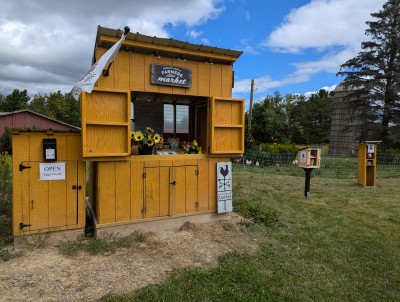
Farm Stand Series - Article 2
So, You Want to Start a Farm Stand: Understanding Product Rules and Licensing Requirements
By Amy Barkley and Kate McDonald Polakiewicz, SWNYDLFC Team
Welcome back to our series of articles about starting farm stands in NYS. Did our last article help you decide that you want to move forward with a stand? If so, let's dive deeper into some common questions regarding what items you can sell in a stand, as well as any regulatory requirements necessary for the legality and safety of the products.
Before jumping into individual product categories, it's important to clear up one of the most common misconceptions about farm stands: that opening one requires extensive permitting. Walk-up structures don't need permits but should comply with township setbacks from the road and other property boundaries. Walk-in structures may require permitting from your town if over a specific square footage in addition to adhering to road and property setback requirements. If you are unsure if your farm stand requires a permit, it's best to reach out to your town or look through the town code to ensure you're in compliance prior to purchasing or building the structure.
When shifting our view to products offered, many require specific adherence to state rules and regulations. Each product class will need to be evaluated to determine which licenses, certifications, inspections, labeling requirements, or food safety rules apply. Below are some common products that are on farm stands across the region, and the regulations and rules that govern them.
Vegetables, Fruits, and Herbs:
When selling whole, raw produce, there are no regulations to follow other than best production practices. If you sell more than $25,000 worth of produce annually, you will need to comply with the FDA's FSMA Food Safety Rule, as of April 6, 2026.
For those who want to cut, dehydrate, freeze dry, can, or otherwise process their fruit, vegetables, or herbs, you will need a 20C license to do so in order to ensure food safety compliance. The only exception to this is jams and jellies made with 100% high acid fruit as their only fresh ingredient; these can be processed with a NYS Ag and Markets Home Processing Exemption.
Eggs
While eggs don't have to be washed under state law, they do have to be free of large stains and any adhering debris, making washing required for most eggs. All eggs must be kept under refrigeration at temperatures of 45?°F and below. This is best achieved by placing the eggs in a refrigerator; ice packs in coolers do not usually provide enough cooling power to keep temperatures in a food safe range.
It's best practice to pack eggs in new cartons. If using used clean cartons, they should have all identifying information obliterated. All egg cartons must have the farm name, address, contents (type of eggs, number) on the package. Adding best by or use by dates is optional but can assist with inventory management.
Red Meat: Pork, Beef, Lamb, and Goat
To sell individual cuts of meat, it must be processed in a USDA facility, with the cuts individually packed and labeled for resale. Meat should stay frozen at temperatures below freezing, and ideally below 0?°F. You are permitted to sell cuts by weight or by package. If selling cuts by weight, they need to be weighted on a scale that's been approved and inspected by NYS Ag and Markets Department of Weights and Measures. Packages need to be labeled with identifying information including farm name, address, and processing facility information.
Poultry:
You can sell fresh whole birds or traditional cuts of poultry from a farm stand that you own by processing under the 1,000 bird exemption or sending the poultry to be processed at a 5A Small Enterprise exempted facility. Poultry must be packaged and labeled as per the requirements under each processing method. While cuts of poultry such as breasts, wings, legs, quarters, and soup bones can be sold in addition to whole poultry, further processing poultry into ground, seasoned, broth, or dried value-added items can only be done in a commercial kitchen under a 20C license.
Fresh chicken should be kept at or below 40?°F, and must be frozen within 4 days following processing. Frozen chicken should be kept below freezing, ideally targeting 0?°F. Poultry can be sold by weight or by the package. If selling by weight, the same certified scale requirement that impacts red meat applies here.
Dairy Products:
Producers looking to sell milk or other dairy products like cheese, yogurt, ice cream, or butter, require licensure in NYS. This applies to both pasteurized and raw milk, with raw milk requirements being more stringent. If you're selling milk purchased from another farm or facility, that processing facility needs to be licensed. Food safe best management practices need to be followed for refrigeration monitoring during transportation and storage.
Honey and Maple
These two products can be processed on-farm when creating single ingredient products. Single ingredient products include transformations of these raw products into value-added items. For example, honey can be packed and sold raw, filtered, whipped, and bottled. Maple can be bottled, made into candy or sugar, or whipped.
There are some exemptions where added ingredients don't require a 20C license for processing, such as shelf stable additions that do not add moisture. But, once you add high moisture additives, it increases the risk to the product's safety and therefore requires a license. Farms looking to repack maple/honey or their products from another producer also require a 20C license.
Baked Goods
Baked goods have enjoyed a boom in popularity in recent years. There are two classes of products to keep in mind: those which require a 20C license and those which require a NYS Department of Ag and Markets Home Processor Exemption. Proper testing and labeling should be followed for items that require it, and that requirement is based on the license type, where products processed under a 20C license are more stringently monitored than those processed under a home processing exemption.
Generally, a home processor exemption allows you to make baked goods that do not have cheese or low-acid additions. These baked goods don't require refrigeration to remain food safe. Items include: bread, bagels, cinnamon rolls, biscuits, muffins, doughnuts, cookies, baklava, biscotti, cakes, cake pops, cupcakes, brownies, double crushed fruit pies, scones, granola, popcorn, fudge, pizzelle, sugared confections, pretzels, crackers, and vegetable/potato chips.
There are very specific lists of items that require 20C licensure. Broadly, these are items that are not food safe at room temperature or have a history of causing foodborne illness in the past. These include: anything using cheese, meat, or uncooked dairy/eggs; any additives that are not high acid (I'm looking at you, jalapeno cheese bread); blended items, chocolate dips or tempered chocolates; beverages/tonics; and raw nuts.
Canned Goods:
Canned or bottled goods require a 20C license, with the exception of jams, jellies, and marmalades that are made with high acid fruits only. Pepper jellies and flower jellies are not considered high acid. Pickles or other jarred acidified vegetables requires the 20C license, as does any fruit or vegetable that is jarred and non-acidified. Items like canned fruits, applesauce, picked eggs, and fruit juice all fall into this category. Again, proper testing and labeling are required for items outside of the high acid fruit-based jams, jellies, and marmalades.
Cosmetics:
Cosmetics are regulated by the Federal Food, Drug, and Cosmetic Act, which covers all products except for soap. Wash-off cosmetics like soaps or scrubs are lower risk than those that are applied to remain on the body like lip balms or tallow balms. Additional insurance may be required to cover these products. It's important to list all ingredients and formulate products carefully to avoid skin irritation.
Plant Sales:
These sales include vegetable seedling sales and the sales of shrubs, trees, cuttings, and anything else that could be planted in the ground. If you are producing any plant material intended for sale, a NYS Department of Ag and Markets Nursery Grower's License is required. This will also allow you to purchase and resell plants and plant material. A NYS Department of Ag and Markets Nursery Dealer's License is required if your intent is only to purchase and resell plant material rather than growing it yourself. The only exemptions to needing a license are if you are selling house plants and cut flowers.
A Note on Reselling:
As a farm stand owner, you can either produce your own products or purchase them in for resale. If you're looking to purchase products in, it's up to you to do your homework and make sure that the regulatory requirements of producing those products are met by the wholesalers.
A Note on Sales Tax:
Sales tax is collected on non-food items, including, but not limited to: cut flowers; plants (seedlings, house plants, trees, shrubs); cosmetics (balms, lotions, body oils, shampoos); fiber creations (regardless of fiber type); crafts; and pet treats.
Raw foods and ready-to-eat food items don't have tax collected on them. These include, but are not limited to: fresh fruits and vegetables; meat; eggs; baked goods; jams/jellies/canned goods.
---
For the sake of length, these are summaries of requirements for each of these product classes, rather than the nitty gritty requirements for each. If you have further questions about a specific product class, please reach out to Amy Barkley (amb544@cornell.edu or 716-640-0844) for more information.
Field Crops
Dairy
Business
Livestock
Grains
Upcoming Events
Poultry Processing Workshop, Canandaigua, NY
September 17, 2026 : Poultry Processing Workshop - Canandaigua, NY
Canandaigua, NY
This program is one of four statewide roadshow stops across the state, offering farmers a full poultry processing experience. The class will teach skills that build confidence, reduce costs, and strengthen your farm's independence. This hands-on workshop gives farmers the chance to process a bird from start to finish, learning every step of the workflow used by small farms across the state.
Tax 101: An Introduction to Income Taxes for Farmers
September 17, 2026 : Tax 101: An Introduction to Income Taxes for Farmers
Join NY Farm Net for a FREE mid-day webinar about income tax basics for farmers. Attendees will learn what documents you need, options for recordkeeping systems, how identify common tax forms and schedules, and more!
Large Animal Awareness Training For First Responders
September 19, 2026
Dunkirk, NY
Join the Chautauqua County Technical Rescue Services and NYS Veterinarian, Dr. Kate Card-Allen, for a specialized training on how to safely and effectively respond to large animal incidents. Learn techniques for managing large animals during traffic accidents, rollovers, entrapments and other transportation emergencies.
Announcements
No announcements at this time.