
Conclusions of CCE Pastured Broiler Study Improve Production & Profits
Amy Barkley, Team Leader & Livestock Specialist
Southwest New York Dairy, Livestock and Field Crops Program
Considerations for Optimizing the Economic Return of Pasture-Raised Slow Growth and Conventional Broilers
by Amy Barkley, Livestock Specialist, SWNYDLFC
Poultry is a low-cost, rapid-return enterprise for small farms in the Northeast. The 2022 Ag Census indicated that there were 825 farms rearing broilers in New York alone. Of those, 81% are classified as small broiler enterprises (<2,000 birds/year). These enterprises don't benefit from the economies of scale like larger producers, so input costs and retail values must be carefully considered. Many times, the true costs of production are not evaluated in enterprise budgets, or even known to the farmer, resulting in farm income losses. Slow growth and Cornish-type (also called conventional) broilers have different efficiencies, which are impacted by genetics, diet, management style, and age at harvest. Value-added processing allowed under the 1,000 bird exemption as well as processing method (on-farm vs outsourcing) can also impact profit margins. Deficient understanding of the optimization of these operations can result in substantial financial loss over many years, and the ultimate demise of small, local broiler enterprises.
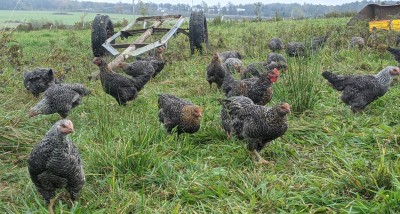
This three-year-long project followed 36 pastured broiler farms across New York State, each of which raised 4 flocks over 2 years. Twenty-eight farms raised traditional Cornish-type broilers on pasture, where an additional 6 raised slow-growth broilers, and 2 farmers raised both varieties. Hatchery and breed of choice was selected by the farm, as were pricing and sales outlets. Slow growth breeds consisted of Royal Grey Broilers, Royal Red Broilers, Freedom Rangers, Kosher Kings, Meyer's Red Broiler, Red Broilers, and Red Jackies.
In year 1, farmers collected production, processing, marketing, and sales data on their flocks to determine their true costs of production. Those financial indicators were benchmarked against the average costs of production from the other pastured broiler farms on the project. Following the first production year, each farmer met with their local extension educator to determine where they could decrease costs and increase income. These changes were implemented for year 2 flocks. Production, processing, marketing, and sales data were collected on these new flocks to benchmark against the previous years' data and the statewide averages. From there, it could be determined how much the adjusted farm practices increased their enterprise income
Project Conclusions
Performance:
- Mortality was the leading cause of production losses in our study, with predators being the primary reason for bird losses later in the growing cycle and poor brooder management and shipping stress being the causes earlier in the cycle. Reducing mortalities later in grow-out will reduce the financial losses for a flock. Setting chicks up for success in the brooder will pay dividends for the producer at harvest time.
- Our project revealed that the losses in raising pastured poultry far exceed those that are outlined by commercial production guides. While commercial guides target a 2% mortality rate, the percentage of individual flocks with mortality numbers higher than 10% were 42% - 57.4% of all flocks and rates higher than 25% were found in 0% - 23% of all flocks. There was no obvious difference between the mortality rates by year for Cornish cross and slow growth broilers.
- There are opportunities to decrease the feed bill and optimize growth by providing a feed with a protein concentration that is matched to the age of the flock.
- Managing brooders to improve conditions (warmer, more space, less moisture) can help set young birds up for success on pasture. Disease and unthriftiness resulting from poor brooder management can result in depressed weight gain and finished weights.
- Targeting an average finished weight per flock rather than an average flock age can help producers meet their goals for pounds of chicken produced in a season. Seasonal temperature and precipitation impact the rate at which broiler chickens grow, and are not always predictable.
- All male flocks tend to finish out birds that are significantly heavier (1.37-1.75 pounds more) and are slightly more feed efficient than all female flocks, which may be a strategy that can be used by producers to get more pounds of meat from their production system.
- Slow growth chickens take about 50% longer to raise out than Cornish cross chickens (average of 10.7 weeks vs 7.4 weeks) to achieve similar finished weights and are less feed efficient (2.47 pounds of feed per pound of live gain for slow growth birds vs 2.10 pounds of feed per pound of live gain for Cornish cross birds).
- Average carcass yield from live was 74.3% for Cornish crosses and 67.5% for slow growth breeds.
- When cut up, the carcasses of Cornish cross birds yield 6.8% more saleable parts than those of slow growth chickens. Slow growth chickens had a larger portion of leg meat as a percentage of the whole carcass vs the Cornish cross. Parting out carcasses with more bone-in, skin-on cuts results in a larger percentage of the whole bird to sell.
Financial:
- Accurate recordkeeping was the most challenging part of this project for farmers. Many farmers commented that there were more input costs associated with raising broiler chickens than they'd initially realized. While 69% of farms operated a profitable broiler enterprise when unpaid labor was excluded, only 26% remained profitable once non-cash labor was included, valued at a minimum wage of $15 per hour.
- Farmers who knew their true costs of production were able to more critically evaluate their enterprise and make changes that led them to be more profitable.
- On average, farmers on the project improved their income per broiler sold by $7.29 (+/- 2.19). With an average flock on the project containing 101 birds, that is a total increased average income of $736.29 (+/- $221.19) per flock.
- 81% of the farmers on the project increased their profitability from year 1 to year 2. Small, incremental improvements helped to accomplish this goal. However, even though profitability increased, the average profit per chicken was $1.26 per bird before labor was taken into consideration.
- The biggest changes that our farmers made from year 1 to year 2 included recordkeeping (39%), time management and scaling the enterprise (23%), improving processing or pasturing equipment (14%), and improving feeding regimes and general health related parameters for the flock (16%). Interestingly, market aggregation and collective purchasing, which are ways to decrease costs and improve access to markets, were not identified by the producers as pathways to profitability.
- When farmers were asked about the changes they'd make into year 3 and beyond, the categories remained the same as they did at the end of year 1, with a shift away from record keeping improvements (down to 30% from 31%) and towards feed and health related changes (increase to 31% from 23%).
This 3-year project gave our project team the opportunity to work with many farmers from our region, and gave us valuable insight into what small, pastured broiler enterprises look like for NYS farmers. The full project report, including tables, charts, and data conclusions for each area of production and pricing analyzed, can be viewed at https://projects.sare.org/project-reports/lne22-435/ For a printed or emailed copy of the report, reach out to Amy Barkley at amb544@cornell.edu or (716) 640-0844.
Collaborators on financial data analysis and conclusions included in this report include Katelyn Walley-Stoll, Ag Team Leader, CCE Chautauqua and John Pirrung, SWNYDLFC Research Technician.
This grant work was supported by the National Institute of Food and Agriculture, U.S. Department of Agriculture, through the Northeast Sustainable Agriculture Research and Education program under subaward number LNE22-435.
Field Crops
Dairy
Business
Livestock

Grains
Upcoming Events
Livestock Production Field Day
August 29, 2026 : Livestock Production Field Day
Chaffee, NY and East Aurora, NY,
Join us on visits to Horizon Ridge Farm in East Aurora and Troll Bridge Farm in Chaffee for an introduction to small beef and small diversified livestock enterprises. Through walking farm tours, attendees will learn about management, meat processing, setting prices, and finding local markets. Dinner will be provided. Register by contacting Amy Barkley at amb544@cornell.edu or 716-640-0844.
Large Animal Awareness Training For First Responders
September 19, 2026
Dunkirk, NY
Join the Chautauqua County Technical Rescue Services and NYS Veterinarian, Dr. Kate Card-Allen, for a specialized training on how to safely and effectively respond to large animal incidents. Learn techniques for managing large animals during traffic accidents, rollovers, entrapments and other transportation emergencies.
Cows, Crops & Critters - Southwest New York Dairy, Livestock & Field Crops Newsletter Sponsorship
December 18, 2026
Our two forms of publications feature research-based and timely information from our four specialists, listed to the right, along with local event notifications and Cornell University outreach. This information is provided to participants who range from dairy, livestock, and field crops producers to agricultural suppliers and consultants.
Weekly Email Update: Shared with 625+ households who have signed up with our program.
Monthly Paper Mailer: To reach our stakeholders and farmers who lack internet access, we send out a monthly mailer where your company's logo and contact information would be featured with a mailing list of 330+ households.
If you sponsor our weekly and monthly publications you reach approximately 955 households.
Visit our website to view our newsletters!
Announcements
No announcements at this time.