
Proper Stored Grain Maintenance over the Winter: A Key to Pest Management
By Mike Stanyard; NWNYDLFC
The combination of low grain prices and above average yields have led many farms to leave the grain in the bin and hope for better prices this spring.
Grain storage is an important step in protecting your investment and lots of money can be lost in reduced quality when it's time to deliver. Hopefully, with the intent of keeping the grain stored longer than usual, steps were taken to keep your grain protected. With longer storage time, small grains and corn can obviously be more vulnerable to insect and mold damage. The usual sanitation prior to grain fill is a must every year. All fines and old grain should be swept up, vacuumed up and removed. An insecticide such as Tempo SC should be used inside and outside of the bin to eliminate any existing insects and form a barrier to keep them out. An insecticide treatment on the grain really helps keep that grain protected over the long haul.
Well, it's January now and if you didn't go through all those steps, you still have aeration as a tool to keep insects and molds under control. Dry grain should be cooled to less than 60 degrees as soon as possible after harvest, and between 20 - 30 degrees for winter storage. Temperature benchmarks for stored grain: Chart credit: Dr, Kenneth J. Hellevang, NDSU Extension Service.
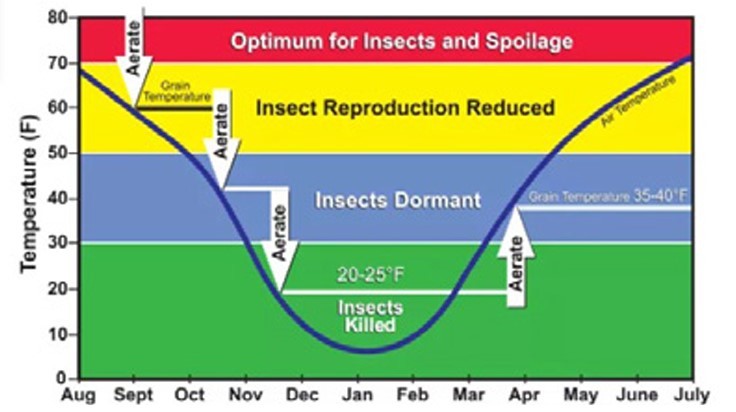
• 80?°F: The ideal temperature for insect and mold growth.
• 70?°F: Insect reproduction begins to decrease.
• 50?°F: Insects become dormant below this temperature.
• 40?°F: Mold growth prohibited below this temperature.
• 30?°F: Insects begin to die.
• 20-30?°F: Grain should be cooled to this range for winter storage.
I was recently asked if you can freeze insects in the grain bin and kill them. Ideally, to kill insects you really need to get that grain below 30 degrees as outside temperatures allow and keep it there for a couple of weeks.
The University of Minnesota has an excellent site on Managing Stored Grain with Aeration. Some of their recommendations for additional mold and insect control are summarized below and the webpage can be found at https://extension.umn.edu/corn-harvest/managing-stored-grain-aeration.
Stored grain should be cooled by aeration whenever the grain temperature exceeds the average outdoor temperature by 10 to 15 degrees. Expect storage time to approximately double with each 10-degree reduction in temperature. Grain should be cooled to about 25 degrees as outdoor temperatures get colder. Check the condition of stored grain about every two weeks while grain is cooling, then about monthly after grain has cooled for winter storage.
When the fans are off during the winter holding period, they should be covered (with canvas or plywood) to prevent the grain near the ducts from getting too cold during severe winter weather. Large temperature differences result in condensation in the cold grain. Spoiled grain over the aeration ducts or perforated floor is a common problem caused by not covering the fan during extended off periods. Also look for melting snow on the roof of the bin as a telltale sign of temperature problems and hot spots which could mean insect activity. Accumulation of fine particles, weed seeds, and other foreign material interferes with airflow. Such accumulations are prime locations for increased mold and insect activity, which result in localized heating and grain deterioration. Normally, these fines collect in the center of the bin as the grain flows toward the walls.
A common practice in bins equipped with center unloading hoppers is to unload some grain from the center "core" to remove some accumulated fines. Fill the bin so it is peaked and unload some of the grain (300 to 1,000 bu, depending on bin size). This removes some of the accumulation and increases airflow in the center if enough grain is unloaded to allow the center core to fill with clean grain.
Another great grain storage resource is from the University of Nebraska, https://cropwatch.unl.edu/grain-storage-management. It is a thorough summary of articles written by other University on all topics related to grain storage management. Check it out!

Field Crops
Dairy
Business
Livestock

Grains
Upcoming Events
Livestock Production Field Day
August 29, 2026 : Livestock Production Field Day
Chaffee, NY and East Aurora, NY,
Join us on visits to Horizon Ridge Farm in East Aurora and Troll Bridge Farm in Chaffee for an introduction to small beef and small diversified livestock enterprises. Through walking farm tours, attendees will learn about management, meat processing, setting prices, and finding local markets. Dinner will be provided. Register by contacting Amy Barkley at amb544@cornell.edu or 716-640-0844.
Large Animal Awareness Training For First Responders
September 19, 2026
Dunkirk, NY
Join the Chautauqua County Technical Rescue Services and NYS Veterinarian, Dr. Kate Card-Allen, for a specialized training on how to safely and effectively respond to large animal incidents. Learn techniques for managing large animals during traffic accidents, rollovers, entrapments and other transportation emergencies.
Cows, Crops & Critters - Southwest New York Dairy, Livestock & Field Crops Newsletter Sponsorship
December 18, 2026
Our two forms of publications feature research-based and timely information from our four specialists, listed to the right, along with local event notifications and Cornell University outreach. This information is provided to participants who range from dairy, livestock, and field crops producers to agricultural suppliers and consultants.
Weekly Email Update: Shared with 625+ households who have signed up with our program.
Monthly Paper Mailer: To reach our stakeholders and farmers who lack internet access, we send out a monthly mailer where your company's logo and contact information would be featured with a mailing list of 330+ households.
If you sponsor our weekly and monthly publications you reach approximately 955 households.
Visit our website to view our newsletters!
Announcements
No announcements at this time.