
Colostrum Construction: Building a Firm Foundation
Katie Callero, Dairy Management Specialist
Southwest New York Dairy, Livestock and Field Crops Program
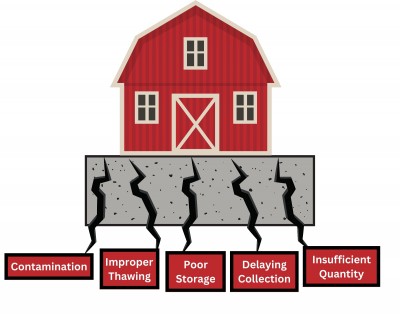
When we feed colostrum, we are pouring the foundation for our cows on which all other things, like milk production and health, will be built on top of. In construction and on our farms, a solid foundation requires four key steps: create a detailed plan, choose quality materials, build the foundation, evaluate and adjust. Whether it is colostrum or construction, closely following these steps will help ensure success and a firm foundation on which you and your calves can stand.
Create a Detailed Plan: Blueprints are essential to have as a physical reference point for the project at hand. What is the blueprint for your colostrum management? This blueprint is an SOP (standard operating procedure). Successful SOP's are printed, have pictures associated with each step, are easy to find for reference, and are regularly reviewed with employees.
Choose Quality Materials: Whether it is concrete, brick, or colostrum, the quality of the materials you are using matters. Quality will ultimately determine the strength of your foundation. Checking the quality of the colostrum you receive from your cows will help ensure you are using good resources. A Brix refractometer is the easiest and cheapest way to test your colostrum quality. Any colostrum with a Brix reading over 22% is considered good quality. Any low-quality colostrum (Brix under 22%) can be used for a second feeding for the calf.
Build the Foundation: Building a foundation takes time and you want to make sure that every step of the process is executed properly. Timing is everything. Rushing certain steps can lead to a sloppy, uneven foundation. The most important time consideration is how soon after birth the calf receives colostrum. The sooner the better, as the calves' ability to absorb key nutrients begins to rapidly decline after birth.
Evaluate and Adjust Regularly: As tempting as it can be to fall into a "set it and forget it" mindset, most buildings need periodic inspections. Your colostrum management plan and execution are no exception. If you have multiple staff members, take the time to review the "blueprints" and ensure that you are all building the SAME foundation. Continual improvement and review of what is and isn't working is the best way to keep on track for achieving long-term success of fantastic cow health and production.
Watch out for cracks in your foundation:
Delaying Collection: Colostrum should be harvested within 6 hours after calving. Waiting too long to harvest the colostrum from the cow can cause a drop in quality due to dilution. There are many strategies farms can use to avoid delays: dedicating a worker each shift to check close-up cows, having a portable milking unit, or livestream cameras that allow remote monitoring of pens.
Contamination: Bacterial contamination can have detrimental effects to calves with no immune system. The items you use to feed your calves, whether it's a tube feeder or a bottle, can collect bacteria rather quickly. Proper cleaning protocols are necessary to prevent unwanted bacterial growth. Best practices include proper dilutions of cleaning products, appropriate water temperature and thoroughly drying items on clean, well-maintained racks.
Insufficient Quantity: Occasionally you may find you do not have enough quality natural colostrum to feed a calf. You can be prepared for these times by freezing excess colostrum, keeping colostrum replacer on hand, and/or using colostrum supplements. If you find your cows are consistently not making enough colostrum, it may be time to review their diets.
Poor Storage: Freezing colostrum in large amounts can make the thawing process more difficult than it needs to be. Aim to freeze individual servings in 1-2-quart portions. If you freeze in lay flat Ziploc bags, you can maximize freezer space and you will freeze the colostrum more quickly.
Lack of Labeling: Putting a date on the colostrum you are storing is helpful. Colostrum should be stored no longer than 2-3 days in the refrigerator and no longer than 6 months to a year in the freezer. Failure to date the colostrum when storing can lead to unnecessary waste and confusion.
Bad Freezer: "Frost-free" freezers sound nice in theory but typically these freezers undergo freeze-thaw cycles that can compromise the colostrum quality. When selecting a freezer for colostrum storage, be sure that it is not frost-free and not part of a refrigerator. I recommend keeping a thermometer inside your freezer to ensure the minimum temperature of -5 degrees Fahrenheit is maintained.
Improper Thawing: Colostrum needs to be thawed slowly in warm, not hot, water. Microwaves should be avoided as they do not heat evenly. This is to ensure that the proteins the calves need stay in the proper form for the calf to utilize them.
Calves are the future of your herd and farm. By taking the time to thoroughly review your colostrum protocols, you can be confident that you are creating a firm foundation for your calves. Not feeling the most confident about your current protocols or simply want a fresh set of eyes to review them? If you have any questions or need further assistance, feel free to reach out to me, Katie Callero, at (607) 422-6788 or via email at krc85@cornell.edu.

Field Crops
Dairy
Business
Livestock

Grains
Upcoming Events
Livestock Production Field Day
August 29, 2026 : Livestock Production Field Day
Chaffee, NY and East Aurora, NY,
Join us on visits to Horizon Ridge Farm in East Aurora and Troll Bridge Farm in Chaffee for an introduction to small beef and small diversified livestock enterprises. Through walking farm tours, attendees will learn about management, meat processing, setting prices, and finding local markets. Dinner will be provided. Register by contacting Amy Barkley at amb544@cornell.edu or 716-640-0844.
Large Animal Awareness Training For First Responders
September 19, 2026
Dunkirk, NY
Join the Chautauqua County Technical Rescue Services and NYS Veterinarian, Dr. Kate Card-Allen, for a specialized training on how to safely and effectively respond to large animal incidents. Learn techniques for managing large animals during traffic accidents, rollovers, entrapments and other transportation emergencies.
Cows, Crops & Critters - Southwest New York Dairy, Livestock & Field Crops Newsletter Sponsorship
December 18, 2026
Our two forms of publications feature research-based and timely information from our four specialists, listed to the right, along with local event notifications and Cornell University outreach. This information is provided to participants who range from dairy, livestock, and field crops producers to agricultural suppliers and consultants.
Weekly Email Update: Shared with 625+ households who have signed up with our program.
Monthly Paper Mailer: To reach our stakeholders and farmers who lack internet access, we send out a monthly mailer where your company's logo and contact information would be featured with a mailing list of 330+ households.
If you sponsor our weekly and monthly publications you reach approximately 955 households.
Visit our website to view our newsletters!
Announcements
No announcements at this time.