
Practical Lessons Learned from Advanced Soil Health Training
Katelyn Miller, Field Crops and Forage Specialist
Southwest New York Dairy, Livestock and Field Crops Program
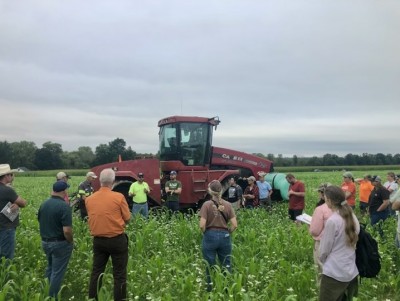
This spring, I applied and got accepted into the Advanced Soil Health Training Cohort being hosted by the American Farmland Trust. Throughout four sessions, this cohort is designed to address practical management challenges in connection to soil health, including topics such as improving soil health, cover crop management, conducting soil health assessments, and economic considerations. In August, we had our first session, and I wanted to share with you some of the lessons I learned from participating.
The average person makes over 30,000 decisions a day. These include what we'll eat, what we'll wear, what we'll say, and how we'll say it (just to name a few). In addition to all these decisions, you also must make countless management decisions on your farm. These decisions may include cropping management practices, like the implementation of conservation practices. It's overwhelming, which is why it's important to remember to do what you can. Think about a farm you know that is already implementing advantageous soil practices. Do you think they started all of them at once? Probably not.
Implementing one practice is better than implementing none; every farm must start somewhere! Practice adoption is not a "go big or go home" mentality. It is important to think about your capacity when making that decision. Consider your time, labor availability, available equipment, and general implementation costs.
If you have decided to implement new practices, you need to start with a goal(s). To select goals, understanding the function of your soil and general soil health principles will help guide you. When we think about soils, we want them to perform many functions; be resistant to compaction, tolerant of extremes (floods & droughts), produce food, cycle nutrients, and store water, just to name a few. Soil health principles focus on maximizing living roots, biodiversity, and soil cover while minimizing disturbance. Determining how you want to improve your soil will help guide you toward what practices to implement.
After you start implementing new practices, it's important to remember that change does not happen overnight. For example, when starting a new diet, we want to see change overnight, but we won't. Your soil is the same way, and some patience needs to be practiced. The speed at which soil changes occur is dependent on many things like climate and soil type. It may be years before we see changes occur like a color difference, but it will take a shorter time to see some differences in aggregate stability. It's helpful to compare fields that have had advantageous practices implemented and those that have not to gain an understanding of the changes occurring.
There are many documents dedicated to assessing soil health in the field. The good news is that you can assess your soil health too! When evaluating soil health, the NRCS identifies four resource concerns: aggregate instability, compaction, organic matter depletion, and soil organism habitat loss or degradation. To evaluate if these resource concerns are present in the field, there are key indicators to look for. NRCS Technical Note 450-06 walks through each soil health indicator (11 total), their importance, and how to assess it in your field. Walk through your fields and ask yourself some questions:
• Is there surface crusting visible?
• Is there water ponding on the soil surface?
• Is there residue on the soil surface?
• Are there visible signs of wheel marks where past traffic has occurred?
While these are just a few examples of questions to ask yourself, they serve as an easier way to evaluate if there may be resource concerns in your field. If you think you have resource concerns that need to be addressed, get in touch with your NRCS, SWCD, or your local friendly Extension Agent. If you're looking to adopt conservation practices on your farm, but are looking for more support, contact Katelyn Miller at 716-640-2047 or by emailing km753@cornell.edu. Participating in this training provides me with unique access to resources and support to help farms implement new practices.
If you are interested in adopting conservation practices, there may be funding available for your farm. The American Farmland Trust has possible funding opportunities available through the Climate-Smart Row Crops Project where technical and financial assistance can be provided for following the NRCS Climate-Smart Conservation Practices: Cover Crops (CPS 340), No-Till (CPS 329), Reduced Till (CPS 345), Nutrient Management (CPS 590), Conservation Crop Rotation (CPS 328), and Soil Carbon Amendments (CPS 336). Practices must be implemented in systems that include corn, soybean, wheat, and/or cotton and has a strong emphasis on Historically Underserved Producers (including limited resource, beginning, socially disadvantaged, or veteran farmers per USDA's definition).
In New York State, the NRCS and SWCD have conservation programs designed promote objectives such as increased soil health, reduced erosion, drought mitigation, water quality, etcetera. An example of such a program is EQIP (Environmental Quality Incentives Program) through NRCS, which is designed to provide technical and financial assistance to agricultural producers to address various natural resource concerns. The best way to identify what programs will best suit your farm goals is to contact your local NRCS or SWCD.
Field Crops
Dairy
Business
Livestock
Grains
Upcoming Events
Livestock Production Field Day
August 29, 2026 : Livestock Production Field Day
Chaffee, NY and East Aurora, NY,
Join us on visits to Horizon Ridge Farm in East Aurora and Troll Bridge Farm in Chaffee for an introduction to small beef and small diversified livestock enterprises. Through walking farm tours, attendees will learn about management, meat processing, setting prices, and finding local markets. Dinner will be provided. Register by contacting Amy Barkley at amb544@cornell.edu or 716-640-0844.
Large Animal Awareness Training For First Responders
September 19, 2026
Dunkirk, NY
Join the Chautauqua County Technical Rescue Services and NYS Veterinarian, Dr. Kate Card-Allen, for a specialized training on how to safely and effectively respond to large animal incidents. Learn techniques for managing large animals during traffic accidents, rollovers, entrapments and other transportation emergencies.
Cows, Crops & Critters - Southwest New York Dairy, Livestock & Field Crops Newsletter Sponsorship
December 18, 2026
Our two forms of publications feature research-based and timely information from our four specialists, listed to the right, along with local event notifications and Cornell University outreach. This information is provided to participants who range from dairy, livestock, and field crops producers to agricultural suppliers and consultants.
Weekly Email Update: Shared with 625+ households who have signed up with our program.
Monthly Paper Mailer: To reach our stakeholders and farmers who lack internet access, we send out a monthly mailer where your company's logo and contact information would be featured with a mailing list of 330+ households.
If you sponsor our weekly and monthly publications you reach approximately 955 households.
Visit our website to view our newsletters!
Announcements
No announcements at this time.