
Adding an Insecticide to your Soybean Herbicide Tank Mix
Katelyn Miller, Field Crops and Forage Specialist
Southwest New York Dairy, Livestock and Field Crops Program
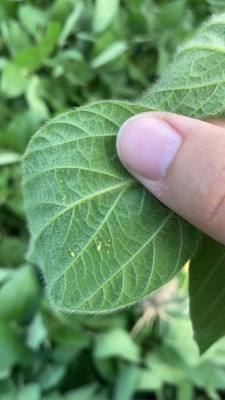
I was recently asked; if you're going to apply herbicides to your soybeans and know that aphids are present, should you add an insecticide to the tank mix? Mike Stanyard, Field Crop Specialist with the Northwest NY Team says that there are 3 specific factors to keep in mind.
- 1. In-season stress
- 2. Natural enemy populations
- 3. Field history
In-season stressors like drought can help influence early-season spraying decisions. When aphids feed, they remove phloem from the plant which contains water. Various parts of the region have been getting rain, but dry conditions remain for many. Because water is already limited to the plant, spraying early on can help reduce plant stress.
Take note of natural enemy populations when scouting. Various insects, such as lady beetles, will help slow down populations by feeding on them. If you notice a high density of natural enemies, consider not adding insecticide to the mix. An application will kill all the unwanted insects, but also all the beneficials. If you know natural enemies are present, let them try to reduce populations naturally.
Field history can be a huge factor in making the decision to spray. Buckthorn is a woody shrub that is the overwintering host of soybean aphids. If it is present on your field edges, your field is at higher risk of infestation in season. Fields that are at high risk should consider using a pre-emergence herbicide to prevent aphid colonization. Aphids can be killed before laying eggs when there is an early frost. This can help to reduce populations for the following year. Remember that this past fall, it was mild, so be prepared for higher levels of aphid colonies in your fields this year.
These factors play into making the decision to add an insecticide to the tank mix, but It's also important to highlight scouting factors that will impact it as well. Let's review some scouting tidbits:
- Scout for aphids every week. Development is fastest when temperatures are between 70°F and mid 80°s. Under ideal conditions, there can be as many as 18 populations per year, making it important to scout frequently to keep ahead of populations.
- Ants will feed on the honeydew produced by aphids. If you see ants on plants, then you know there are aphids present.
- Remember to scout the young, fuzzy leaves on a plant. These leaves are the most susceptible to feeding. Typically, you will find them on the underside of the leaves, so make sure to check both sides of the leaf.
- The action threshold for aphids is 250 per plant. If 80% of the plants you pulled meet this threshold, then you should act. This threshold gives you approximately 7 days to treat the field before populations reach the economic threshold of 500 aphids per plant.
For more information on soybean aphids, visit https://extension.umn.edu/soybean-pest-management/scouting-soybean-aphid#whole-plant-counts-1353560.
Field Crops
Dairy

Business
Livestock

Grains
Upcoming Events
Livestock Production Field Day
August 29, 2026 : Livestock Production Field Day
Chaffee, NY and East Aurora, NY,
Join us on visits to Horizon Ridge Farm in East Aurora and Troll Bridge Farm in Chaffee for an introduction to small beef and small diversified livestock enterprises. Through walking farm tours, attendees will learn about management, meat processing, setting prices, and finding local markets. Dinner will be provided. Register by contacting Amy Barkley at amb544@cornell.edu or 716-640-0844.
Large Animal Awareness Training For First Responders
September 19, 2026
Dunkirk, NY
Join the Chautauqua County Technical Rescue Services and NYS Veterinarian, Dr. Kate Card-Allen, for a specialized training on how to safely and effectively respond to large animal incidents. Learn techniques for managing large animals during traffic accidents, rollovers, entrapments and other transportation emergencies.
Cows, Crops & Critters - Southwest New York Dairy, Livestock & Field Crops Newsletter Sponsorship
December 18, 2026
Our two forms of publications feature research-based and timely information from our four specialists, listed to the right, along with local event notifications and Cornell University outreach. This information is provided to participants who range from dairy, livestock, and field crops producers to agricultural suppliers and consultants.
Weekly Email Update: Shared with 625+ households who have signed up with our program.
Monthly Paper Mailer: To reach our stakeholders and farmers who lack internet access, we send out a monthly mailer where your company's logo and contact information would be featured with a mailing list of 330+ households.
If you sponsor our weekly and monthly publications you reach approximately 955 households.
Visit our website to view our newsletters!
Announcements
No announcements at this time.