
Seedcorn Maggot Risk Assessment
Katelyn Miller, Field Crops and Forage Specialist
Southwest New York Dairy, Livestock and Field Crops Program
Seedcorn maggot (SCM) is a pest that was first introduced in the mid-1800s from Europe. Today, it is distributed throughout the United States and southern Canada. This pest impacts large-seeded crops such as corn and soybeans, creating feeding damage to germinating seed.
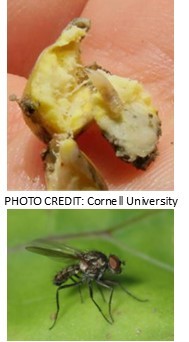
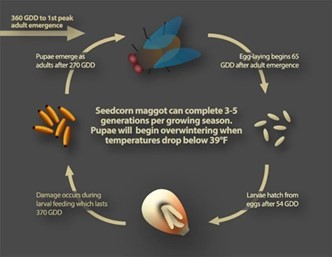
The seedcorn maggot life cycle begins with the adult fly, which resembles a house fly. The adults lay eggs in the soil early in the spring near food sites or in soil cracks. Because the flies lay eggs in specific locations, fields that are heavily manured or have newly terminated cover crops are favored. The maggots hatch and burrow into the seeds looking for food, creating damage that greatly reduces the chance of a healthy plant emerging, often times killing it. Damage is more severe during cool, wet springs because of delayed seedling emergence. Reduced plant stands will become evident approximately a week after plants begin to emerge.
Unfortunately, there are no rescue treatments for seedcorn maggot. When a field has been severely damaged by the pest, the only option is to replant. This makes preventing infestation the best practice. Partaking in cultural practices like planting when soil and moisture conditions favor quick germination helps to reduce damage to the crop. Management practices revolve around the use of neonicotinoids, which are insecticides chemically related to nicotine. Currently, neonicotinoids are under review for their effects on the environment and pollinators. At this time, seed can still be purchased with the neonicotinoid treatment already applied, but the insecticide has been reclassified as a restricted use pesticide. If you're curious about which products have been re-classified, visit the DEC chemical database, which can be found here:
https://www.dec.ny.gov/chemica....
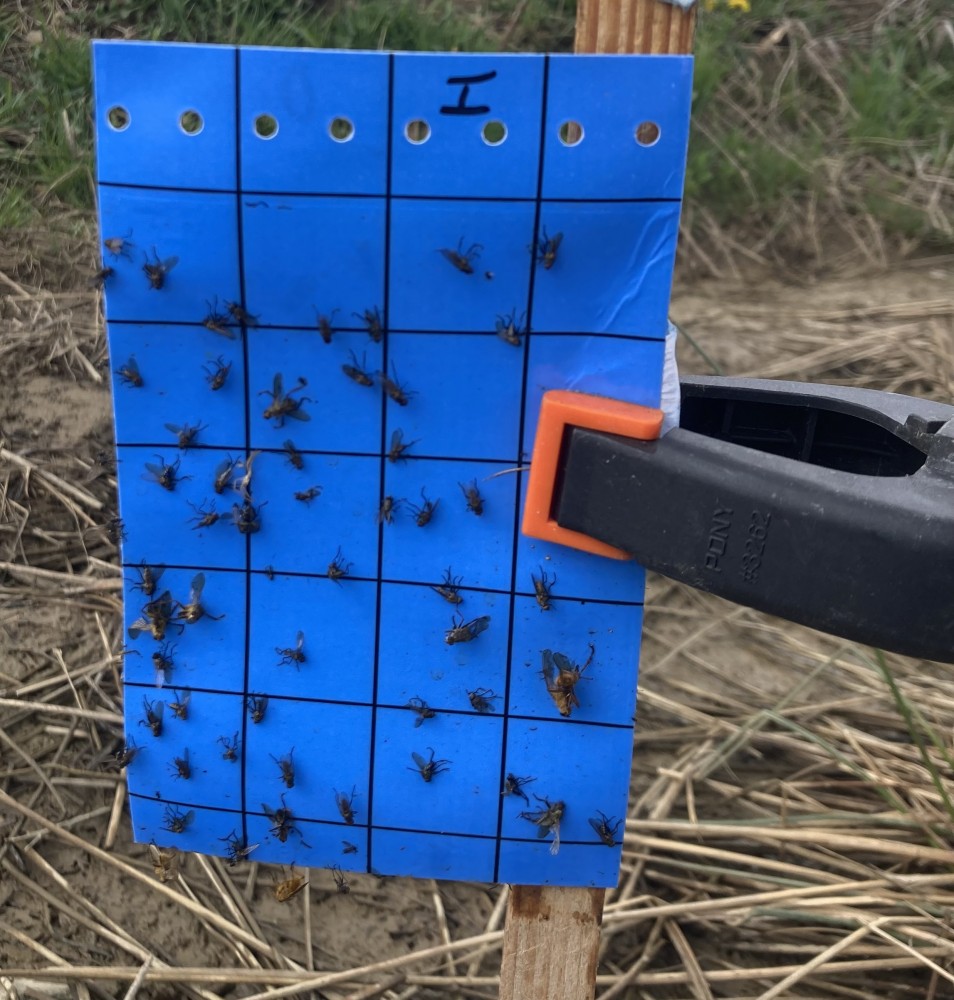
The New York State Integrated Pest Management (NYSIPM) Program is currently working with NYS Agriculture and Markets to evaluate alternative treatments for this pest. Simultaneously, the Poveda Lab with Cornell University is working on creating a prediction model for the pest that correlates to our Northeast climate. Research is designed to minimize the economic impacts of SCM damage by developing a predictive early season emergence model for the Network for Environment and Weather Application (NEWA) platform, which can be viewed here: https://newa.cornell.edu/. Data is being collected throughout the state for this model, with 9 locations here in Southwest, NY. At each location, there are two sticky traps placed 100 feet apart with a temperature probe. The traps were placed in the first week of April, and will remain until the middle of June, as this is the usual time the pest will attack corn. Every week during this time, the sticky cards are sent in and pest data is correlated to the weather data being collected. Once this research is completed, a new and improved model will be available to producers to help predict SCM emergence!
Field Crops
Dairy
Business
Livestock
Grains
Upcoming Events
Livestock Production Field Day
August 29, 2026 : Livestock Production Field Day
Chaffee, NY and East Aurora, NY,
Join us on visits to Horizon Ridge Farm in East Aurora and Troll Bridge Farm in Chaffee for an introduction to small beef and small diversified livestock enterprises. Through walking farm tours, attendees will learn about management, meat processing, setting prices, and finding local markets. Dinner will be provided. Register by contacting Amy Barkley at amb544@cornell.edu or 716-640-0844.
Large Animal Awareness Training For First Responders
September 19, 2026
Dunkirk, NY
Join the Chautauqua County Technical Rescue Services and NYS Veterinarian, Dr. Kate Card-Allen, for a specialized training on how to safely and effectively respond to large animal incidents. Learn techniques for managing large animals during traffic accidents, rollovers, entrapments and other transportation emergencies.
Cows, Crops & Critters - Southwest New York Dairy, Livestock & Field Crops Newsletter Sponsorship
December 18, 2026
Our two forms of publications feature research-based and timely information from our four specialists, listed to the right, along with local event notifications and Cornell University outreach. This information is provided to participants who range from dairy, livestock, and field crops producers to agricultural suppliers and consultants.
Weekly Email Update: Shared with 625+ households who have signed up with our program.
Monthly Paper Mailer: To reach our stakeholders and farmers who lack internet access, we send out a monthly mailer where your company's logo and contact information would be featured with a mailing list of 330+ households.
If you sponsor our weekly and monthly publications you reach approximately 955 households.
Visit our website to view our newsletters!
Announcements
No announcements at this time.