
Ways to Reduce Spray Drift and Other Considerations
By Dwight Lingenfelter, Penn State
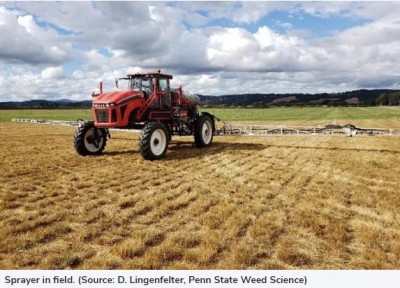
The importance of keeping crop protectant applications on target continues to be at the forefront of growers' minds as well as people neighboring the farms. Making sure the product stays on the intended target is critical for the health of the plant as well as those surrounding the area. As most already know, wind often can derail your plans to spray. Keep in mind the objectives of any spray application are to balance productivity, efficacy, and prevent off-site movement of pesticides. It is also challenging to find a functional intermediate between controlling drift and not sacrificing herbicide (or other crop protectants) coverage and efficacy. Any change that is made to the spraying system (e.g., nozzle selection, ground speed, pressure, different pesticide formulations, adjuvants, etc.) will ultimately impact droplet size, potential drift, and possibly efficacy. In some situations, reducing spray drift can be easier said than done. Below are several things to consider to help keep the product on target.
- Spray at low wind velocities (3 to 10 mph). In general, winds are less of an issue early in the morning or late in the evening. Read the label carefully. For example, new dicamba product (e.g., Engenia, Xtendimax, etc.) labels call for applications one hour after sunrise until two hours before sunset to help reduce drift issues, while the Liberty (glufosinate) label recommends it is best to apply between dawn and 2 hours before sunset for optimal weed control.
- Reduce spraying pressures. Lower pressures allow for larger droplet sizes. Be aware that nozzles can produce different droplet sizes at different pressures. So, a nozzle might produce medium droplets at low pressure but fine droplets at higher pressures. However, some of the new drift-reducing nozzles are designed to require higher pressures for better spray coverage but still produce less drift than other types of nozzles. In most cases, contact herbicides such as Gramoxone, Liberty, Reflex, Cadet, etc. should be applied through nozzles that produce medium to coarse droplets, thus some of the newer drift-reducing nozzles might not provide the best spray coverage for effective weed control. However, increasing the spray volume can help to improve coverage.
- Increase carrier volumes/application rates. If possible, use 20 gallons or more per acre instead of 10 gallons or less per acre.
- Select the proper nozzles with coarse spray droplets. There are several companies that manufacture nozzles that are designed to reduce drift. Some examples include TeeJet's AI, AIXR, and TTI; and Greenleaf Technologies' TurboDrop XL and Hypro Ultra Low Drift noted in the article Selecting Spray Nozzles to Reduce Particle Drift. Of course, after selecting the proper nozzle, proper speed, pressure, and output must be determined and achieved as demonstrated in the Boom Sprayer Calibration video.
- Use lower spray boom heights. Make sure to use nozzles that have 110 degrees or more spray angle. This will allow the boom to be lowered more than nozzles with lesser angles but will ensure spray pattern and proper overlap is maintained. In general, for a boom with 20-inch nozzle spacings, maintain a boom height of 24 inches or less above the crop canopy.
- Reduce sprayer ground speed (less than 10 mph). Faster speeds will cause the boom to bounce and spray vortex to occur, sending spray droplets higher in the air.
- Use drift retardants. There are many good products on the market for this purpose. However, some are not compatible with certain drift-reducing nozzle types.
- Spray when wind direction is away from sensitive crops, homes, etc.
- Consider including buffer zones if sensitive crops are in adjacent fields. Some suggestions include a buffer of at least 250 to 300 feet near sensitive areas. If the buffer is included as part of the production area, treat the buffer with different products that will not affect the sensitive crop and/or spray that area during a different timeframe to avoid injuring the sensitive crop. Another option is to plant a cover crop in the buffer zone so there will not be an issue if it's injured or killed by spray drift.
- Invest in "high-tech" sprayers (e.g., pulse width modulation). Some of the new sprayers use a pulsing system to assist in a better application and drift reduction. Keep in mind, however, that some of the new sprayers increase pressure to maintain output if the ground speed is increased, thus producing additional fine droplets.

Field Crops
Dairy

Business

Livestock

Grains
Upcoming Events
Livestock Production Field Day
August 29, 2026 : Livestock Production Field Day
Chaffee, NY and East Aurora, NY,
Join us on visits to Horizon Ridge Farm in East Aurora and Troll Bridge Farm in Chaffee for an introduction to small beef and small diversified livestock enterprises. Through walking farm tours, attendees will learn about management, meat processing, setting prices, and finding local markets. Dinner will be provided. Register by contacting Amy Barkley at amb544@cornell.edu or 716-640-0844.
Large Animal Awareness Training For First Responders
September 19, 2026
Dunkirk, NY
Join the Chautauqua County Technical Rescue Services and NYS Veterinarian, Dr. Kate Card-Allen, for a specialized training on how to safely and effectively respond to large animal incidents. Learn techniques for managing large animals during traffic accidents, rollovers, entrapments and other transportation emergencies.
Cows, Crops & Critters - Southwest New York Dairy, Livestock & Field Crops Newsletter Sponsorship
December 18, 2026
Our two forms of publications feature research-based and timely information from our four specialists, listed to the right, along with local event notifications and Cornell University outreach. This information is provided to participants who range from dairy, livestock, and field crops producers to agricultural suppliers and consultants.
Weekly Email Update: Shared with 625+ households who have signed up with our program.
Monthly Paper Mailer: To reach our stakeholders and farmers who lack internet access, we send out a monthly mailer where your company's logo and contact information would be featured with a mailing list of 330+ households.
If you sponsor our weekly and monthly publications you reach approximately 955 households.
Visit our website to view our newsletters!
Announcements
No announcements at this time.