
Safety for Supplementing Heat to Livestock
Amy Barkley, Team Leader & Livestock Specialist
Southwest New York Dairy, Livestock and Field Crops Program
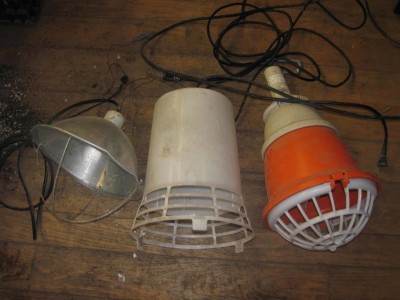
Safety for Supplementing Heat to Livestock
When it becomes necessary to provide supplemental heat to livestock, management of the barn and heat sources is important to ensure building and livestock safety.
While most livestock can tolerate colder temperatures well, there are times when providing supplemental heat may be necessary to promote their health and welfare. Newborn animals entering the world in the middle of the coldest months is just one example. While there are many ways to supplement heat, mindful steps need to be taken to ensure that those heat sources are both effective and safe.
Heat lamps are one of the most commonly used heat sources due to their low cost and simplicity. However, they are a major cause of barn fires, making design selection crucial for safety. Lamps should have solid ceramic bases, thick, intact cords, and a protective covering around the bulb. The protective covering, which is made of a wire or plastic, keeps the bulb from touching the ground should the heat lamp fall, and reduces the risk of animals potentially breaking the bulb.
Other options for heating include radiant plates, heat pads, and gas heaters, though these should be rated for barn use, firmly affixed to the wall, ceiling, or floor, and kept out of reach of livestock. Portable space heaters are not a good idea, since they can be knocked over by animals. Ideally, heaters should have an automatic shut-off in the case they are tipped.
A few general rules can help promote safe heating. Dust accumulations on any heater should be regularly removed. If possible, heaters should be kept at least two feet away from flammable items such as wood, bedding, fertilizer, pesticides, or cobwebs. Any device should be plugged directly into the wall; using extension cords can increase the risk of fire and malfunctions.
Commercial-sized (5 - 10 pound) fire extinguishers should be kept within easy reach in and around farm buildings. An ABC extinguisher is best, since it can tackle the various fire classes that can start within a barn. The installation of fire alarms, especially in areas where supplemental heat is used, can provide an advance notice of a fire. This can result in quicker response times, saving a barn or livestock. Having an emergency plan in place in the case of a fire including a list of contacts and evacuation plan is advantageous should an adverse event happen.
Supplemental heat is a tool that can be used to maintain the health and comfort of some newborn animals such as chicks, piglets, kids, and lambs; smaller livestock like rabbits, which may be more sensitive to cold; and individuals in poor health which cannot make enough of their own body heat. While heating a livestock area can present risks, they can be mitigated by following the considerations above.
If you are interested in learning more about heating barns or heater safety, contact Livestock and Beginning Farm Specialist, Amy Barkley, at 716-640-0844 or amb544@cornell.edu.
Photo Caption: Heat lamps have varying levels of safety. In this image, the most expensive, safest style is on the right, and the cheapest, riskiest style is on the left. Photo by Michael Glos of Kingbird Farm. This photo was originally shared by the Cornell Small Farms Program.
Field Crops
Dairy
Business
Livestock
Grains
Upcoming Events
Livestock Production Field Day
August 29, 2026 : Livestock Production Field Day
Chaffee, NY and East Aurora, NY,
Join us on visits to Horizon Ridge Farm in East Aurora and Troll Bridge Farm in Chaffee for an introduction to small beef and small diversified livestock enterprises. Through walking farm tours, attendees will learn about management, meat processing, setting prices, and finding local markets. Dinner will be provided. Register by contacting Amy Barkley at amb544@cornell.edu or 716-640-0844.
Large Animal Awareness Training For First Responders
September 19, 2026
Dunkirk, NY
Join the Chautauqua County Technical Rescue Services and NYS Veterinarian, Dr. Kate Card-Allen, for a specialized training on how to safely and effectively respond to large animal incidents. Learn techniques for managing large animals during traffic accidents, rollovers, entrapments and other transportation emergencies.
Cows, Crops & Critters - Southwest New York Dairy, Livestock & Field Crops Newsletter Sponsorship
December 18, 2026
Our two forms of publications feature research-based and timely information from our four specialists, listed to the right, along with local event notifications and Cornell University outreach. This information is provided to participants who range from dairy, livestock, and field crops producers to agricultural suppliers and consultants.
Weekly Email Update: Shared with 625+ households who have signed up with our program.
Monthly Paper Mailer: To reach our stakeholders and farmers who lack internet access, we send out a monthly mailer where your company's logo and contact information would be featured with a mailing list of 330+ households.
If you sponsor our weekly and monthly publications you reach approximately 955 households.
Visit our website to view our newsletters!
Announcements
No announcements at this time.