
Dairy farming essentials: How to infuse intramammary medications
Camila Lage, Dairy Management Specialist
Southwest New York Dairy, Livestock and Field Crops Program
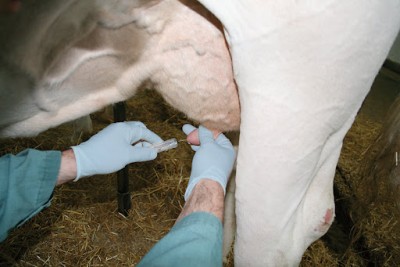
Dairy farming essentials: How to infuse intramammary medications
Mastitis continues to be the costliest disease of dairy cattle. Antibiotic therapy still plays an essential role in the control of mastitis in dairy cows. Treatment during lactation is not effective in all mastitis cases. Therefore, dry cow therapy is still an essential tool to eliminate previous infections and prevent new cases of mastitis.
Since the development of blanket therapy, a lot has changed. Many farms in the US have eliminated Strep. Ag. and S. aureus from their herd and improved their milk quality significantly. It's not rare to see herds with BTSCC's of 150,000 or lower. In this context, and with growing public concern over antibiotic usage in farms, there's been an increase in the use of selective dry cow therapy (For more information about selective dry cow therapy, read this). For herds using this approach, teat sealants play an important role by preventing new infections without relying on antibiotics.
Although mastitis treatments might be changing, it is essential to remember that: how we infuse intramammary medications on our cows matters. A careful procedure is critical to achieve desired results. Although relatively a simple technique, it is essential to remember this important principle: Teats need to be clean and dry. The only thing that can enter the teats is a sterile cannula and the drug. If the process is not done correctly, we can cause mastitis by inadvertently introducing microorganisms through the teat canal.
The best procedure is to follow these easy steps (Source: NMC):
- Use CLEAN gloves during the process.
- Dip teats in an effective germicidal product. Allow 30 seconds of contact time before wiping tears with an individual, disposable towel.
- Thoroughly clean and disinfect each teat end Scrub the teat opening with a cotton swab soaked in 70% alcohol. Use a separate swab for each teat.
- Prepare teats on side farthest from you first, followed by teats on the near side. (Teats may be cleaned and infused individually, if necessary.)
- Treat quarters in reverse order; near side first, far side last.
- Insert only the tip of the cannula into the teat end and express all the contents. Do not allow the sterile cannula to touch anything before infusion.
- Do not massage the teats to disperse the product.
- Dip teats in an effective germicidal product after treatment.
- Identify/mark treated cows and remove them from the milking herd to prevent antibiotics from entering the milk supply.
Sanitizing the teats is necessary even if treatment is administered immediately after milking. Although the udder and teats appear clean from your pre-milking routine, the teat end can be contaminated with mastitis-causing bacteria after milking. These microorganisms could be carried into the teat canal along with the infusion cannula if not correctly disinfected during the process. In addition, always dip gloved hands in a sanitizing solution between treating individual animals to reduce the spread of pathogens.
Avoid fully inserting the conventional mastitis tube syringe cannula. This could result in temporary dilation of the teat sphincter muscle, allowing the entry of microorganisms. The syringe cannula may also push microorganisms that are colonized in keratin into the teat cistern.
For more information, check out these procedures for intramammary treatment in dairy cows by clicking on the pdf located on the bottom of this page
This information is for educational and reference purposes only and is not a substitute for sound veterinarian consultation and following product labels. Cornell Cooperative Extension is dedicated to providing research-based information to our agricultural producers. Every effort has been made to provide correct, complete, and up-to-date recommendations.
Procedures for Intramammary Treatment in Dairy Cows (pdf; 1018KB)

Field Crops
Dairy

Business
Livestock

Grains
Upcoming Events
Poultry Processing Workshop, Canandaigua, NY
September 17, 2026 : Poultry Processing Workshop - Canandaigua, NY
Canandaigua, NY
This program is one of four statewide roadshow stops across the state, offering farmers a full poultry processing experience. The class will teach skills that build confidence, reduce costs, and strengthen your farm's independence. This hands-on workshop gives farmers the chance to process a bird from start to finish, learning every step of the workflow used by small farms across the state.
Tax 101: An Introduction to Income Taxes for Farmers
September 17, 2026 : Tax 101: An Introduction to Income Taxes for Farmers
Join NY Farm Net for a FREE mid-day webinar about income tax basics for farmers. Attendees will learn what documents you need, options for recordkeeping systems, how identify common tax forms and schedules, and more!
Large Animal Awareness Training For First Responders
September 19, 2026
Dunkirk, NY
Join the Chautauqua County Technical Rescue Services and NYS Veterinarian, Dr. Kate Card-Allen, for a specialized training on how to safely and effectively respond to large animal incidents. Learn techniques for managing large animals during traffic accidents, rollovers, entrapments and other transportation emergencies.
Announcements
No announcements at this time.