
The Dirt on Dairy Cow Hygiene
Katie Callero, Dairy Management Specialist
Southwest New York Dairy, Livestock and Field Crops Program
The inspiration for this article came from watching a video on social media where a homesteader was sharing a video of her milking her single dairy cow. The comment section was filled with remarks about how clean her cow was which led to one person leaving a comment expressing concern about how dirty most cows must be if that was the prevailing comment type. As most people who work with cows on a regular basis understand, it is impossible to keep them looking like a perfectly manicured show cow all the time but how dirty is actually too dirty? Cow hygiene isn't just for appearance, it is used as one of many metrics of cow welfare on a farm. An excessively dirty cow can face milk quality challenges and signal that their bedding conditions may not be the greatest. One way to objectively assess cleanliness and identify areas for improvement is through standardized hygiene scoring.
Scoring Cleanliness
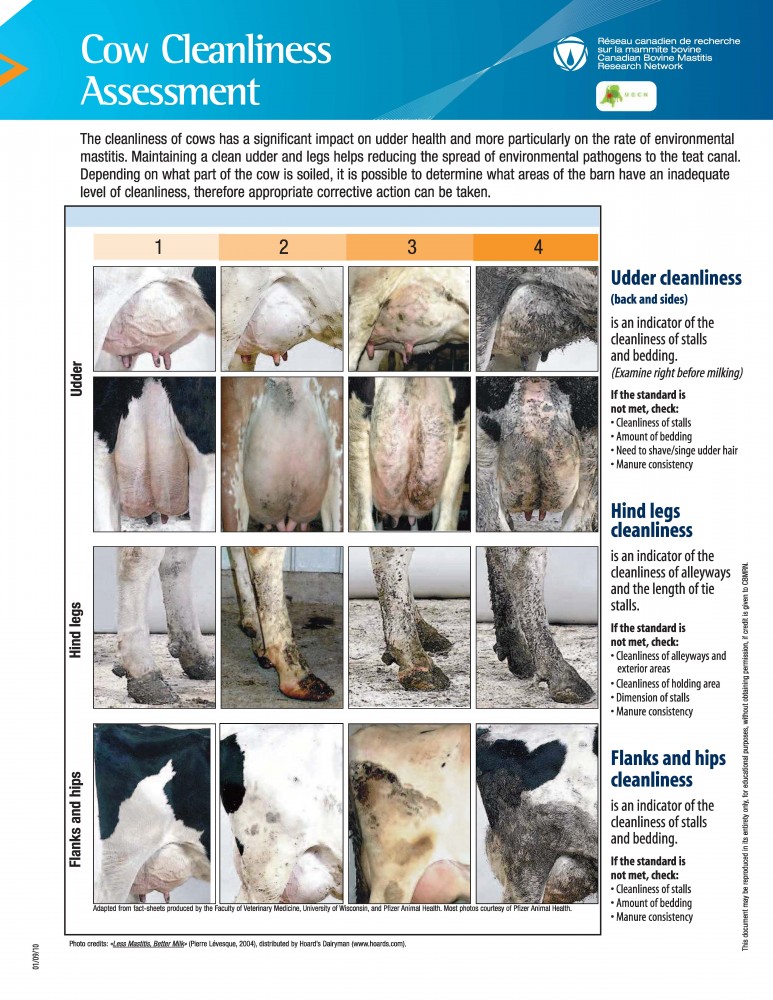
The National Dairy Farmers Assuring Responsible Management (FARM) Animal Care Reference Manual 5 contains the cow hygeine scoring guidelines that are used during FARM evaluations. The FARM scores are as follows: "Score 1: Clean - Mud or manure does not exceed 11 inches in length in the hock or flank area, Score 2: Moderate - Mud or manure exceeds 11 inches in length in a single area (hock or flank), and Score 3: Very Dirty - Mud or manure exceeds 11 inches in length in both the hock and flank". I appreciate the more measureable approach that the FARM program rubric uses but I find it a bit more difficult to casually employ on your own farm for managing cow cleanliness. I prefer the Cow Cleanliness Assessment from the Canadian Bovine Mastitis Research Network (CBMRN) that I have added to this article as it has nice photos to help distinguish between the different score levels. When scoring cows using the attached CBMRN cleanliness rubric, you should be aiming for a standard of less than 10% of cows with udder score of 3 and 4, less than 10% of cows with flanks/hips score of 3 and 4, and less than 50% of cows with hind legs score of 3 and 4. If your herd is less than 100 cows it is best to score all of the cows, if your herd is larger than that you should assess 25% of the cows. Once hygiene scores are collected, the next step is understanding what influences those results.
Management Strategies
Factors that can affect cleanliness are the comfort and cleanliness of the stall, amount and type of bedding, manure consistency, cleanliness of alleys, space allowance per cow, and amount of hair on the udder. The Facility Characteristics and Cow Comfort on U.S. Dairy Operations Report in 2007 by National Animal Health Monitoring System (NAHMS) reported that "the lowest percentage of cows with a hygiene score of 3 were on operations that bedded stalls with coarse sand, composted manure, or dried manure (primarily freestall operations)" whereas cows that were bedded with straw, sawdust, or fine sand typically had dirtier cows. The NAHMS report also found that as bedding quantity and stall condition decreased the percentage of dirty cows increased. These findings emphasize that both bedding type and bedding management frequency play a direct role in overall cow cleanliness.
Ultimately, clean cows do not happen by accident. They are the result of intentional facility design, consistent bedding management, and thoughtful daily management. When hygiene scores begin to slip, than often serves as an early indicator that management adjustments are needed before milk quality and cow welfare is affected.

Field Crops
Dairy

Business
Livestock

Grains
Upcoming Events
Tractor Safety Workshop
August 20 - August 22, 2026
Cherry Creek , NY
August 20 - August 22, 2026
Cows, Crops & Critters - Southwest New York Dairy, Livestock & Field Crops Newsletter Sponsorship
December 18, 2026
Our two forms of publications feature research-based and timely information from our four specialists, listed to the right, along with local event notifications and Cornell University outreach. This information is provided to participants who range from dairy, livestock, and field crops producers to agricultural suppliers and consultants.
Weekly Email Update: Shared with 625+ households who have signed up with our program.
Monthly Paper Mailer: To reach our stakeholders and farmers who lack internet access, we send out a monthly mailer where your company's logo and contact information would be featured with a mailing list of 330+ households.
If you sponsor our weekly and monthly publications you reach approximately 955 households.
Visit our website to view our newsletters!
Paper Copy of Cows, Crops & Critters Newsletter (for recipients outside of 5 county region) July 2026-June 2027
May 31, 2027
To be more environmentally friendly and make sure our resources go directly toward our mission, we have been updating how we share news from Cornell Cooperative Extension's Southwest New York Dairy, Livestock and Field Crops Team.
You will continue to receive newsletters quicky and conveniently through email every month!
Announcements
No announcements at this time.