
Summer tips to prevent winter hoof health issues - Progressive Dairy
Summer tips to prevent winter hoof health issues
Roger Olson - Progressive Dairy (May 11, 2023)
Warm weather provides the perfect environment for pathogen activity and hoof damage. Address the dairy's management now to prevent hoof health issues when temperatures drop.
When it comes to maintaining herd profitability, seasonal awareness and management decisions are critical. During the summer, cows face additional challenges due to heat stress and can become stuck in a negative cycle of lameness and ultimately decrease productivity. A dairy's summer management will directly determine if cows avoid this cycle and maintain performance during seasonal change.
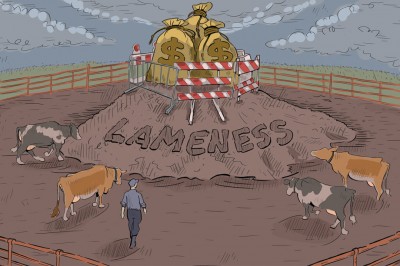
Lameness is a thief and steals your profits. When a cow has early or advanced hoof issues, she often will spend a greater amount of her time budget lying down since she struggles to get to the feedbunk and spend time there. This results in lower dry matter intake (DMI) and can decrease milk production by up to 40%, lower immune function and slash reproductive performance. On top of lost productivity, lameness in the herd accrues additional costs with a direct need for more time, labor, trimming, treatment and, in severe cases, culling of cows.
While hoof health issues can be present in your herd year-round, they tend to make themselves known when the temperature drops. The summer provides the perfect environment for pathogen activity and for hooves to sustain damage. With heat abatement as a top priority, many producers utilize sprinklers at the feedbunk and in the holding pen to cool cows down. This added water leads to more slurry and standing water throughout the barns. Prolonged time standing in these wet conditions will later manifest as sole ulcers and digital dermatitis as the water softens the surrounding skin and keratin in the hoof. Hoof stress slowly accumulates, making lameness more prevalent in your herd as time passes and colder weather appears.
Cows experiencing heat stress will spend more time standing in an effort to expose more skin surface area to cool down faster while decreasing feed intake. In hot conditions, flies also act as an agitator to heat-stressed animals, causing cows to huddle and radiate extra heat onto their herdmates. This extra time on hoof and decreased energy intake leads to changes in rumen pH, which impact blood flow to the hoof. This puts more tension directly on the hoof and diverts energy away from hoof maintenance.
To save yourself a headache and additional costs, hone in on summer management and nutrition:
- Reduce standing time to keep cows out of water.
- Manage the barn to promote comfort and keep cows laying down when not at the bunk.
- Take time to analyze stall design, stall availability, floor conditions, fan placement and airflow. A clean, open stall is not enough to encourage rest in hot months. Lying down traps heat and exposes less skin to cooling, requiring fans and airflow that can move enough air over the top of the cow to properly dissipate heat. Cows like to lie down in fast-moving air blowing around their heads.
- Manage lighting and curtains to keep well-ventilated areas and stalls shaded with no direct sunlight. This will keep the air cooler and encourage cows to fully utilize space. To make sure the barns promote cow comfort, I recommend referencing the Dairyland Initiative Housing Module from the University of Wisconsin - Madison.
Investing time into training your team to identify hoof issues can also pay off in the long run. A marginally lame cow will probably become severely lame in 60 to 90 days - making early detection the best money saver. Utilize experts who can teach the team how to identify environmental issues and signs of lameness early on. When everyone on-farm is able to notice less-than-ideal conditions and conduct locomotion scoring, cows can be treated early, which gives them a better chance to recover. Work with a skilled hoof trimmer who can conduct maintenance trims on each animal twice a year to help with hoof posture and balanced weight bearing.
Most importantly, nutrition and feeding are the glue that will hold these management strategies together. Keeping a tight feed schedule and pushing up feed throughout the day helps avoid rumen pH fluctuations and maintains DMI. With the right amount of energy, body functions such as hoof blood flow and growth can be maintained. In addition to timing, feeding a proven nutrition program that meets all the cow's trace mineral requirements will protect hoof health and maintain a return on investment throughout the seasons. Trace minerals are necessary for immunity, skin growth and wound healing. Adequate stores need to be present in the animal for these actions to take place and act as a preventive measure.
Do not let lameness be a barrier to the health and profitability of your herd. Be mindful of seasonal challenges and enact management strategies that protect hoof health. Work with an expert who can help analyze the herd's specific needs and work alongside your team to identify and prevent barriers to your herd. Taking the time to create an ideal environment, provide the best nutrition and continuously evaluate your facilities and records to prevent hoof issues will keep lameness out of sight and pay off in dividends.
Field Crops
Dairy
Business
Livestock
Grains
Upcoming Events
Livestock Production Field Day
August 29, 2026 : Livestock Production Field Day
Chaffee, NY and East Aurora, NY,
Join us on visits to Horizon Ridge Farm in East Aurora and Troll Bridge Farm in Chaffee for an introduction to small beef and small diversified livestock enterprises. Through walking farm tours, attendees will learn about management, meat processing, setting prices, and finding local markets. Dinner will be provided. Register by contacting Amy Barkley at amb544@cornell.edu or 716-640-0844.
Poultry Processing Workshop, Naples, NY
September 17, 2026 : Poultry Processing Workshop - Naples, NY
Naples, NY
This program is one of four statewide roadshow stops across the state, offering farmers a full poultry processing experience. The class will teach skills that build confidence, reduce costs, and strengthen your farm's independence. This hands-on workshop gives farmers the chance to process a bird from start to finish, learning every step of the workflow used by small farms across the state.
Large Animal Awareness Training For First Responders
September 19, 2026
Dunkirk, NY
Join the Chautauqua County Technical Rescue Services and NYS Veterinarian, Dr. Kate Card-Allen, for a specialized training on how to safely and effectively respond to large animal incidents. Learn techniques for managing large animals during traffic accidents, rollovers, entrapments and other transportation emergencies.
Announcements
No announcements at this time.