
Chop talk: The importance of forage particle size in the diet -Progressive Dairy
Chop talk: The importance of forage particle size in the diet - Progressive Dairy (For the original article, click here)
by Casey Havekes
Most dairy farms feed carefully balanced diets that are formulated to meet the dietary needs of their cows, depending on their age and stage of lactation. However, the diet formulated on paper and delivered to the farm is only part of the equation. How that diet is mixed and delivered to the cows, as well as how the cow actually consumes the diet, are all vital pieces of the equation. Preferential selection of the diet, or feed sorting, is a common behavior performed by dairy cows. Typically, cows will sort in favor of the grain component of the diet and against long forage particles, due to the high palatability of the grain. This behavior can lead to various undesirable consequences, including subacute ruminal acidosis and the compromised nutritive value of feed remaining at the feedbunk for cows feeding later in the day.
The appeal of incorporating long, dry forage particles into the diet, particularly in the fresh cow diet, is understandable. Historically, it has been believed that these long forage particles (often in the form of dry hay) stimulate rumination and promote better rumen health. While long forage particles have their place in maintaining a healthy rumen, it's important to understand the role that forage particle size truly has on rumination, chewing activity and, consequently, rumen health. In order for forage nutrients to be utilized by the cow, she must first chew the forage and break it down into smaller pieces so that the rumen microbes can have a greater surface area to work on. Previous research has concluded that cows will chew the total mixed ration (TMR) particles until they are a uniform size of 8 to 11 millimeters before they swallow the bolus, which evidently takes time. According to one group of researchers, cows need to spend more time chewing per unit of fiber when forage particle size is longer, and other researchers have concluded that longer forage particle size equates to longer eating time at the bunk. This is in part because of the mechanics of chewing longer forage particles, but also because longer forage particles increase the risk of sorting, and if cows are sorting, research has shown that they will take longer to consume a meal while not necessarily increasing their dry matter intake (DMI). If you think about what this means for the cow and her time budget, longer forage particle size in the diet may end up reducing resting and lying time. This makes it increasingly important to provide cows with sufficient fiber to stimulate chewing and activate saliva secretion, all while balancing for optimal time budgets and a variety of other management aspects. In a perfect world, cows should be spending three to five hours of their day eating and 12 hours of their day resting, with a large portion of that resting time being shared with rumination.
Physically effective fiber (peNDF) is the portion of fiber that is effective in stimulating chewing, and it is a tool that can be used to monitor forage particle size in the diet. Physically effective fiber in the diet can be calculated by multiplying the portion of feed particles that remain on the top three screens of the Penn State Particle Separator (PSPS) by the neutral detergent fiber (NDF) content of the diet. It's been well documented that lactating cows require 19% to 22% peNDF in the diet to ensure proper rumen function, but to many people's surprise, forage particle size does not actually have to be that long to provide sufficient peNDF to the cow. For example, in one research study, cows were fed a high quantity of wheat straw (9% of TMR on a DM basis) that was chopped with a 1-inch screen or a 4-inch screen. Even at the 1-inch chop length, the diet supplied 20.8% peNDF, which is sufficient to maintain proper rumen function. The easiest way to accomplish having enough peNDF in the diet while limiting the risk of sorting is to limit the amount of forage particles retained on the top screen of the PSPS and focus more on the particles retained on the second and third screen. To put this in context, the third screen of the PSPS has an opening of 0.16 inch, which means that the particles retained on this screen are smaller than 0.3 inch but greater than 0.16 inch. This fraction is referred to as the "physical effectiveness factor" because this is the fraction that contains particles long enough to stimulate chewing. This serves as a good reminder that small forage particles (less than 0.16 inches or 4 millimeters) are still sufficient at stimulating chewing and rumination.
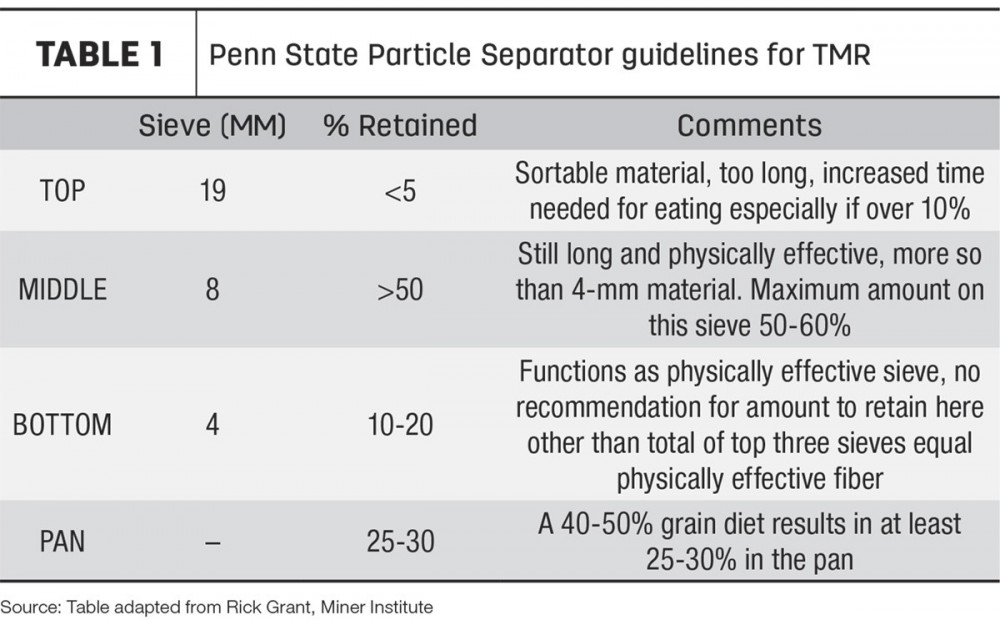
It was mentioned earlier that long forage particles in the diet can result in increased sorting and consequently increased meal time and reduced lying time. It's important to remember that cows will sort a diet where the particles are more easily distinguishable - or in other words, if the diet is easier to sort, they will sort it. To minimize the risk of sorting, provide a diet that is more uniform in particle size. This will make it physically more difficult for the cow to sort, and it will ensure that she, as well as her more subordinate pen mates, are consuming a well-balanced diet. Table 1 outlines revised PSPS recommendations for lactating cows. These recommendations come from Rick Grant at the Miner Institute.
Field Crops
Dairy

Business
Livestock

Grains
Upcoming Events
Livestock Production Field Day
August 29, 2026 : Livestock Production Field Day
Chaffee, NY and East Aurora, NY,
Join us on visits to Horizon Ridge Farm in East Aurora and Troll Bridge Farm in Chaffee for an introduction to small beef and small diversified livestock enterprises. Through walking farm tours, attendees will learn about management, meat processing, setting prices, and finding local markets. Dinner will be provided. Register by contacting Amy Barkley at amb544@cornell.edu or 716-640-0844.
Poultry Processing Workshop, Naples, NY
September 17, 2026 : Poultry Processing Workshop - Naples, NY
Naples, NY
This program is one of four statewide roadshow stops across the state, offering farmers a full poultry processing experience. The class will teach skills that build confidence, reduce costs, and strengthen your farm's independence. This hands-on workshop gives farmers the chance to process a bird from start to finish, learning every step of the workflow used by small farms across the state.
Large Animal Awareness Training For First Responders
September 19, 2026
Dunkirk, NY
Join the Chautauqua County Technical Rescue Services and NYS Veterinarian, Dr. Kate Card-Allen, for a specialized training on how to safely and effectively respond to large animal incidents. Learn techniques for managing large animals during traffic accidents, rollovers, entrapments and other transportation emergencies.
Announcements
No announcements at this time.