
Is your footbath working for you?
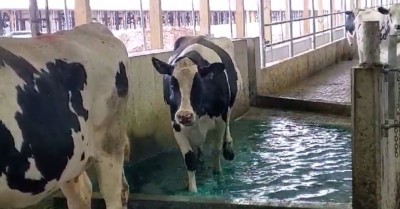
Is your footbath working for you?
Betsy Hicks - South Central Team Dairy Management Specialist (For original article click here)).
As I was working with a set of farms on a lameness project this summer, the question of footbath protocols was included in the set of intake questions. Very few of the farms included in the project could definitively say what concentration they were aiming for, or what the volume of the bath was that they were using. This brings the question, is your farm making your footbath work for you? Or are you just guessing?
Taking the Guesswork Out of the Equation
With setting up a footbath, none of the steps should be guesswork. Fortunately, the University of Wisconsin Dairyland Initiative has put together an excellent resource to do exactly this. Simply put, the only measurements needed to calculate the volume of a footbath are length, width, and depth to fill height. The spreadsheet calculates different concentrations of varying products to remove all guesswork. The spreadsheet can be found at: https://thedairylandinitiative.vetmed.wisc.edu/wp-content/uploads/2017/09/Footbath-Dose-Calculator_090617.xlsx.
Footbath Best Practices
Also shared on the Dairyland Initiative website at https://thedairylandinitiative... are footbath best practices, as shared below:
- Bath as infrequently as possible to reduce transitions from chronic to acute DD (Digital Dermatitis or hairy heel wart) lesions
- Use a well-designed footbath to optimize the transfer of antibacterial to feet
- Locate a mixing station adjacent to the footbath for safe handling of chemicals
- Start a regime once a day for 4 days per week and adapt based on the outcome
- Use an antibacterial with proven efficacy that DOES NOT DAMAGE THE SKIN DEFENSE - maintain pH>3.0
- Use the bath as long as it is effective ~ 100-300 cow passes
- Don't forget the dry cows and heifers!
Issues Found During the Project
When using a footbath, the goal is to achieve a minimum of two dunks per foot through the footbath. On many farms, the design of the footbath rarely allows for this, and only one dunk is achieved. Often, the cow passing through the bath is able to bypass the bath with at least one foot, and that foot is often the foot with an issue. Watching cows pass through the bath or videoing cow passes is a good way to assess if this is happening on your farm or not. I have a time-lapse camera that can be set up to record if this is a concern on your dairy.
Another problem I encountered was one I didn't anticipate. One farm, knowing that the bottom of their bath had hard rubber nubs that cows didn't like to step on, put rubber mats in the bottom of the bath. This is a great workaround for the comfort of the cow passing through the bath. However, the rubber mats sometimes would get flipped up and be above the footbath level, causing a trip or balk hazard for the cow. It also takes away some of the volume of the bath, so unless the farm measured the gallons using a known amount, the concentration of the bath was a complete guess.
A third issue was making the concentration of the bath "too hot". As stated by the Dairyland Initiative, the bath should be efficacious WITHOUT damaging the skin. In other words, we want control of heel warts, but not at the expense of skin integrity. Most farms did not check the pH of their bath, and the concentration of the product was a guess.
Key Points for an Ideal Footbath
- Know the bath volume! If there are mats included in the bottom, be sure they are accounted for to get a true amount of water in the bath!
- Measure the amount of product (Copper, Formalin or other) to be added! To make it easier for those filling the bath, you can draw lines on buckets, cut off plastic bottles to the desired level, or any other way to get the right amount of product included. Just don't guess!
- Watch cows pass through the bath to make sure you're getting two dunks per foot. If not, it may be time to take a good look at the location and set up and make a change.
Have you watched our previous Understanding and Mitigating Lameness series? You can access the recordings here and also our Lameness resources for Spanish speakers here.
Field Crops
Dairy
Business
Livestock

Grains
Upcoming Events
Livestock Production Field Day
August 29, 2026 : Livestock Production Field Day
Chaffee, NY and East Aurora, NY,
Join us on visits to Horizon Ridge Farm in East Aurora and Troll Bridge Farm in Chaffee for an introduction to small beef and small diversified livestock enterprises. Through walking farm tours, attendees will learn about management, meat processing, setting prices, and finding local markets. Dinner will be provided. Register by contacting Amy Barkley at amb544@cornell.edu or 716-640-0844.
Poultry Processing Workshop, Naples, NY
September 17, 2026 : Poultry Processing Workshop - Naples, NY
Naples, NY
This program is one of four statewide roadshow stops across the state, offering farmers a full poultry processing experience. The class will teach skills that build confidence, reduce costs, and strengthen your farm's independence. This hands-on workshop gives farmers the chance to process a bird from start to finish, learning every step of the workflow used by small farms across the state.
Large Animal Awareness Training For First Responders
September 19, 2026
Dunkirk, NY
Join the Chautauqua County Technical Rescue Services and NYS Veterinarian, Dr. Kate Card-Allen, for a specialized training on how to safely and effectively respond to large animal incidents. Learn techniques for managing large animals during traffic accidents, rollovers, entrapments and other transportation emergencies.
Announcements
No announcements at this time.